
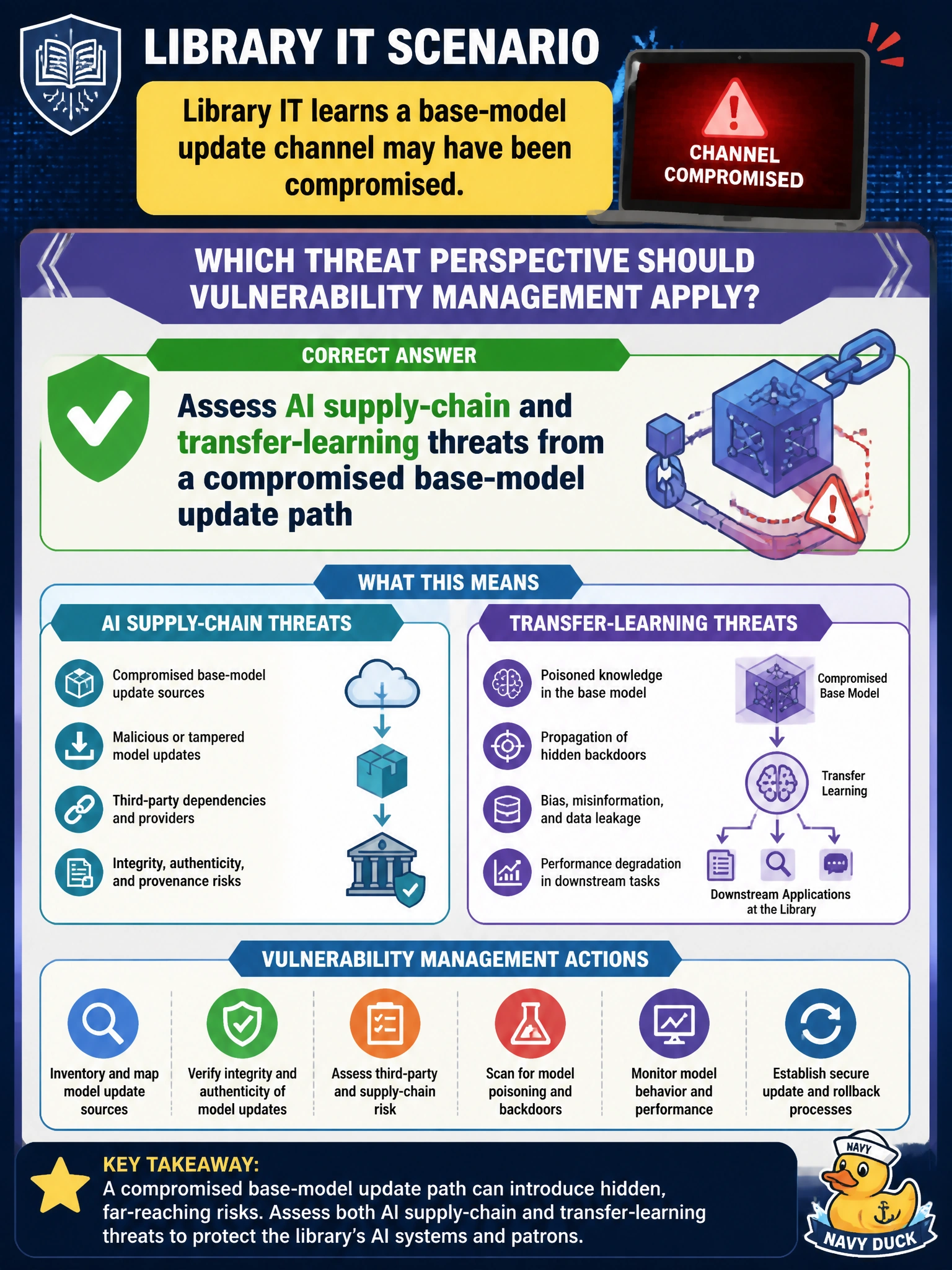
Library IT learns a base-model update channel may have been compromised. Which threat perspective should vulnerability management apply?
Select an answer to reveal the explanation.
Short Explanation
Poisoned model updates are supply-chain trouble with a neural twist. Assess the channel, verify what you pull, and don’t rely on prompt-filter block rates or chatbot abuse logs tied to the update to characterize the compromise. And verifying training-data consent docs and bias test results won’t give you the AI supply-chain perspective, and monitoring inference latency and GPU usage misses the point entirely.
Full Explanation
If a library base-model update channel may have been compromised, vulnerability management should assess AI supply-chain and transfer-learning threats along that path. Poisoned or substituted weights can implant backdoors, degrade safety filters, or alter behavior in fine-tuned civic assistants that inherit the base model. Assessing authenticity, integrity, and provenance of updates works because model distribution is a software supply chain with higher opacity than typical packages; trust must be earned through verification, not assumed.
Monitoring inference latency and GPU usage trends on the deployed base-model serving endpoint fails because those performance metrics reflect serving efficiency and load, not whether the base-model update channel itself was compromised or whether weights are authentic. Analyzing prompt-filter block rates and chatbot abuse logs tied to the base-model update release fails conceptually: those metrics reflect runtime abuse and safety filtering, not whether the base-model update channel itself was compromised or whether weights are authentic. Verifying training-data consent documentation and bias test results for the base-model version fails because it addresses data governance and responsible-AI documentation rather than the AI model supply chain and does not establish the standing AI supply-chain and transfer-learning threat perspective vulnerability management must apply to every future update, mirror, and fine-tuning artifact.
Exam caveat: supply-chain assessment includes mirrors, fine-tuning artifacts, and LoRA adapters, not only the flagship base checkpoint. Operational check: pin trusted model sources, verify checksums/signatures where available, stage updates in isolated evaluation before production promotion, monitor for anomalous post-update behavior, and document provenance in the library AI asset inventory.
Prefer to study offline? Printable PDF study book + test engine ($7.50, unofficial). These questions stay free here.