
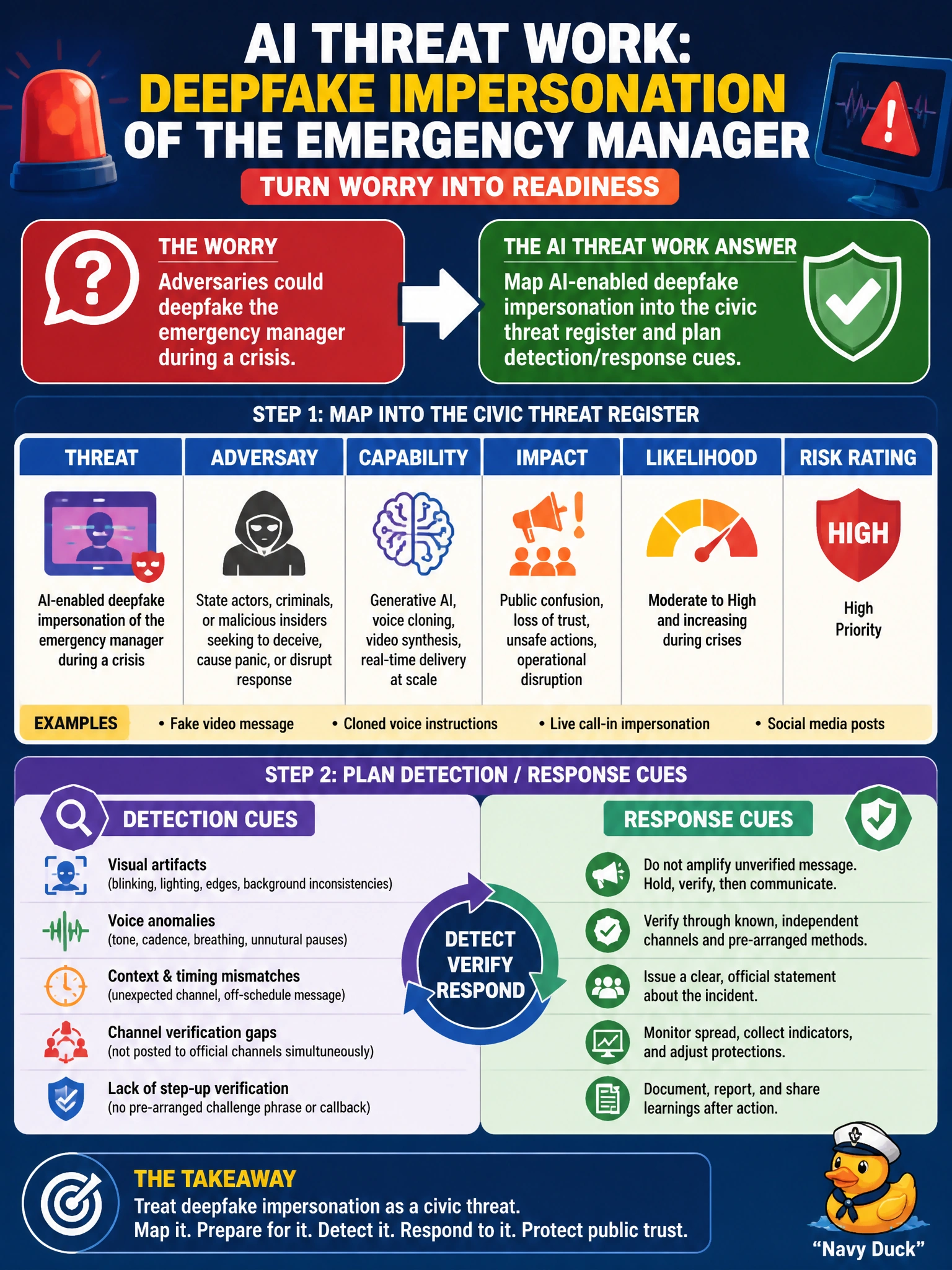
Emergency management worries adversaries could deepfake the emergency manager during a crisis. How should this appear in AI threat work?
Select an answer to reveal the explanation.
Short Explanation
A fake face of the emergency manager is an AI-flavored social-engineering threat. Put it on the threat register with cues you'll use to spot and stop it—you'll miss the attack if you file it as hallucination for accuracy review, and email gateway filtering updates won't stop a fake video. And logging it for sentiment trend reporting reviews won't give you a crisis response.
Full Explanation
Emergency management must map AI-enabled deepfake impersonation of the emergency manager into the civic threat register and plan detection and response cues. Deepfakes are AI-facilitated social engineering that can inject false directives during crises, undermining public trust and operational coordination. Registering the threat works because preparedness depends on named scenarios, verification protocols (out-of-band confirmation, passphrase/code words, multi-channel checks), and staff training—not after-the-fact surprise.
Mapping AI-enabled deepfake impersonation into the civic threat register for email gateway filtering updates fails because it reduces a civic AI-enabled impersonation threat to an email security problem, missing the broader need for verification protocols, out-of-band confirmation, and public-facing crisis coordination. Mapping AI-enabled deepfake impersonation in the civic threat register as hallucination for accuracy review fails because a deliberate adversarial deepfake is a security threat, not a model training error, and treating it as an accuracy issue skips the detection and response cues the crisis demands. Mapping AI-enabled deepfake impersonation into the civic threat register for sentiment trend reporting reviews fails conceptually: sentiment reporting is passive observation, not a viable crisis response, and it leaves the organization without detection cues, verification procedures, or a plan to act when a fake directive goes out.
Exam caveat: deepfake risk includes audio and video, and internal coordination channels can be targeted as well as public broadcasts. Operational check: add deepfake impersonation to the threat register with owners, publish verification procedures for high-impact directives, run a tabletop injecting a fake executive message, and measure whether staff use the out-of-band check before acting.
Prefer to study offline? Printable PDF study book + test engine ($7.50, unofficial). These questions stay free here.