
A water utility operates a leak-prediction model in production. Which vulnerability-management practice best sustains assurance over time?
Select an answer to reveal the explanation.
Short Explanation
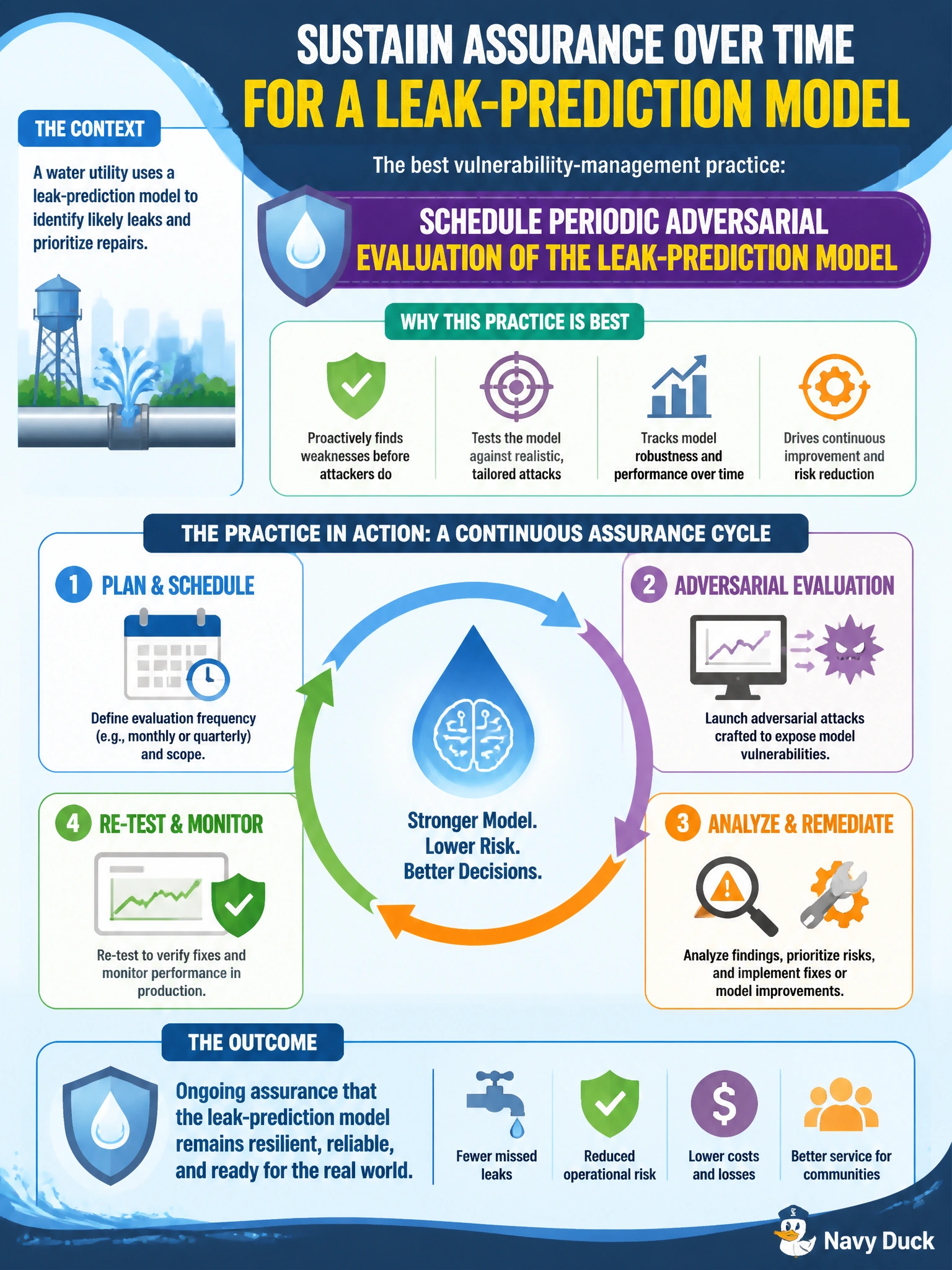
Annual scans of the model server won’t show you if the model can be fooled. Keep poking the leak model on a schedule so new tricks and drift don’t sneak past. Tracking how fast you fix known flaws doesn’t mean you’ll catch new ways to fool it.
Full Explanation
A water utility’s leak-prediction model in production needs periodic adversarial evaluation as ongoing vulnerability management. Annual vulnerability scans of the leak-prediction model server age poorly for model assurance: they check the host for known infrastructure vulnerabilities rather than adversarially testing the leak-prediction model, while attackers adapt, data distributions drift, integrations change, and new bypasses appear. Scheduled adversarial evaluation works because sustained assurance requires repeated attempts to evade, poison inputs, or manipulate outputs under controlled conditions, then feed findings into patches, monitoring, and residual-risk updates for OT-adjacent civic AI.
Performing annual vulnerability scans of the leak-prediction model server fails because server scanning is a point-in-time snapshot of host infrastructure, not continuous adversarial assurance of the leak-prediction model. Tracking mean time to remediate reported leak-prediction model flaws fails conceptually: remediation-time metrics track how fast known flaws are fixed but do not actively discover resistance to evasion, poisoning, or integrity attacks. Conducting quarterly access reviews of the leak-prediction model API fails because access reviews are an authorization control for who can reach the API, not ongoing adversarial vulnerability management, and they do not actively test the model for evasion, poisoning, or output manipulation.
Exam caveat: adversarial evaluation cadence should match criticality and change rate—major model or pipeline changes should trigger out-of-cycle tests. Operational check: calendar quarterly (or risk-tiered) adversarial tests, include poisoning and evasion cases relevant to sensor/telemetry inputs, track findings to remediation owners, and block model promotion when critical adversarial cases regress.
Prefer to study offline? Printable PDF study book + test engine ($7.50, unofficial). These questions stay free here.