
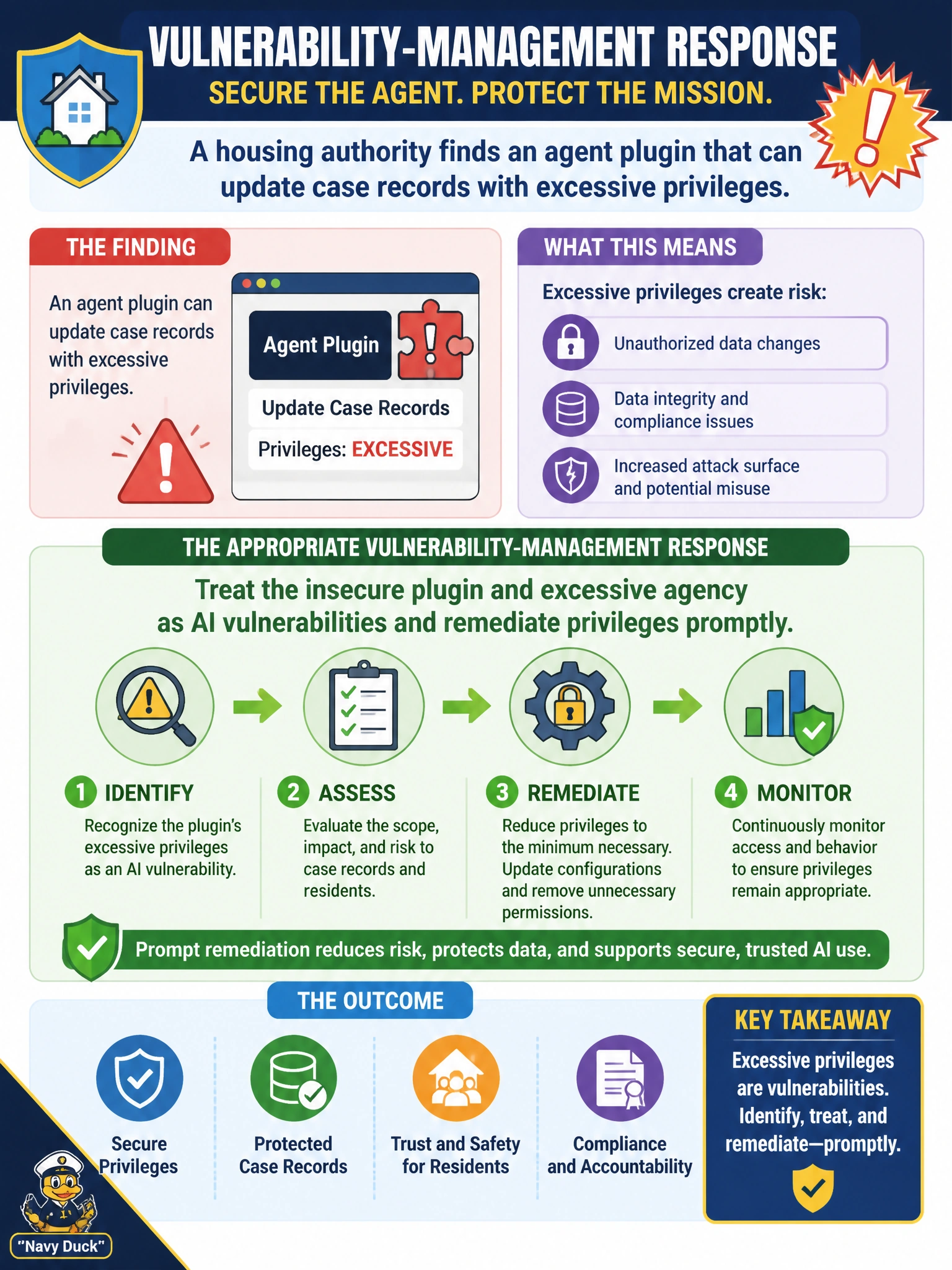
A housing authority finds an agent plugin that can update case records with excessive privileges. What is the appropriate vulnerability-management response?
Select an answer to reveal the explanation.
Short Explanation
An agent with a too-powerful plugin is a vulnerability with a smile. Shrink the privileges and patch the integration—don’t treat sanitizing fields, encryption at rest, or refreshing content filters as a fix while excessive write access remains. Excessive agency is a bug, not a feature.
Full Explanation
A housing-authority agent plugin that can update case records with excessive privileges is an AI vulnerability: insecure integration plus excessive agency expands the blast radius of prompt injection, logic errors, or compromised agents into case-management systems. The appropriate response is to treat the finding as a vulnerability and remediate privileges promptly—least privilege, scoped write actions, human approval for sensitive updates, and logging. Remediating works because agent tooling converts natural-language influence into system state changes; privilege reduction is the primary containment control.
Treating the plugin output as untrusted data and sanitizing case record fields before database writes fails because input sanitization does not reduce excessive privilege; a compromised or misdirected agent can still issue authorized writes to sensitive case data within its overbroad scope. Classifying the excessive write access as a data governance gap and enforcing case record encryption at rest fails because encryption protects stored data confidentiality, not write authorization; excessive privileges still allow a compromised or misdirected agent to alter sensitive case data. Containing the agent session and refreshing model content filters to prevent malicious case record prompts fails because content filters do not bound agency; excessive write privileges remain exploitable via prompt injection, logic errors, or legitimate-but-misdirected actions.
Exam caveat: some write-back may be legitimate for efficiency, but sensitive case updates should require step-up authorization and immutable audit trails. Operational check: inventory agent tools and their scopes, revoke excess grants, enforce allow-lists of record fields, add approval gates for status or benefit-impacting changes, retest prompt-injection paths against the plugin, and record remediation evidence in the AI vulnerability tracker.
Prefer to study offline? Printable PDF study book + test engine ($7.50, unofficial). These questions stay free here.