
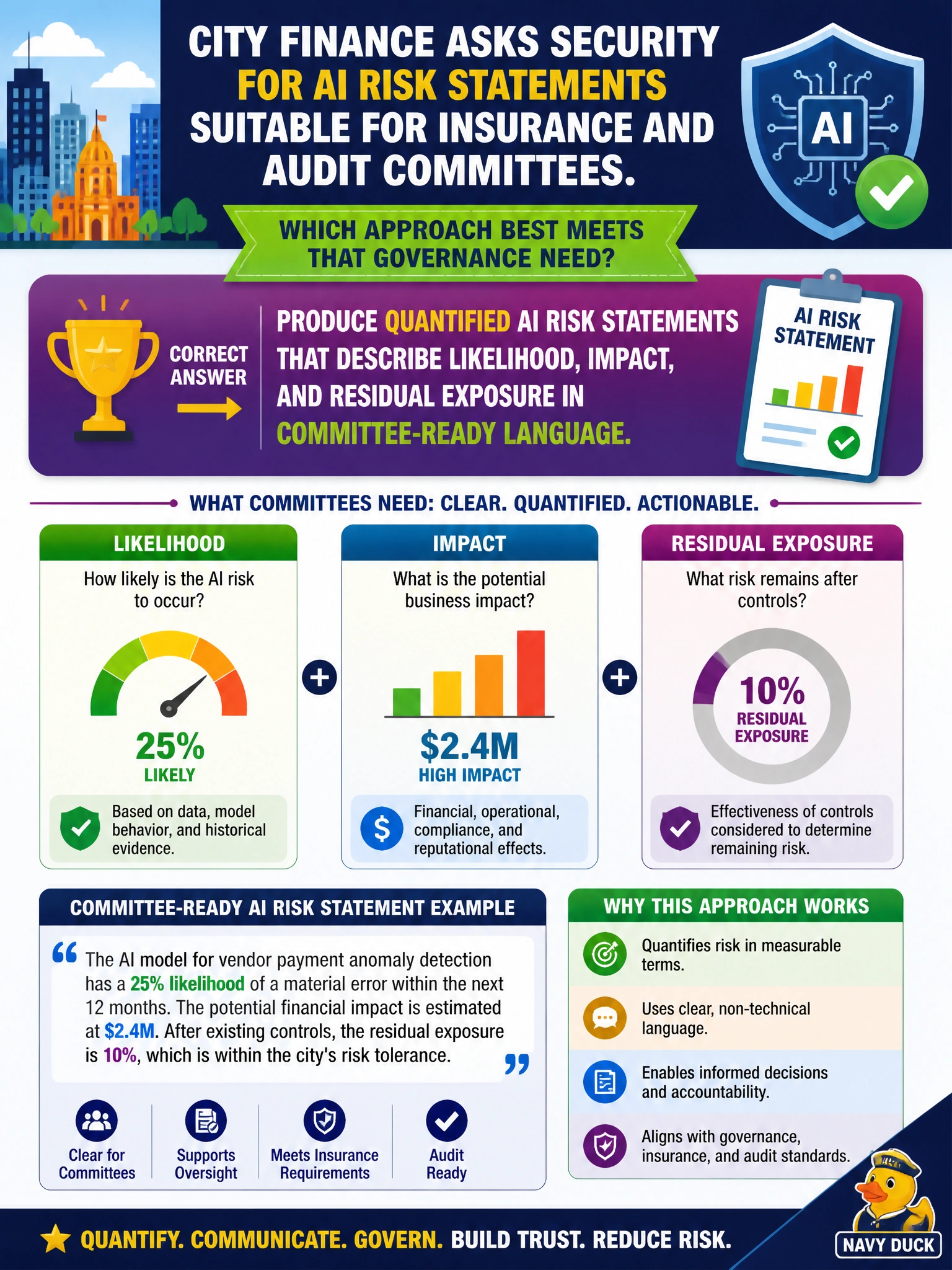
City finance asks security for AI risk statements suitable for insurance and audit committees. Which approach best meets that governance need?
Select an answer to reveal the explanation.
Short Explanation
Committees don’t buy vibes—they buy clear risk math. Translate AI issues into likelihood, impact, and what’s left after controls so insurance and audit can act. Heat maps and maturity ratings aren’t residual-risk statements.
Full Explanation
City finance, insurance, and audit committees need AI risk communicated in decision-ready form: scenario description, likelihood, impact, and residual exposure after treatment. Producing quantified or otherwise structured AI risk statements in committee-ready language meets that governance need because nontechnical overseers allocate budget, buy coverage, and demand accountability using comparable risk constructs—not vendor slogans. Structured statements also create an auditable trail linking municipal AI uses to accepted residual risk and planned controls, which supports ongoing oversight as portfolios change.
Presenting detailed model performance metrics like accuracy and latency trends fails because performance statistics alone do not convey likelihood, impact, ownership, or residual-risk context needed for insurance or audit action. Summarizing existing IT control attestations and audit findings into AI governance summaries fails because repackaging general IT evidence does not establish AI-specific likelihood, impact, or residual exposure for municipal use cases. Delivering qualitative heat maps with high-medium-low ratings and control maturity narratives fails because prioritization planning is not the same as committee-ready residual exposure; insurance and audit need quantified likelihood, impact, and residual risk tied to specific municipal AI uses, not general maturity ratings.
Exam caveat: quantification can be ranges, ordinal scales, or calibrated estimates—precision theater is not required, but structure and residual-risk clarity are. Operational check: for each material civic AI use, publish a one-page risk statement (scenario, likelihood band, impact band, key controls, residual rating, owner, next review date) and confirm insurance and audit stakeholders can use it without deciphering model jargon.
Prefer to study offline? Printable PDF study book + test engine ($7.50, unofficial). These questions stay free here.