
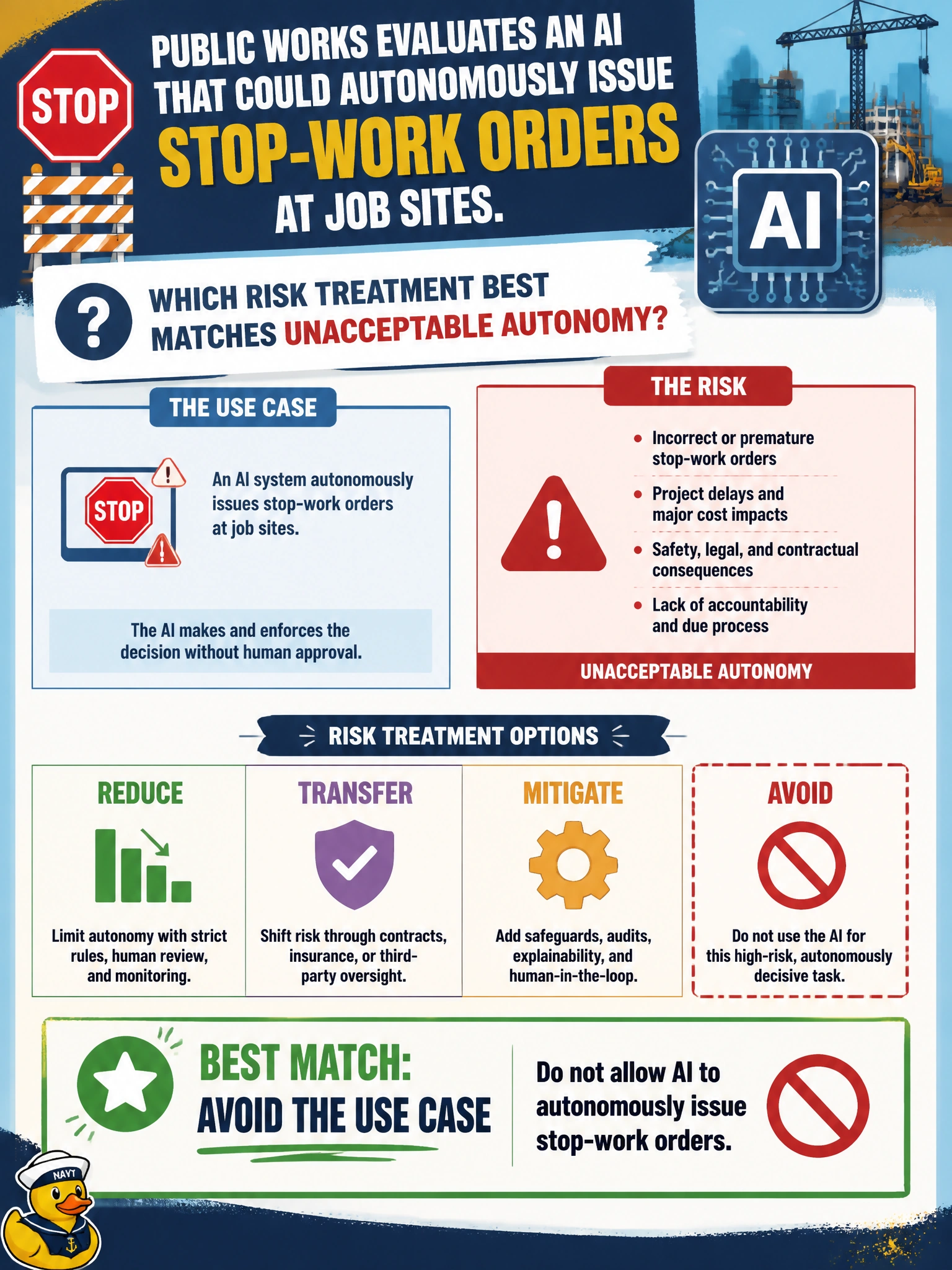
Public works evaluates an AI that could autonomously issue stop-work orders at job sites. Which risk treatment best matches unacceptable autonomy?
Select an answer to reveal the explanation.
Short Explanation
Some powers shouldn’t be on autopilot. If the AI would slam a stop-work order without a human, the right treatment is avoid—just don’t do that use case. Even expanded training on site-specific stop-work criteria won’t fix unacceptable autonomy when you’re still letting it issue orders by itself.
Full Explanation
When public works evaluates AI that could autonomously issue stop-work orders, risk avoidance is the appropriate treatment if that autonomy exceeds municipal risk appetite. Enforcement actions carry legal, safety, and due-process consequences; allowing a model to exercise them without a human decision-maker creates unacceptable residual risk that soft controls cannot fully neutralize. Avoiding the use case—explicitly prohibiting autonomous issuance—prevents the capability from entering production rather than hoping alerts or contracts will contain it. The correct treatment works because avoidance is a legitimate risk response when impact severity and control uncertainty are both high.
Mitigating autonomy risk with independent audit of AI-issued stop-work orders fails because auditing only reviews enforcement actions after they happen and does not eliminate the unacceptable autonomy or provide a defensible governance basis for letting the AI issue orders. Mitigating autonomy risk with human review of sampled AI-issued stop-work orders fails because reviewing only a sample leaves unsampled orders to take effect without human authorization and does not resolve the due-process problem of autonomous enforcement. Mitigating autonomy risk with expanded training on site-specific stop-work criteria fails because better training improves violation detection but does not restore human authorization or due process before an autonomous enforcement action takes effect.
Exam caveat: avoidance of autonomous issuance does not forbid AI that drafts recommended stop-work language for a licensed official to approve. Operational check: encode a control that blocks autonomous enforcement APIs, require human digital approval for any stop-work action, and test that prompt or agent paths cannot bypass the approval gate in staging before production.
Prefer to study offline? Printable PDF study book + test engine ($7.50, unofficial). These questions stay free here.