
School-district security sees teachers installing classroom AI agents without review. What procedural control should be embedded?
Select an answer to reveal the explanation.
Short Explanation
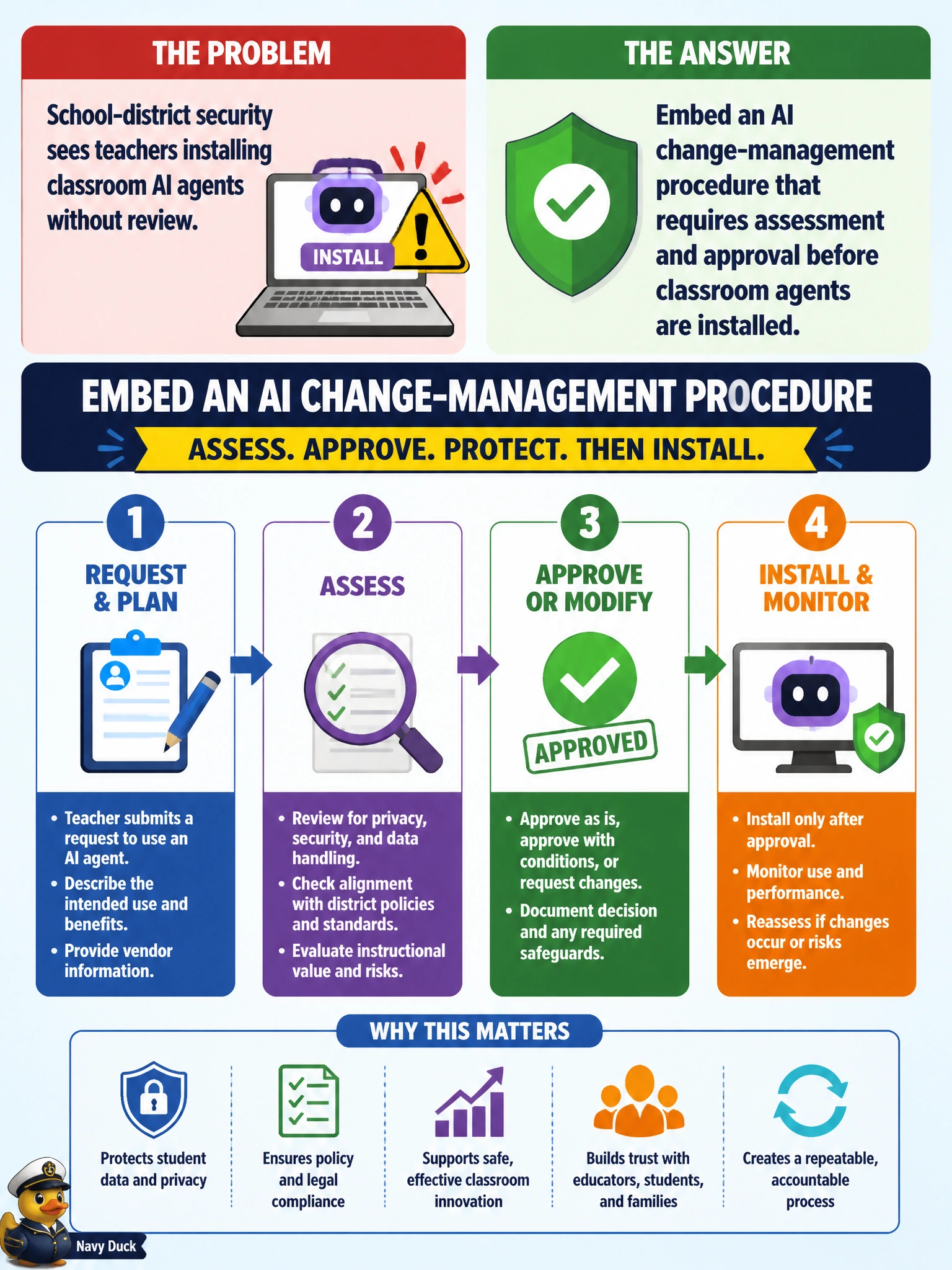
Classroom agents are changes to the learning environment, not stickers on a laptop. Route them through change management—assess, approve, then install—so “free” doesn’t mean “unchecked on kids’ data.”
Full Explanation
Embedding an AI change-management procedure that requires assessment and approval before classroom agents are installed is the procedural control school-district security should use when teachers self-install agents. Classroom agents alter data flows, student interaction patterns, and possibly grading or behavioral nudges; change management forces privacy, security, and pedagogical review before installation rather than after a breach or parent complaint. Treating AI agents as changes aligns educational AI with existing ITSM discipline.
A rule that any free browser extension is pre-approved for student use fails because “free” does not mean safe, compliant, or pedagogically sound—and pre-approval without assessment is an anti-control. A ban on documenting classroom AI so auditors cannot find it fails conceptually and ethically: concealment defeats oversight and often violates records or accountability expectations. Delegation of all change approval to students’ personal devices policies only fails because classroom-directed tools are institutional changes, not solely BYOD lifestyle choices.
Exam caveat: change procedures should be lightweight enough for teachers to follow (clear intake, SLAs) or shadow installs will continue; friction without enablement backfires.
Operational check: publish an AI agent change procedure, require assessment/approval before install, remove blanket free-extension pre-approvals, and inventory classrooms for unsanctioned agents.
Prefer to study offline? Printable PDF study book + test engine ($7.50, unofficial). These questions stay free here.