
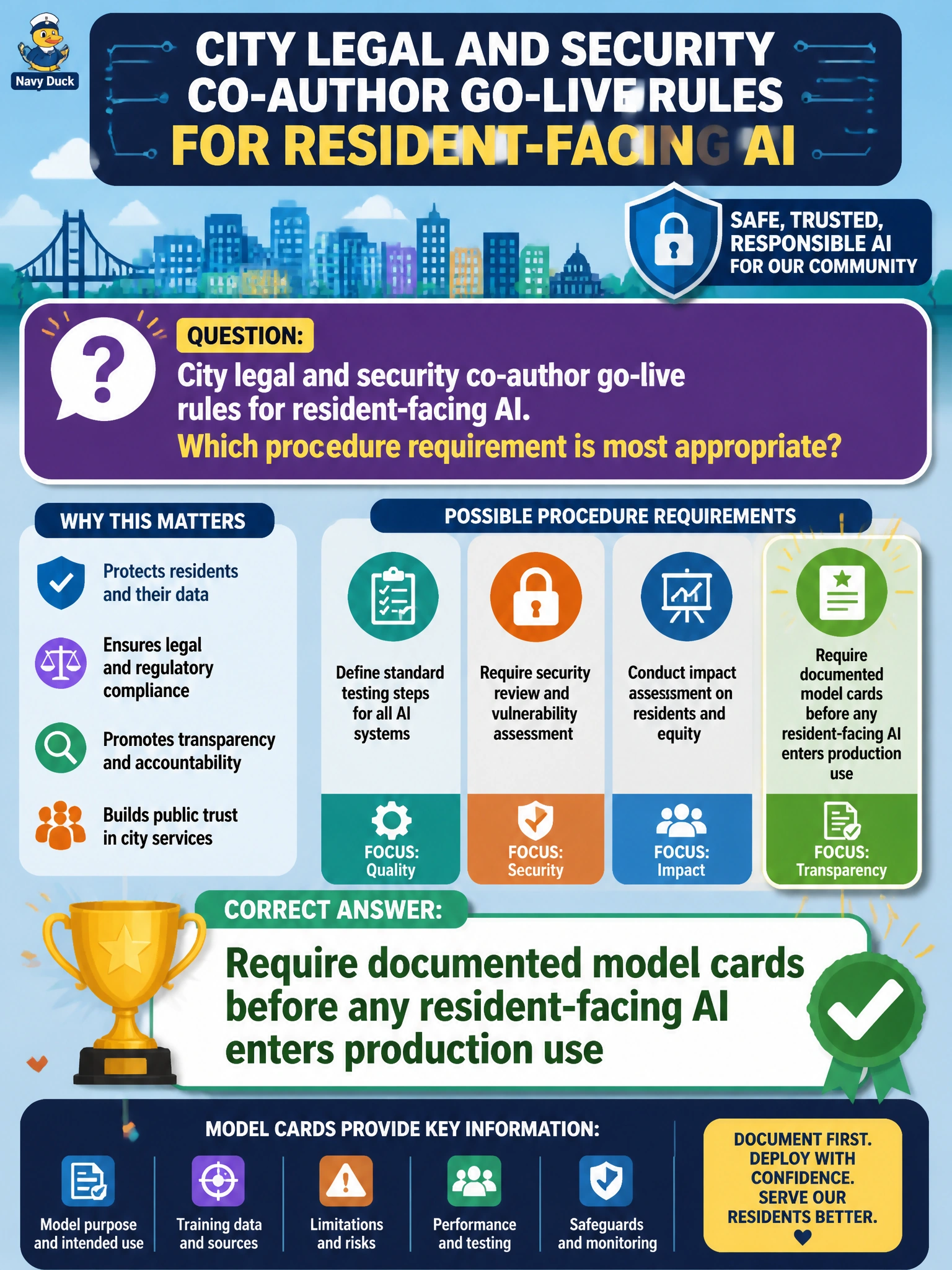
City legal and security co-author go-live rules for resident-facing AI. Which procedure requirement is most appropriate?
Select an answer to reveal the explanation.
Short Explanation
No model card, no keys to the city website. Document what the system is, what it isn’t, and how it fails—before residents see it—not after the first meltdown or because someone called it a “pilot.”
Full Explanation
Requiring documented model cards before any resident-facing AI enters production use is the most appropriate go-live procedure for city legal and security co-authorship. Model cards capture intended purpose, data, performance limits, known failure modes, and human oversight expectations—information residents’ advocates and internal approvers need before a system influences public services. Making documentation a precondition prevents “pilot” branding from becoming a permanent exception to accountability.
Allowing production launch with undocumented models if demos impress executives fails because executive enthusiasm is not a risk assessment or disclosure of limitations. Requiring model cards only after a public incident occurs fails conceptually: documentation after harm is reactive learning, not preventive governance. Treating documentation as optional for any system labeled a pilot fails because pilots that touch residents still create real-world effects and often persist without ever being reclassified.
Exam caveat: model cards must be maintained as systems change; a one-time PDF at launch that drifts from production behavior becomes misleading assurance.
Operational check: gate resident-facing production on current model cards, reject demo-only approvals, close pilot loopholes in procedure language, and schedule periodic card updates tied to model/data changes.
Prefer to study offline? Printable PDF study book + test engine ($7.50, unofficial). These questions stay free here.