
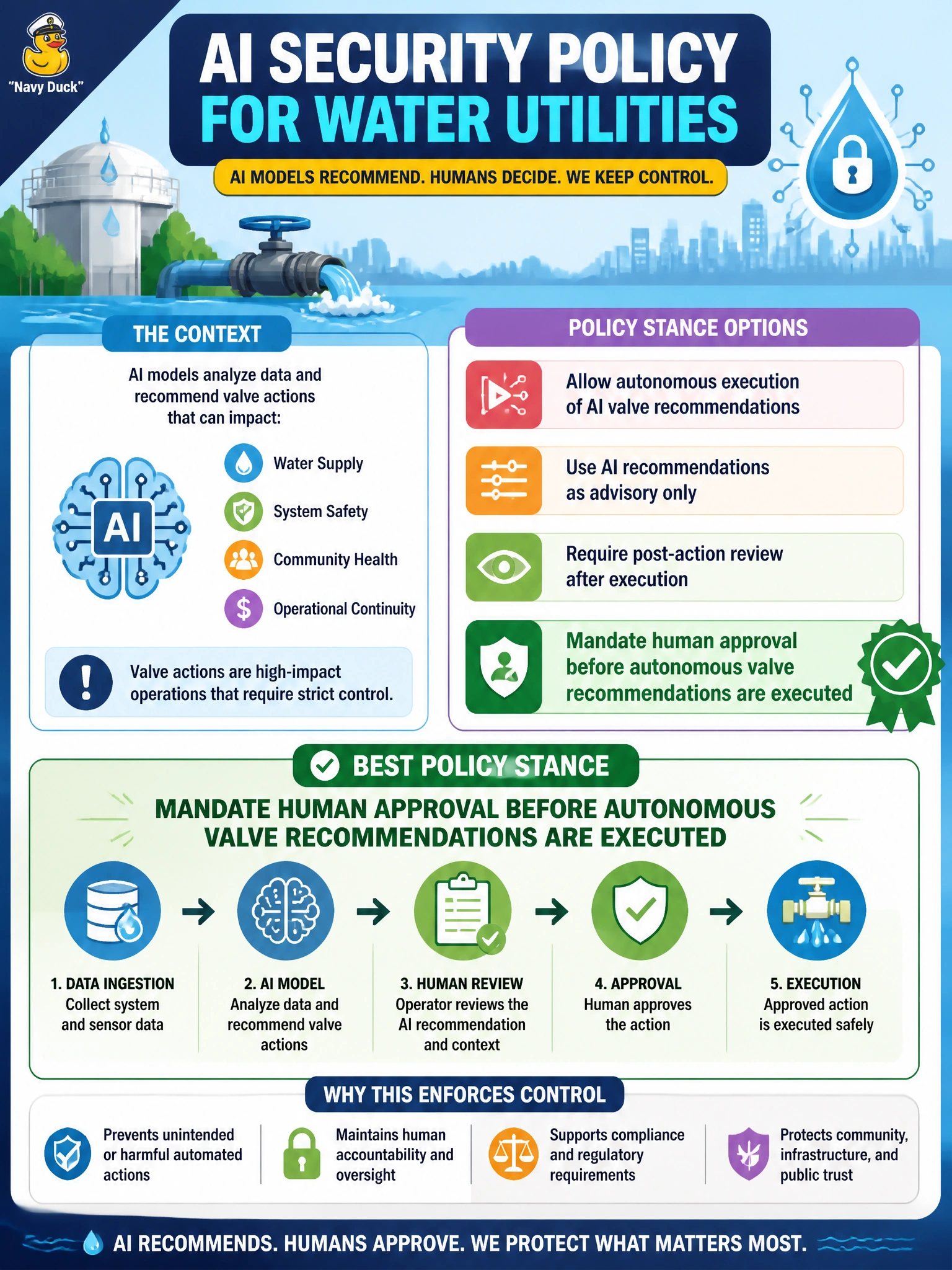
A water utility’s AI security policy addresses models that recommend valve actions. Which policy stance best enforces control for high-impact operations?
Select an answer to reveal the explanation.
Short Explanation
Valves aren’t a autocomplete suggestion. Getting batch approval still isn’t a human operator—policy should require a person to approve before anything turns, with logs kept so you can explain what almost happened. Another model checking it or a vendor signing off doesn’t give you accountable operator approval.
Full Explanation
Mandating human approval before autonomous valve recommendations are executed is the policy stance that best enforces control for high-impact water-utility AI. Mandating batch approval before autonomous valve recommendations are executed is not enough: bulk sign-off without per-valve review is not legal or operational authorization. Human-in-the-loop approval keeps physical changes inside the utility’s accountable operating model while still allowing AI to prioritize and explain recommendations.
Mandating batch approval before autonomous valve recommendations are executed fails because bulk approval does not provide individualized review of process-safety consequences for each valve action and allows unsafe actions to execute under a collective sign-off. Requiring peer model validation before autonomous valve recommendations are executed fails as a preventive human control because a second model is still autonomous machine judgment, not accountable operator authorization, and can share the same data and failure modes. Mandating vendor approval before autonomous valve recommendations are executed fails because the vendor is outside the utility’s accountable operating authority and cannot provide timely, context-aware authorization for safety-critical physical actions.
Exam caveat: human approval must be timely and informed (with context and override authority); rubber-stamping batched recommendations without individual review recreates autonomy under a human label.
Operational check: enforce policy that valve-affecting AI outputs require authorized operator approval before actuation, retain recommendation and decision logs, and prohibit batch-approval-only or vendor-approval-only control schemes.
Prefer to study offline? Printable PDF study book + test engine ($7.50, unofficial). These questions stay free here.