
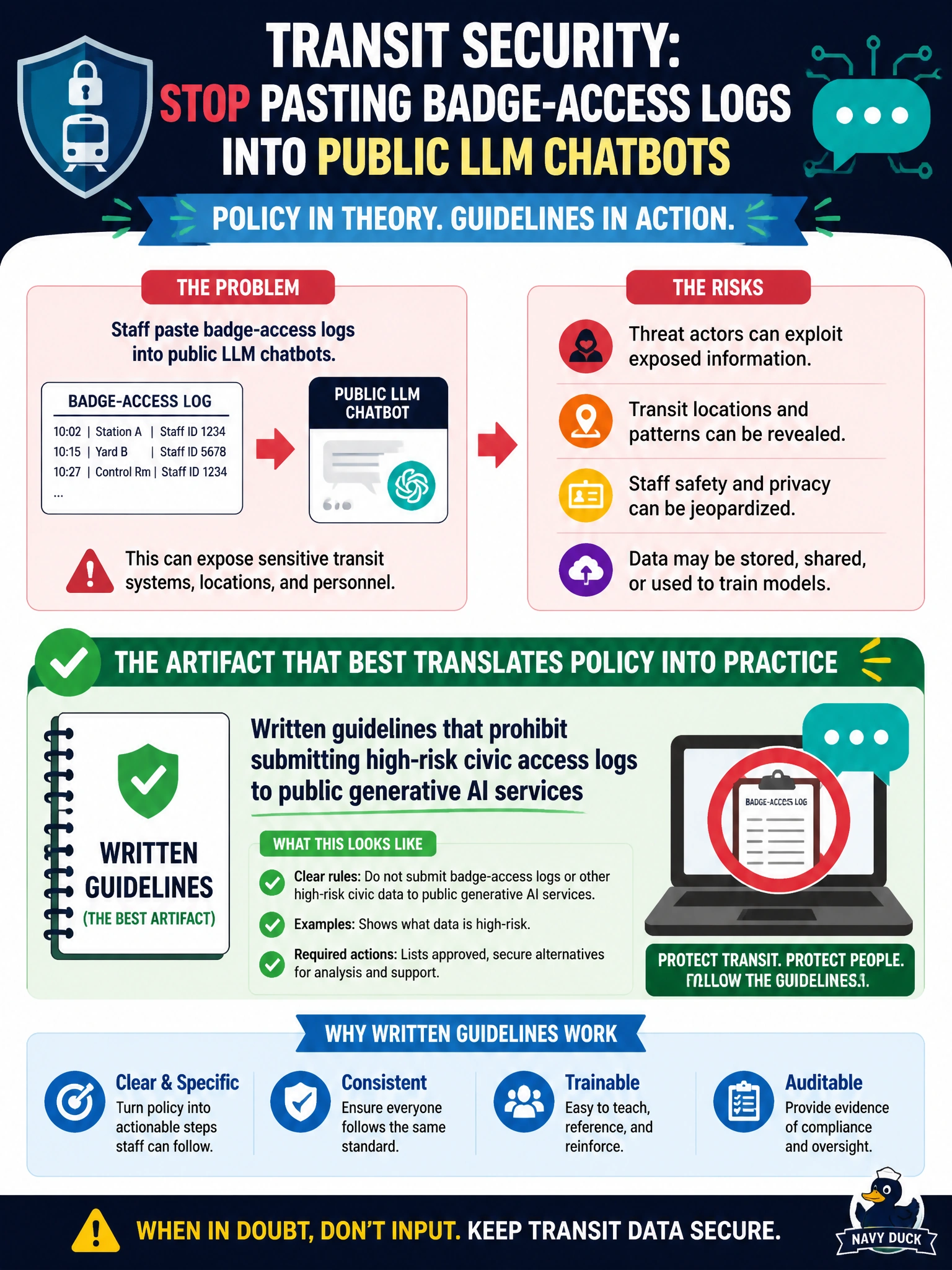
Transit security must stop staff from pasting badge-access logs into public LLM chatbots. Which artifact best translates policy into practice?
Select an answer to reveal the explanation.
Short Explanation
Badge logs in a public chatbot are like leaving the master key under a café napkin. Put the “don’t paste this” rule in writing so every shift hears the same hard stop—not a one-time hallway whisper.
Full Explanation
Written guidelines that prohibit submitting high-risk civic access logs to public generative AI services best translate transit security policy into practice. Badge-access logs reveal facilities patterns, employee movements, and potential attack paths; pasting them into public LLMs risks confidentiality loss under consumer retention/training regimes and can create insider-threat intelligence for adversaries. Durable written guidelines give every shift the same hard stop and support disciplinary consistency.
A motivational poster with no data-handling rules fails because inspiration is not an enforceable control specification. An undocumented verbal warning delivered once at onboarding fails conceptually: one-time hallway guidance is forgotten, unequally applied, and invisible to auditors. A guideline that encourages public LLMs for all security log analysis fails by actively increasing confidentiality and integrity risk rather than reducing it.
Exam caveat: prohibition guidelines should pair with approved enterprise analytics alternatives so staff are not forced to choose between productivity and compliance.
Operational check: publish written prohibitions on public-LLM use of badge logs, provide sanctioned analysis tools, train security staff, and monitor for shadow pasting of access data.
Prefer to study offline? Printable PDF study book + test engine ($7.50, unofficial). These questions stay free here.