
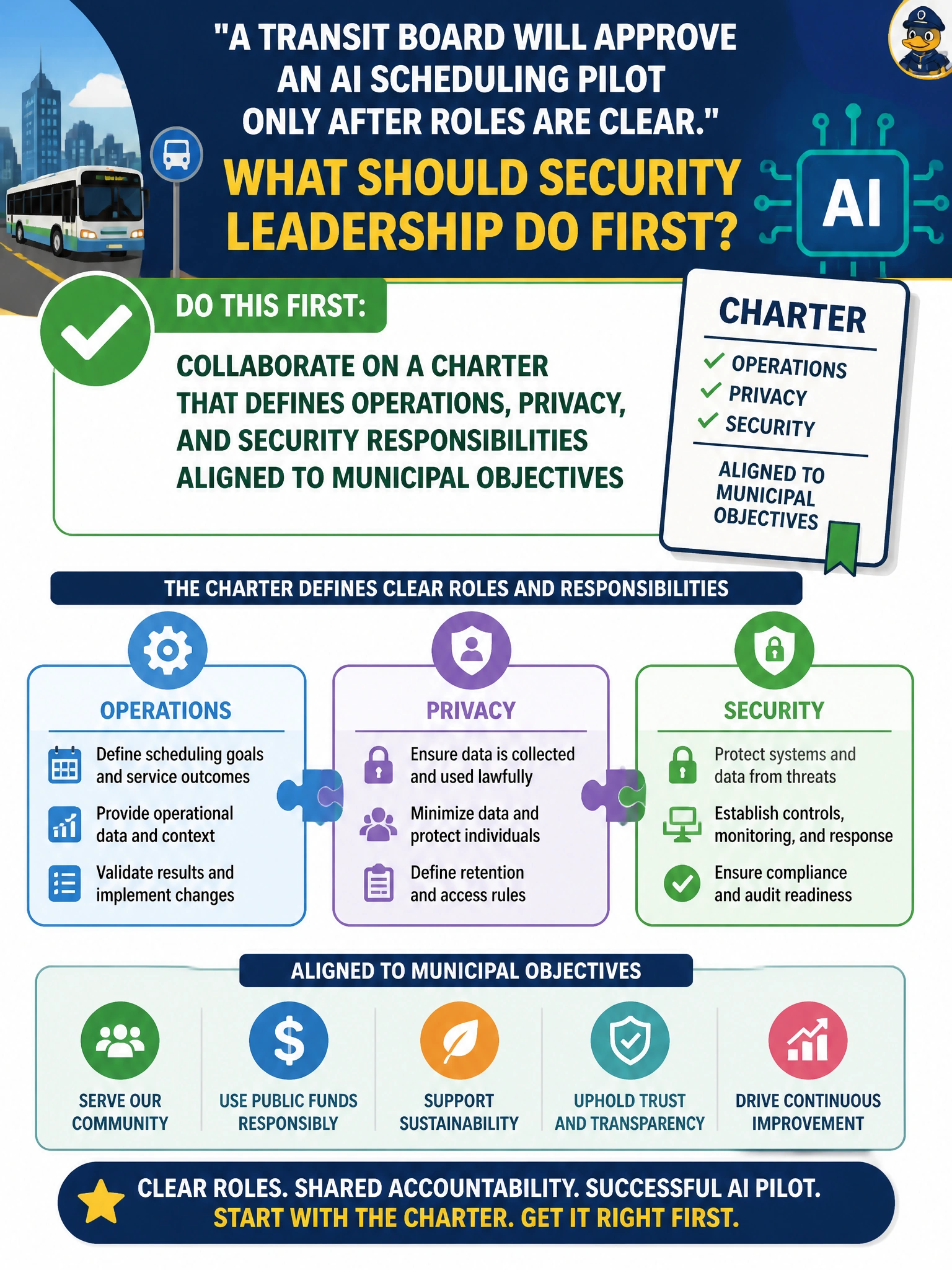
A transit board will approve an AI scheduling pilot only after roles are clear. What should security leadership do first?
Select an answer to reveal the explanation.
Short Explanation
No contractor builds without a signed agreement on who owns what. Same principle applies to AI scheduling: define roles and standards before pilots run, so decision rights are clear.
Full Explanation
Collaborating on a charter that defines operations, privacy, and security roles is the action that best anchors the board's approval condition. The transit board's condition—roles and accountability clarity—signals that pilots without documented governance are unacceptable. A charter formalizes who approves model updates, who reviews schedule changes, who owns privacy concerns, and who signs off on residual risk. Operating under this framework from pilot day one prevents roles from being invented ad-hoc.
Working with IT to draft a charter for authentication and logging ownership aligned to uptime goals sounds like a useful step, yet it does not satisfy the board's stated condition that operations, privacy, and security roles be defined together. Technical ownership for uptime matters, but without a charter clarifying who owns decisions across operations, privacy, and security aligned to municipal objectives, an authentication and logging charter alone leaves governance gaps and unclear ownership of residual risk.
Coordinating with legal teams to draft a charter for ridership data reviews aligned to compliance deadlines is valuable, but it addresses only one piece of the board's role-clarity condition. Without an operations-privacy-security charter establishing who approves model changes and who signs off on risk, a ridership-data-review charter tied to compliance deadlines runs without clear decision rights or municipal accountability.
Partnering with planning leads to draft a charter for pilot targets aligned to service reliability metrics is useful, yet it puts metrics before comprehensive governance. The board requires role clarity across operations, privacy, and security first; a targets-only charter tied to service reliability metrics risks defining success without assigning who owns schedule changes, exceptions, privacy concerns, or residual risk.
Operational check: before any pilot milestone, confirm the charter is signed by operations, privacy/security, and the board, and that role assignments are tested against a sample of operational decisions (schedule changes, exception handling, residual-risk acceptance).
Prefer to study offline? Printable PDF study book + test engine ($7.50, unofficial). These questions stay free here.