
An elections office is drafting an RFP for a ballot-help assistant. How should leading ethical AI principles influence procurement governance?
Select an answer to reveal the explanation.
Short Explanation
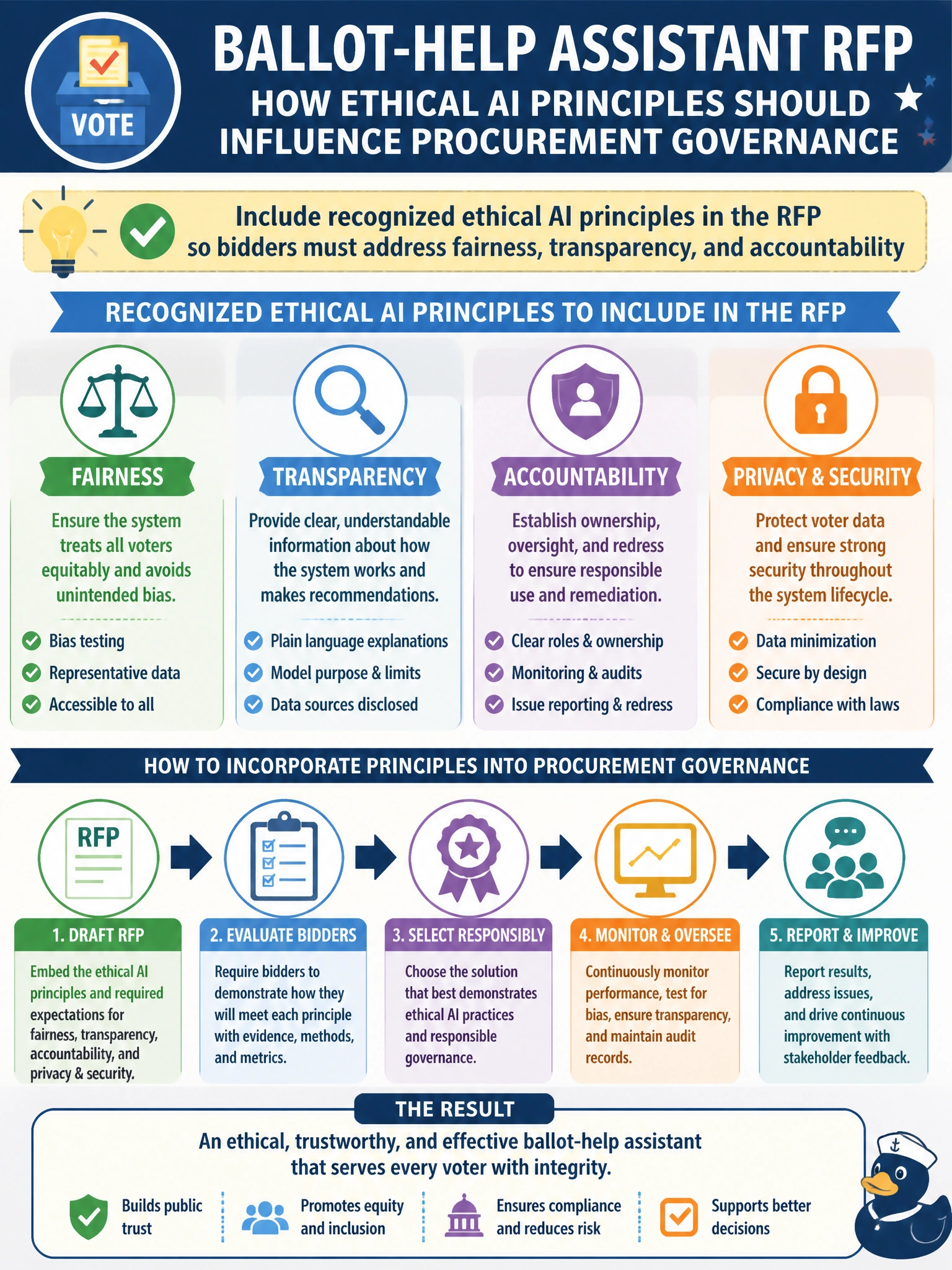
Ballot design is too important to leave ethics to chance. You use the RFP to set voting-specific ethical guardrails by name, so every bidder knows fairness, transparency, and accountability aren't optional paperwork.
Full Explanation
Including recognized ethical AI principles in the RFP so bidders must address how their design handles bias, transparency, and voter agency is the action that ensures ethical considerations shape proposals from the start. Ballot-help assistants must serve voters fairly across literacy, language, and accessibility needs—and the RFP is the mechanism to signal that ethical thinking is non-negotiable. Bidders who address bias mitigation, output transparency, and preservation of voter agency in their proposals are more likely to build systems that respect voting rights.
Directing RFP ethics review toward plain-language ballot explanations and usability testing to improve voter comprehension is a reasonable start, yet it stops short of naming recognized AI ethics principles outright; a vendor could pass usability testing and still ship a design that quietly discriminates or that nobody can audit, because the RFP never asked for a transparency or accountability commitment. The question asks how the RFP best ensures bidders address ethics—by naming recognized principles that vendors can operationalize. Requiring vendors to submit existing corporate AI ethics policies and privacy certifications as proof of ballot-assistance fairness leaves the same gap open: a vendor's general-purpose ethics policy and privacy certification say nothing about how its specific ballot-assist design handles bias, language access, or voter agency, so a well-certified vendor can still submit a product that fails voters. Requiring vendors to document ethics controls in model training pipelines and validation reports for procurement file evaluation is weaker than naming the principles the design itself must satisfy; a vendor can file a complete paper trail on its training process while the ballot-assist product that voters actually use never gets held to fairness, transparency, or accountability criteria.
Exam caveat: ethical principles must be married to measurable acceptance criteria (bias thresholds, comprehension testing) or they remain aspirational. The RFP should reference both principles and the verification methods that will be used post-award.
Operational check: after RFP release, confirm that at least two bidders' proposal sections on bias, transparency, and voter agency demonstrate thoughtful consideration of voting-specific ethical concerns—not generic ethics boilerplate.
Prefer to study offline? Printable PDF study book + test engine ($7.50, unofficial). These questions stay free here.