
Public-health leadership wants NIST AI RMF language in the department’s AI oversight board charter. Which outcome does that primarily achieve?
Select an answer to reveal the explanation.
Short Explanation
NIST AI RMF here is like agreeing on the same map legend before a multi-agency drill. Putting its language in the charter doesn’t create a certified management system for auditing AI processes under ISO/IEC 42001, set up a formal authorization pathway for clearing predictive models under FDA review, or impose a detailed control catalog for implementing safeguards under NIST SP 800-53. It just gives the board a common way to talk about risk, controls, and who owns what.
Full Explanation
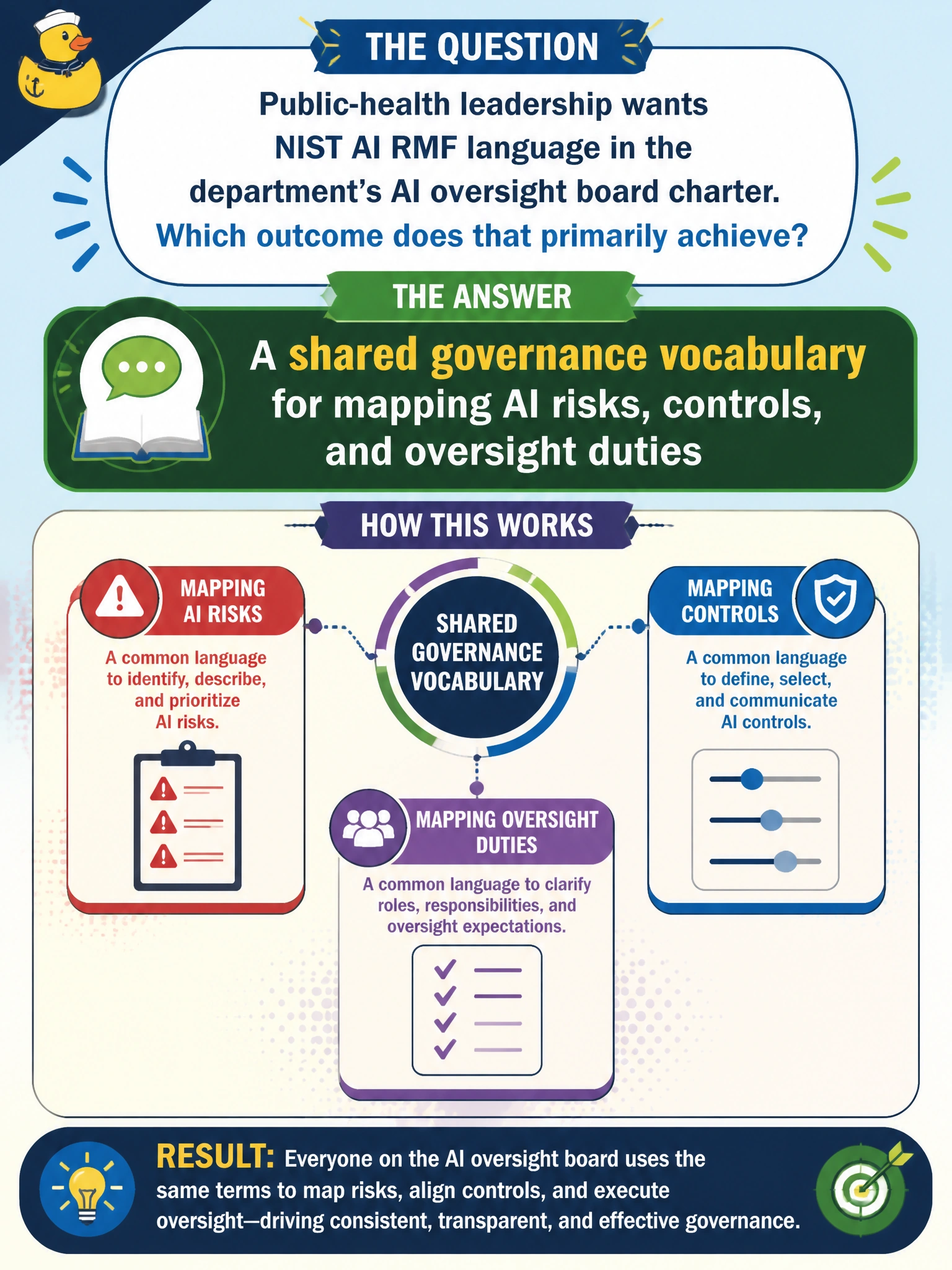
Embedding NIST AI RMF language in the public-health AI oversight board charter primarily achieves a shared governance vocabulary for mapping AI risks, controls, and oversight duties.
Govern, Map, Measure, and Manage–style framing gives clinical, privacy, security, and operations leaders a common way to inventory use cases, assign owners, choose metrics, and escalate residual risk.
In a multi-program health department, that shared lexicon reduces talking-past-each-other during board reviews and makes minutes and action items auditable against a recognized structure rather than ad-hoc department slang.
A certified management system for auditing AI processes under ISO/IEC 42001 fails as the primary outcome: NIST AI RMF language in a charter establishes governance vocabulary and oversight duties, not a certifiable management system, and ISO/IEC 42001 requires its own scoped implementation and third-party audit rather than charter wording alone.
A formal authorization pathway for clearing predictive models under FDA review fails because RMF language in a charter sets governance expectations, not regulatory clearance; FDA review follows its own statutory safety and effectiveness criteria, not charter adoption of AI RMF vocabulary.
A detailed control catalog for implementing safeguards under NIST SP 800-53 fails because AI RMF language establishes a shared governance vocabulary and process expectations rather than a prescriptive security control catalog; SP 800-53 implementation still requires system-level tailoring under the information security policy set alongside board oversight.
Exam caveat: citing NIST AI RMF in a charter is organizational adoption of vocabulary and process expectations, not a claim that every NIST publication is law or that checklist completion equals clinical validation.
Operational check: ensure the board charter defines how Map/Measure outputs feed approval gates, retains mandatory privacy and clinical review seats, and cross-references—not replaces—the information security policy set before any production health AI expansion.
Prefer to study offline? Printable PDF study book + test engine ($7.50, unofficial). These questions stay free here.