
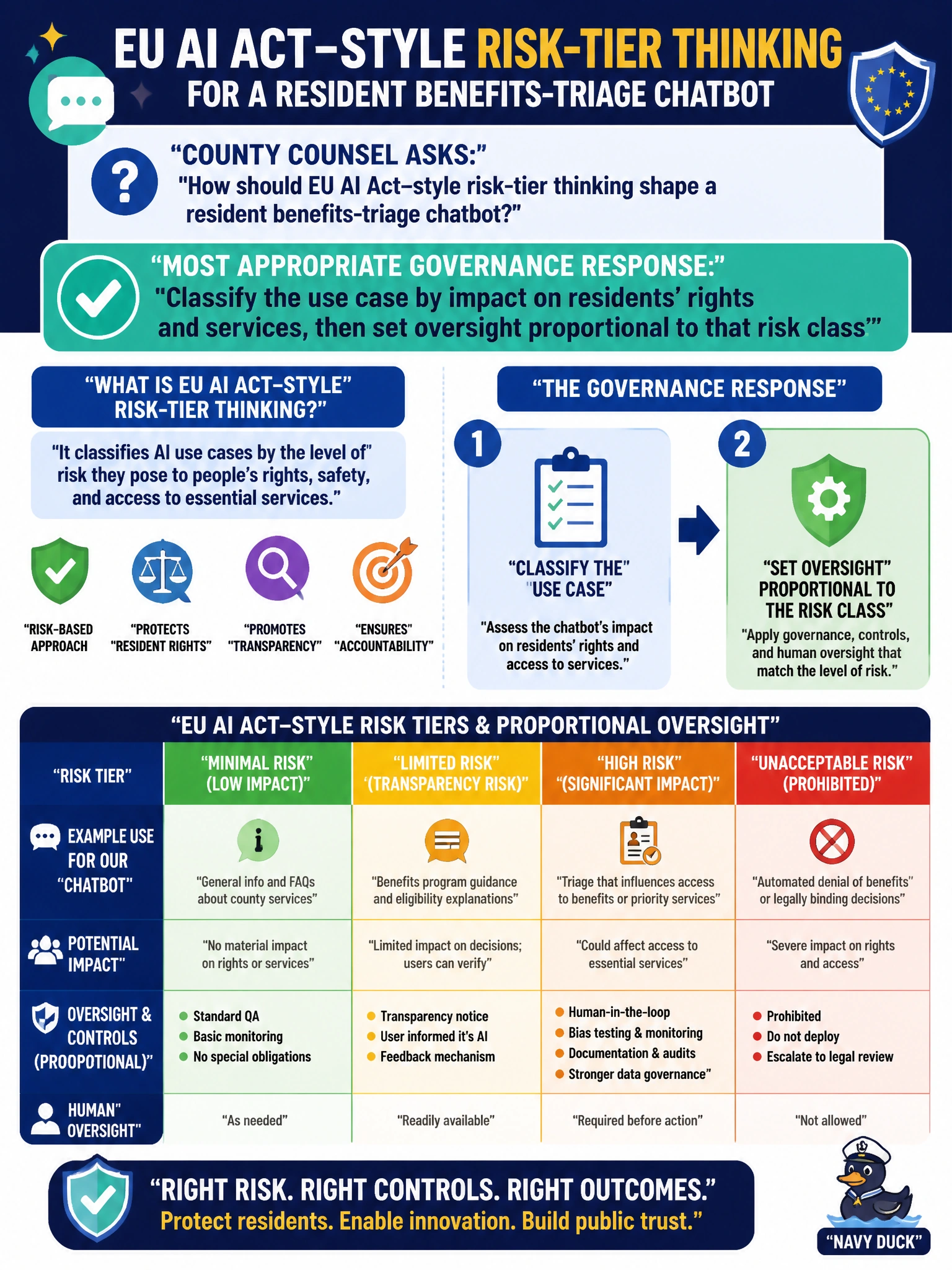
County counsel asks how EU AI Act–style risk-tier thinking should shape a resident benefits-triage chatbot. What is the most appropriate governance response?
Select an answer to reveal the explanation.
Short Explanation
Risk tiers are like fire-code occupancy classes: a quiet reading room and a crowded arena don’t get the same rules. Map how much the benefits chatbot can affect people’s rights and services, then dial oversight up or down—don’t paste foreign statute text into the model prompt.
Full Explanation
Classifying the resident benefits-triage chatbot by its impact on residents’ rights and services, then setting oversight proportional to that risk class, is the governance response that mirrors EU AI Act–style risk-tier thinking without pretending statutory text is a prompt trick. Benefits triage can affect eligibility pathways, documentation burden, and access to essential services; those impacts belong in a use-case risk class with matching human review, logging, appeal paths, and change control. Proportional oversight concentrates scarce legal and security effort where harm potential is highest while still allowing lower-impact FAQ flows to proceed under lighter but documented controls.
Treating every FAQ chatbot as identical risk and skipping classification fails because risk is driven by consequence and context, not by the shared technology label “chatbot.” Uniform treatment either over-controls low-impact assistants or under-controls high-impact triage. Copying EU statutory articles verbatim into the system prompt fails conceptually: prompts are not conformity mechanisms, do not create organizational accountability, and can misstate obligations when law evolves. Banning all generative assistants because foreign regulation “always” forbids civic chatbots misreads risk-tier regimes, which calibrate requirements rather than impose blanket civic bans, and would starve legitimate service modernization without reducing unmanaged shadow AI.
Exam caveat: foreign regulatory “style” informs risk thinking; it does not automatically transplant every extraterritorial duty into a U.S. county program. Local counsel still maps applicable law, contracts, and records rules to the classified use case.
Operational check: document the benefits chatbot’s resident-impact class, list proportional controls (review, retention, escalation), and verify that prompt text is not being used as a substitute for policy, DPIA-style analysis, or counsel sign-off.
Prefer to study offline? Printable PDF study book + test engine ($7.50, unofficial). These questions stay free here.