
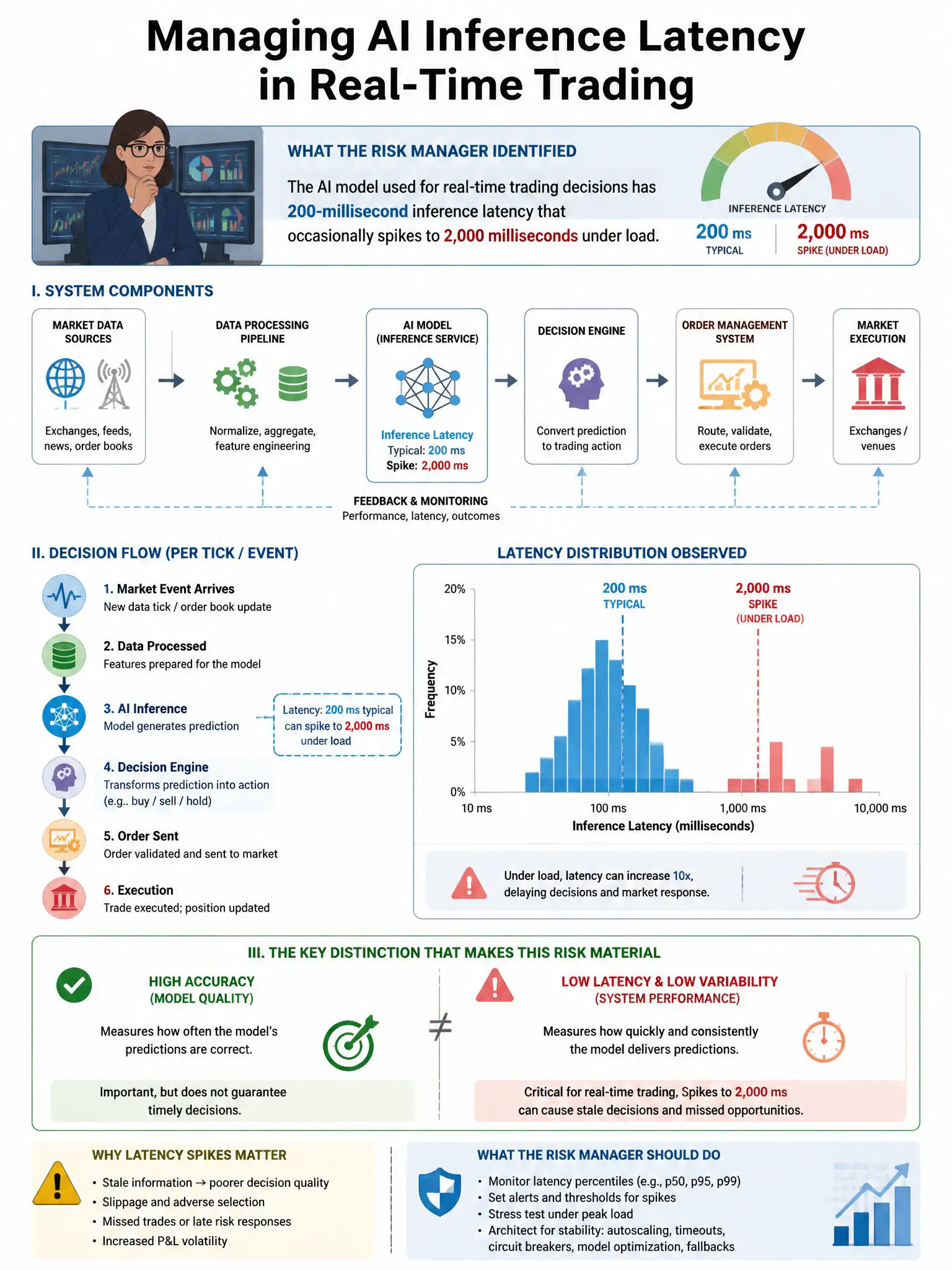
A risk manager identifies that an AI model used for real-time trading decisions has a 200-millisecond inference latency that occasionally spikes to 2,000 milliseconds under load. In this context, what risk does latency variability create?
Select an answer to reveal the explanation.
Short Explanation
Here's the deal — in real-time trading, you need decisions to hit the market while the data is still fresh. When latency jumps from 200 ms to 2,000 ms, your model can act on stale prices, creating market timing risk. FINRA doesn't have AI accuracy standards like that.
Full Explanation
Market timing risk where delayed model outputs cause trades based on stale market data is correct. In real-time trading, latency spikes cause decisions to execute on data that is no longer current; a 10x latency increase in fast-moving markets creates material market timing risk. The FINRA AI accuracy standards option is wrong because FINRA does not have AI accuracy standards of this type. The data poisoning option is wrong because it is not a direct consequence of latency. The bias amplification option is wrong because it is not a documented effect of latency variability.