
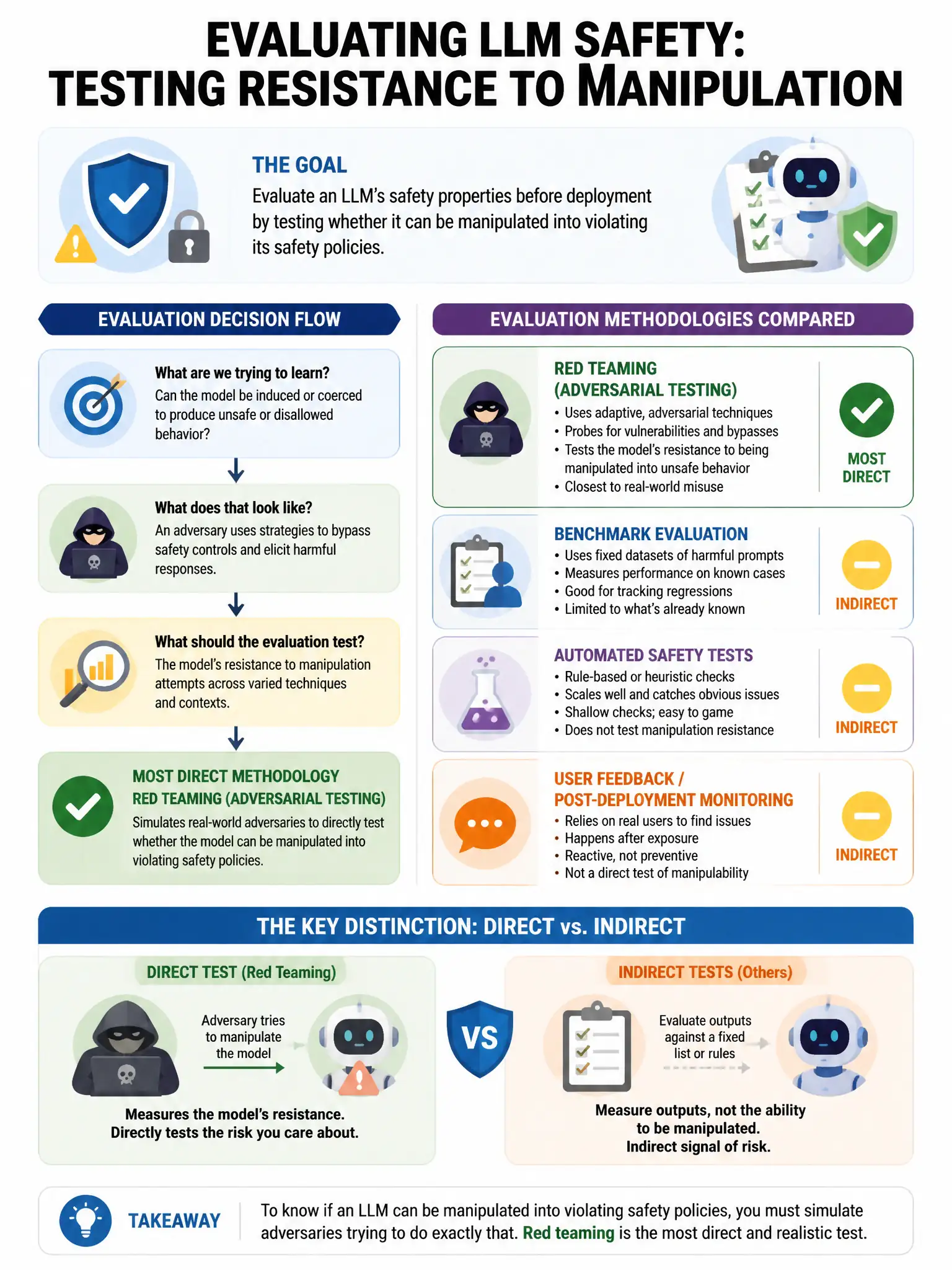
An organization wants to evaluate an LLM's safety properties before deployment. Which evaluation methodology MOST directly tests whether the model can be manipulated into violating its safety guidelines?
Select an answer to reveal the explanation.
Short Explanation
Here's the deal — structured red-teaming using adversarial prompts designed to elicit unsafe outputs is correct because having human adversaries or automated systems probe the model with carefully crafted inputs designed to bypass safety guidelines directly tests whether it can be manipulated. Standard benchmarks, perplexity, and content-filter comparisons don't test that robustness.
Full Explanation
Structured red-teaming using adversarial prompts designed to elicit unsafe outputs is correct because having human adversaries or automated systems probe the model with carefully crafted inputs designed to bypass safety guidelines directly tests the model's robustness against manipulation. Standard benchmark testing on academic NLP datasets measures general language understanding, not safety. Measuring the model's perplexity on a held-out validation corpus measures language modeling quality. Comparing model outputs against a rules-based content filter tests the filter, not the underlying model safety properties.