
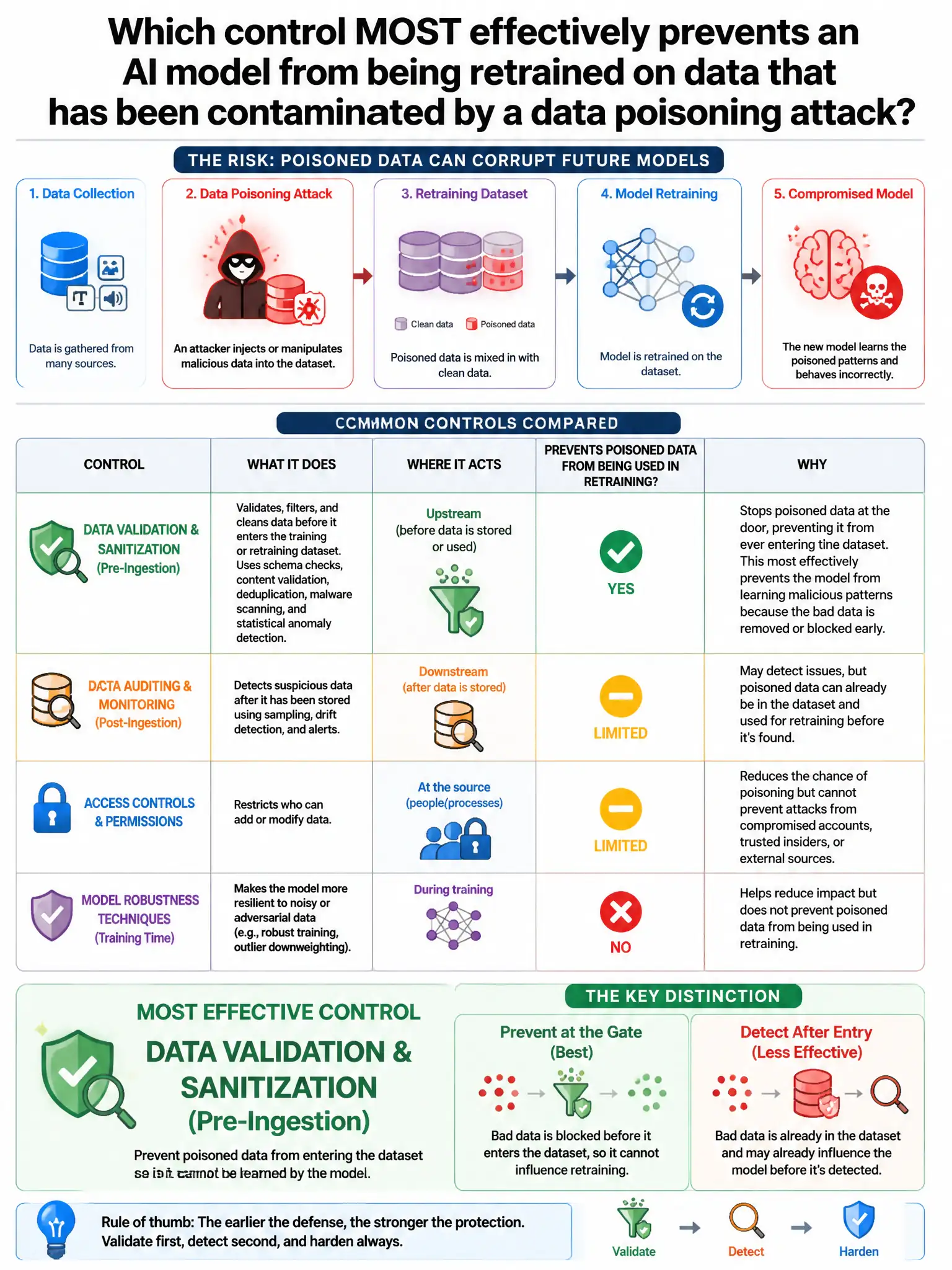
Which control MOST effectively prevents an AI model from being retrained on data that has been contaminated by a data poisoning attack?
Select an answer to reveal the explanation.
Short Explanation
Here's the deal — anomaly detection on incoming training data is the most effective control because it flags statistical outliers, unusual label distributions, or anomalous feature patterns before contaminated data enters the retraining pipeline. You stop poisoning at the front door instead of hoping encryption, isolation, or a smaller model will save you.
Full Explanation
The anomaly detection option is correct because anomaly detection on incoming training data — flagging statistical outliers, unusual label distributions, or anomalous feature patterns — is the most direct preventive control against data poisoning by detecting contaminated data before it enters the retraining pipeline. The AES-256 encryption option protects data at rest from unauthorized access but does not detect poisoning. The air-gapped retraining option prevents internet-based attacks but not insider or supply-chain poisoning. The fewer-parameters option reduces model capacity but does not prevent poisoning from entering the training set.