
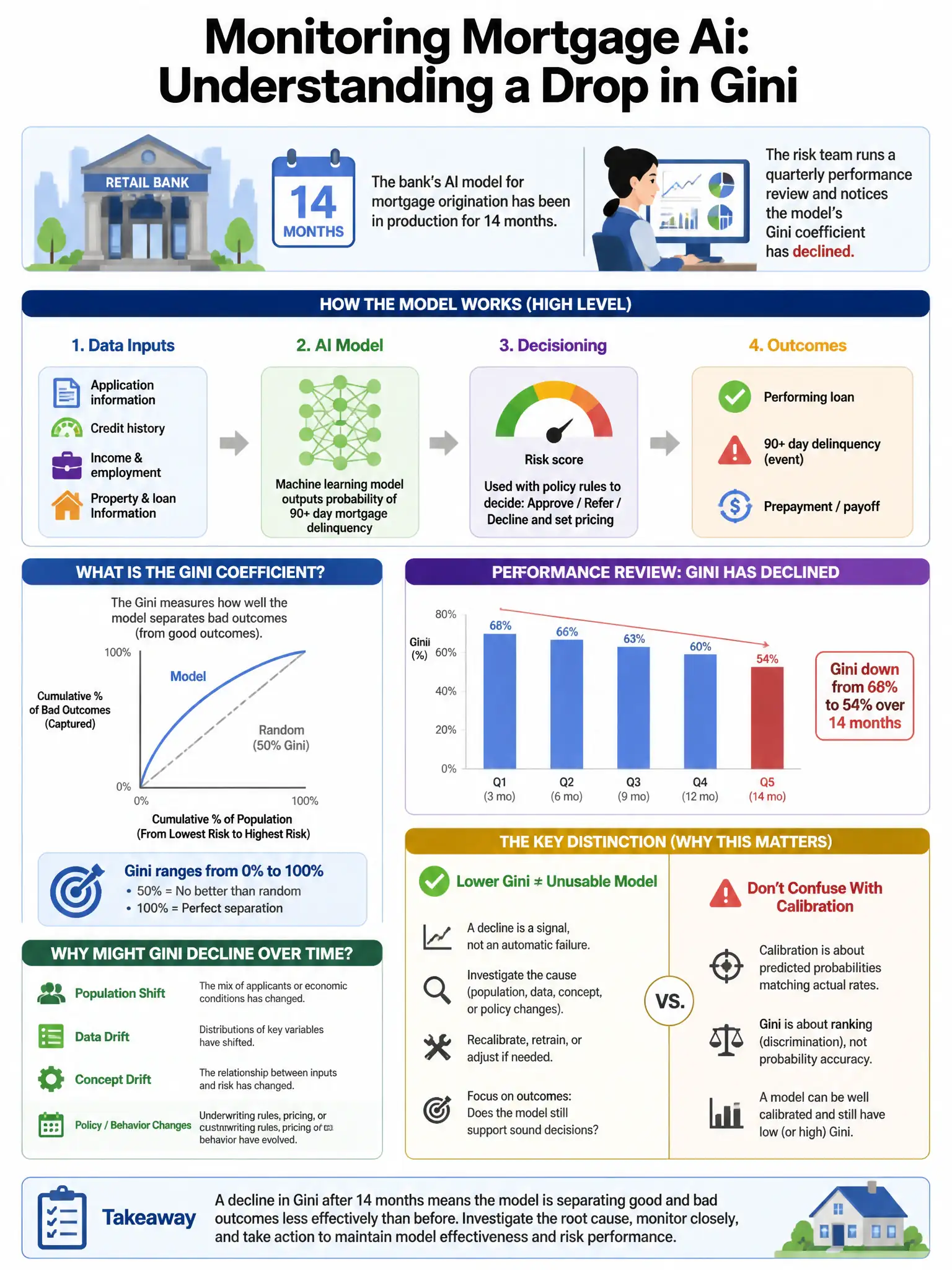
A retail bank's AI model for mortgage origination has been in production for 14 months. The risk team runs a quarterly performance review and notices the model's Gini coefficient has declined from 0.72 to 0.61. What action is MOST appropriate?
Select an answer to reveal the explanation.
Short Explanation
Here's the deal — when a mortgage model's Gini coefficient drops from 0.72 to 0.61, you don't shrug it off. You kick off a formal performance review, hunt for root causes like data drift, concept drift, or market changes, and decide if retraining or redevelopment is needed before it gets worse.
Full Explanation
A Gini coefficient decline from 0.72 to 0.61 represents meaningful degradation in discriminative ability, meaning the model is significantly less effective at separating good from bad borrowers. The appropriate action is a formal model performance review: investigate root causes such as data drift, concept drift, or market changes, compare current predictions to actual outcomes on recent originations, and assess whether retraining or redevelopment is warranted before discriminative ability further degrades. Accepting the decline as normal market fluctuation and continuing monitoring is inappropriate for a significant decline in a high-stakes lending model. Immediately decommissioning the model and reverting to manual underwriting is disproportionate without first investigating cause and impact. Requesting data science to re-tune hyperparameters to restore the original Gini is not appropriate for degradation caused by data or concept drift; retraining on updated data, not tuning existing parameters, is typically required.