
An AI governance committee is evaluating whether to permit the use of synthetic training data generated by a generative AI model to supplement scarce real training data for a medical diagnosis AI. Which risk should receive the HIGHEST priority in this evaluation?
Select an answer to reveal the explanation.
Short Explanation
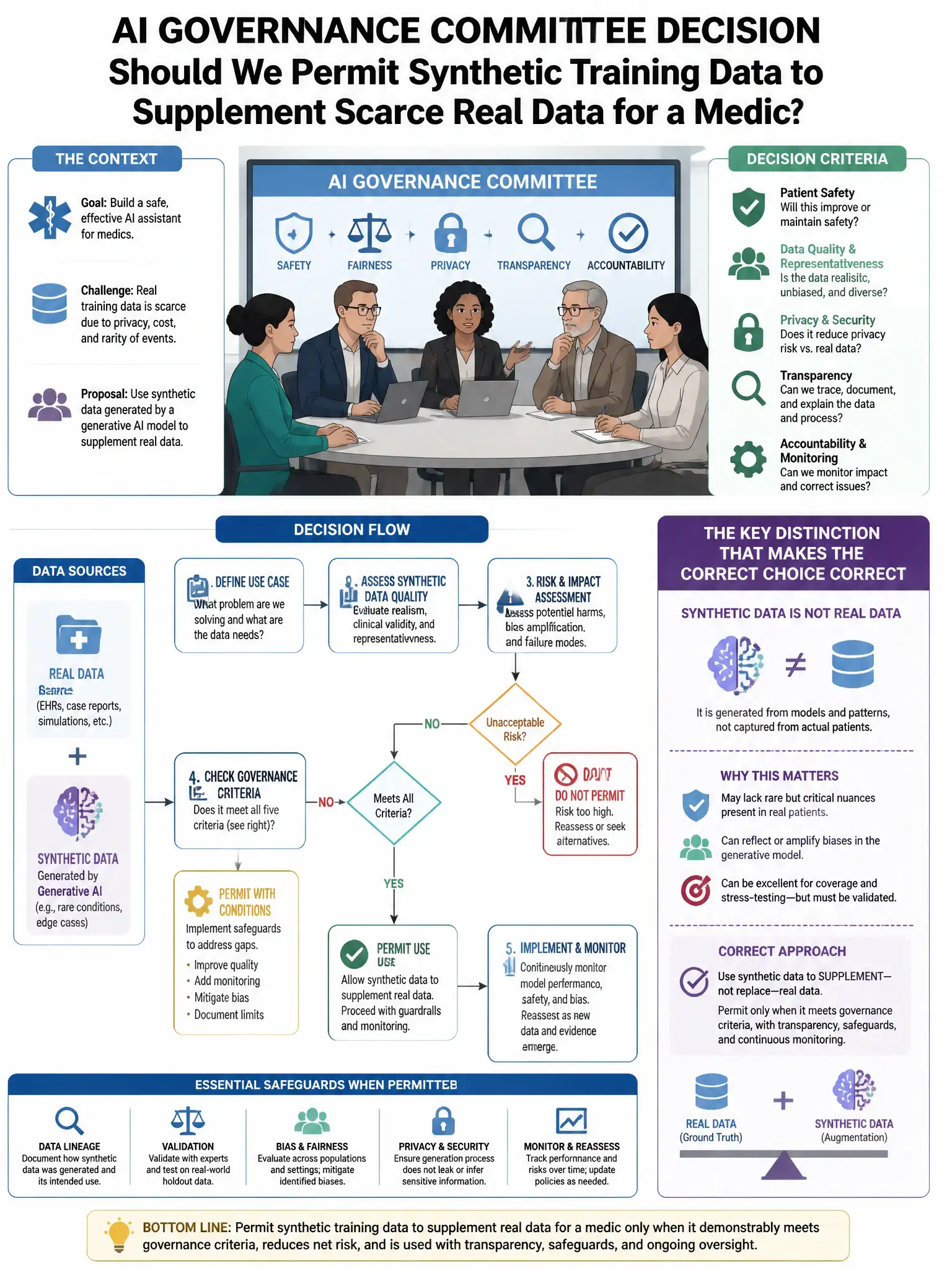
Here's the deal — you need to prioritize the risk that synthetic data misses the full distribution of real clinical cases, especially rare but critical presentations. If the model only learns typical cases, it can fail exactly when accuracy matters most.
Full Explanation
The highest priority is the risk that synthetic data fails to capture the full distribution of real clinical cases, including rare but critical presentations, potentially creating a model that performs poorly on edge cases that matter most clinically. In medical AI, the most dangerous failure modes are often rare clinical presentations, meaning uncommon but life-threatening conditions. Synthetic data generated by a model that learned from the same scarce real data may not represent these rare but critical cases, and may amplify the scarcity problem by generating only typical cases. A model trained on such synthetic data may underperform exactly when accuracy matters most. Computational cost of generating large volumes of synthetic medical images, intellectual-property status of the generative model used to create synthetic data, and environmental impact of additional computational resources are legitimate concerns, but secondary to the patient-safety risk of inadequate coverage of rare but critical presentations.