
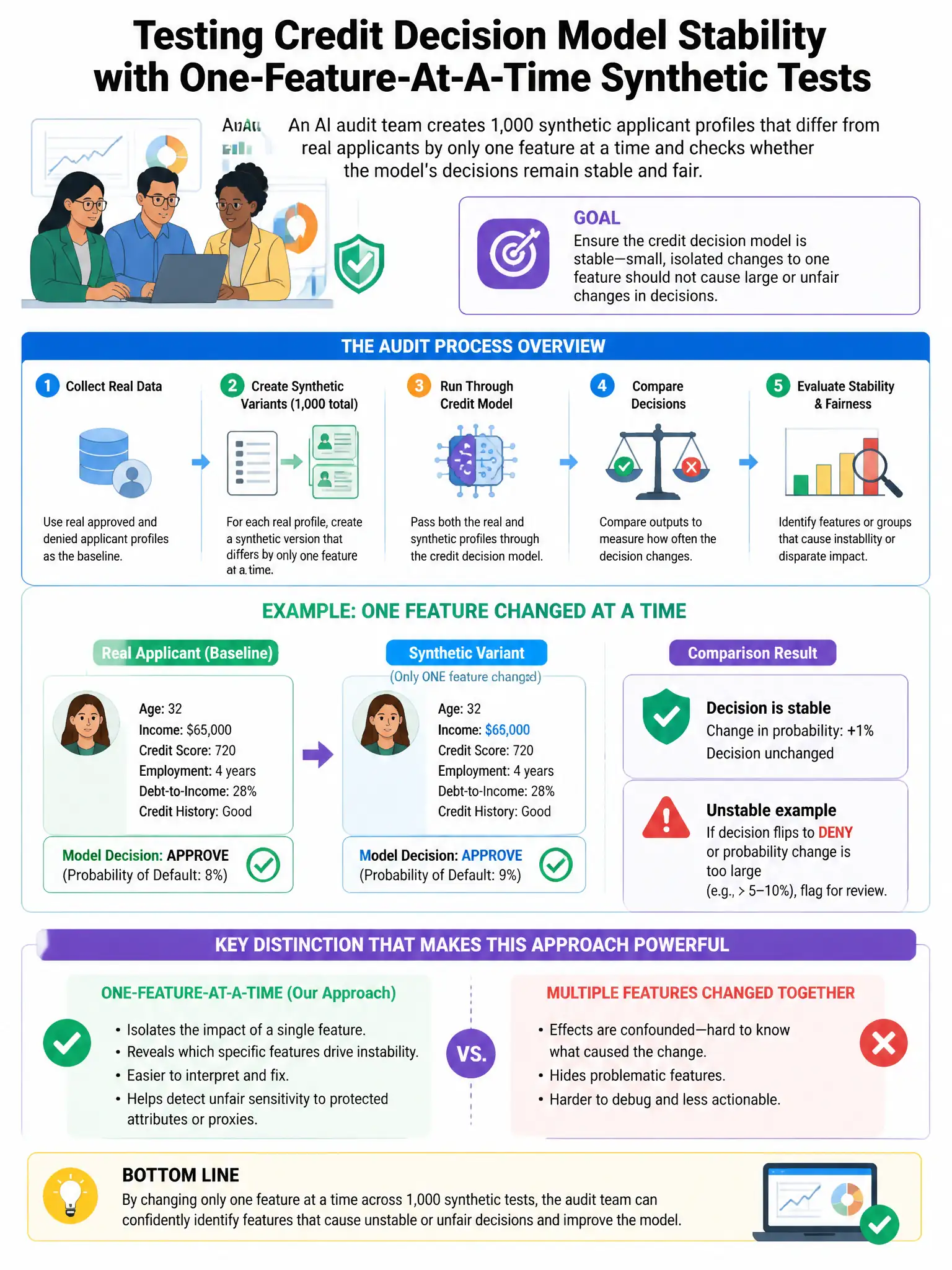
An AI audit team is testing a credit decision model for stability. They create 1,000 synthetic applicant profiles that differ from real applicants by only one feature at a time and compare predicted scores. What technique is this?
Select an answer to reveal the explanation.
Short Explanation
Here's the deal — you're changing one feature at a time while holding the others constant, so you're running one-at-a-time sensitivity analysis. That shows which features cause big score swings and helps you spot stability problems in a credit model.
Full Explanation
The correct technique is one-at-a-time sensitivity analysis. By changing one feature at a time while holding the others constant, you measure how much each feature influences the model output independently. That identifies unstable features that produce disproportionately large score changes, which is a model robustness and reliability concern for credit models. Adversarial robustness testing using FGSM perturbations is wrong because FGSM uses gradient-based adversarial perturbations, not one-feature-at-a-time changes. Counterfactual fairness testing is wrong because it identifies the minimum change needed to flip a credit decision for a specific applicant, not general feature sensitivity across synthetic profiles. Population stability testing using PSI is wrong because PSI compares distributional statistics between training and production data, not individual prediction sensitivity.