
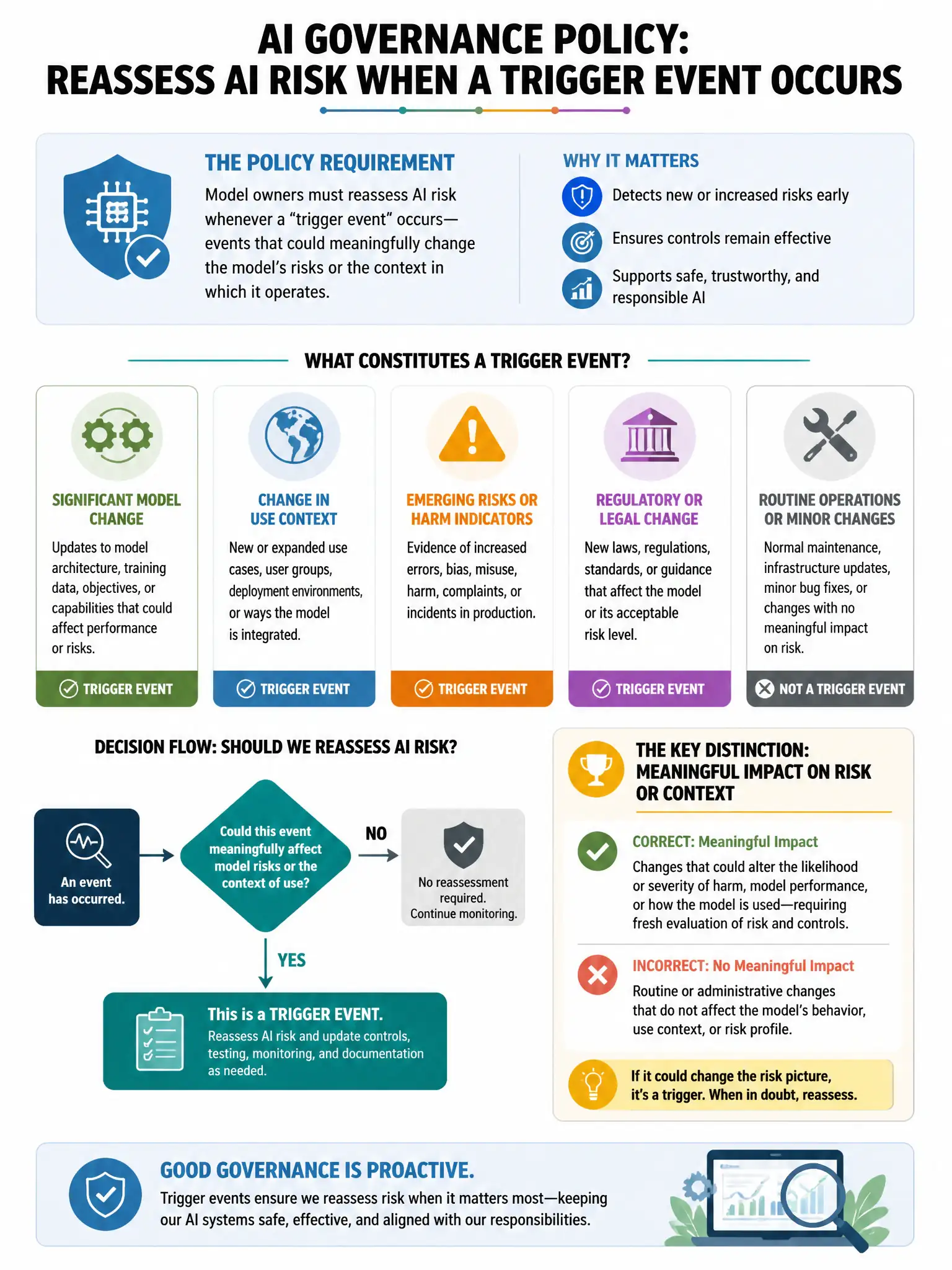
An AI governance policy requires model owners to reassess AI risk when a 'trigger event' occurs. Which of the following would MOST appropriately constitute a trigger event requiring reassessment?
Select an answer to reveal the explanation.
Short Explanation
Here's the deal — you need reassessment when the model is expanded to serve a new customer segment with different demographics and risk profiles not represented in the original training data. That's a material change in use case that can invalidate the original validation, because the model was validated for a specific population and may perform differently for the new segment.
Full Explanation
The correct answer is the model being expanded to serve a new customer segment with different demographic characteristics and risk profiles not represented in the original training data. This represents a material change in use case that can invalidate the original validation's findings. The model was validated for a specific population, and performance may differ substantially for a new segment. This is a classic trigger event for reassessment. The training data being collected three years ago may be relevant but is not inherently a trigger; what matters is whether it still represents the current population. Staff turnover since the original validation affects governance but not model validity directly. Predicted outcomes being directionally consistent with actual outcomes over the past quarter supports maintaining the current risk assessment, not triggering reassessment.