
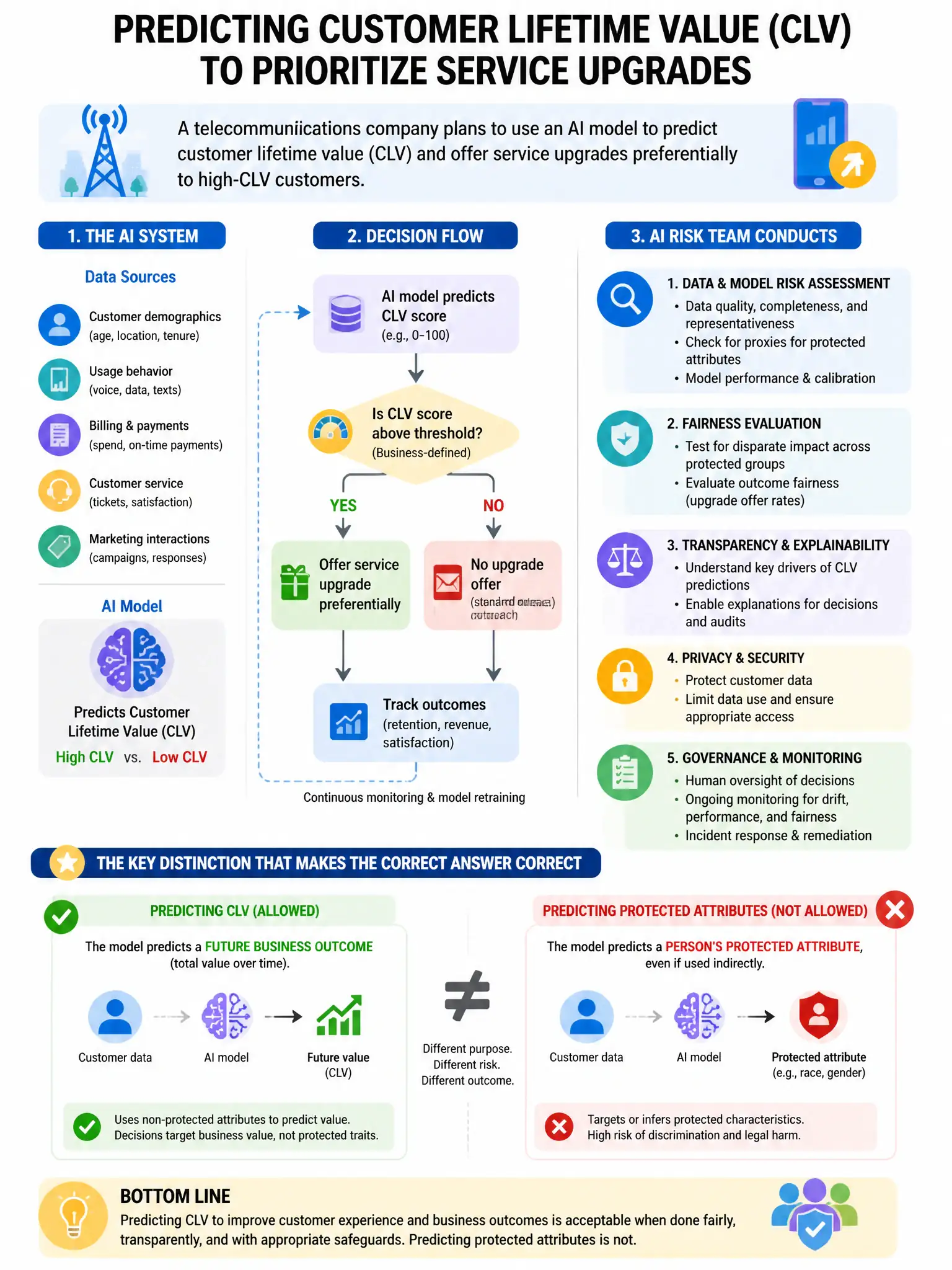
A telecommunications company plans to use an AI model to predict customer lifetime value (CLV) and offer service upgrades preferentially to high-CLV customers. An AI risk team conducts a disparate impact assessment and finds that high-CLV customers are disproportionately White and high-income. What recommendation should the AI risk team make?
Select an answer to reveal the explanation.
Short Explanation
Here's the deal — you can't just approve a facially neutral CLV model if its use creates racially disparate service outcomes. You need to check whether the preferential upgrade offers trigger consumer protection or equal-treatment rules, then look for CLV-independent eligibility criteria that meet the business goal with less disparate impact.
Full Explanation
Assessing whether the preferential service upgrade offers constitute discriminatory treatment under applicable consumer protection regulations, and evaluating alternative CLV-independent criteria for upgrade eligibility, is correct because even though CLV is facially race-neutral, when its application produces racially disparate outcomes in customer service quality, this can trigger consumer protection and equal treatment obligations. The team must assess legal and regulatory implications in the relevant jurisdiction and consider whether alternative eligibility criteria can achieve the business objective with less disparate impact. Approving the model as-is because CLV is a race-neutral metric is incorrect because facially neutral criteria that produce protected-class disparate outcomes are not automatically acceptable. Removing race and income from CLV inputs to eliminate disparate impact does not address the issue, because CLV is already calculated without race and income but correlates with them due to historical socioeconomic disparities. Limiting the model to internal business analytics and not allowing it to drive customer-facing service decisions is overly restrictive; the goal is to manage risk, not eliminate a business tool.