
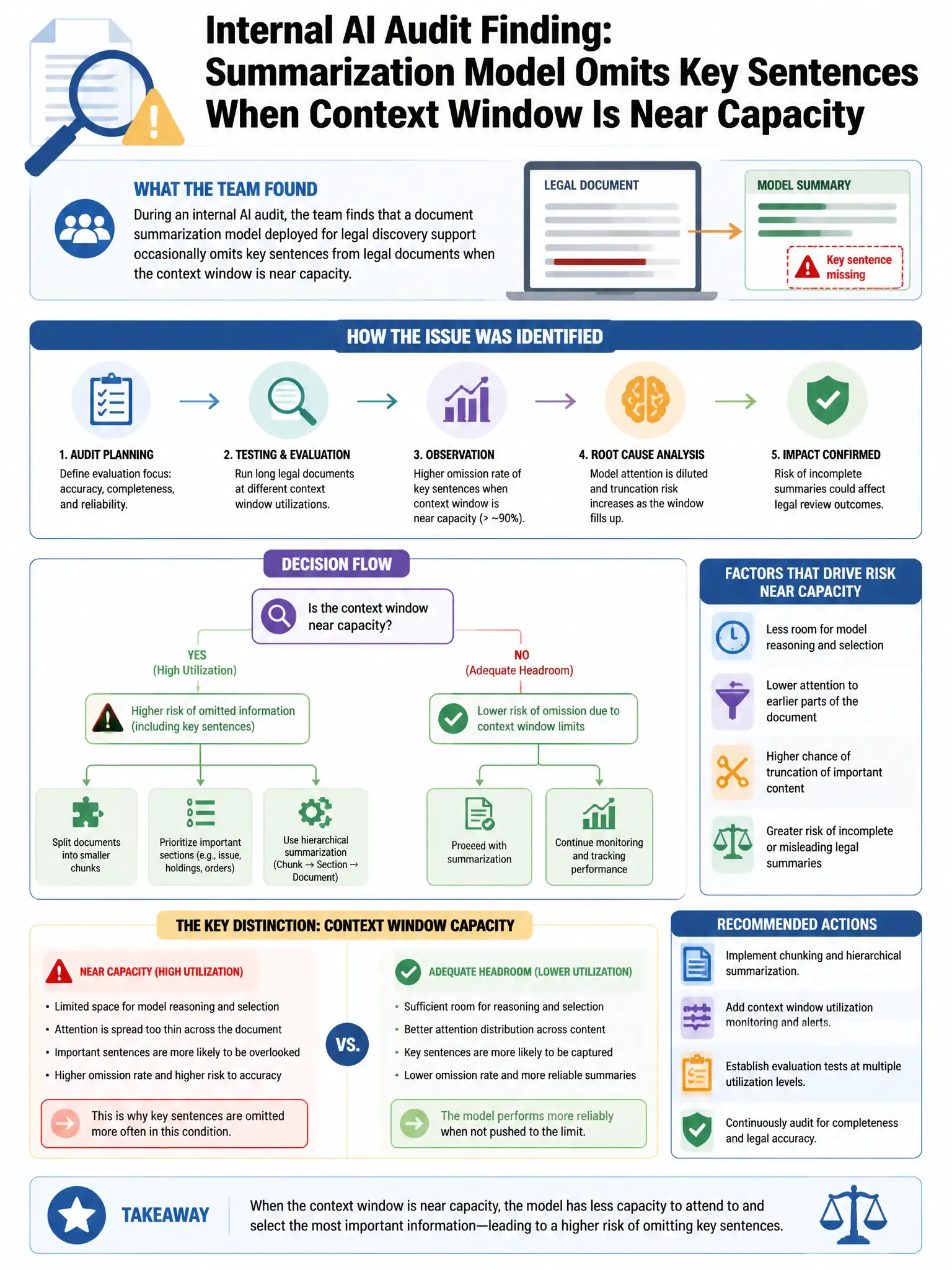
During an internal AI audit, the team finds that a document summarization model deployed for legal discovery support occasionally omits key sentences from legal documents when the documents contain complex multi-clause sentences. What type of AI risk does this MOST represent, and what is the appropriate audit finding?
Select an answer to reveal the explanation.
Short Explanation
Here's the deal — you're looking at a model reliability risk, not a patch problem. Systematic omission of complex legal content can lead to incomplete discovery and legal liability, so you need documented limitations and compensating controls.
Full Explanation
The model reliability risk finding is correct because systematic omission of content from legal documents is a reliability failure with direct legal consequences: incomplete discovery could expose the organization to sanctions, adverse judgments, or malpractice claims. This is a model risk issue requiring documented limitations, such as a model card update, compensating controls, such as human review of complex documents, and consideration of whether the model should be restricted to certain document types. The cybersecurity vulnerability requiring immediate patch deployment to the model's API is wrong because the issue is not a security defect. The training data quality issue requiring procurement of additional legal document training data is wrong because training data is one possible cause, but the audit finding is about the risk, not the cause. The user interface design problem that should be addressed by the UX team rather than the risk team is wrong because the problem is model-level content omission, not a UX issue.