
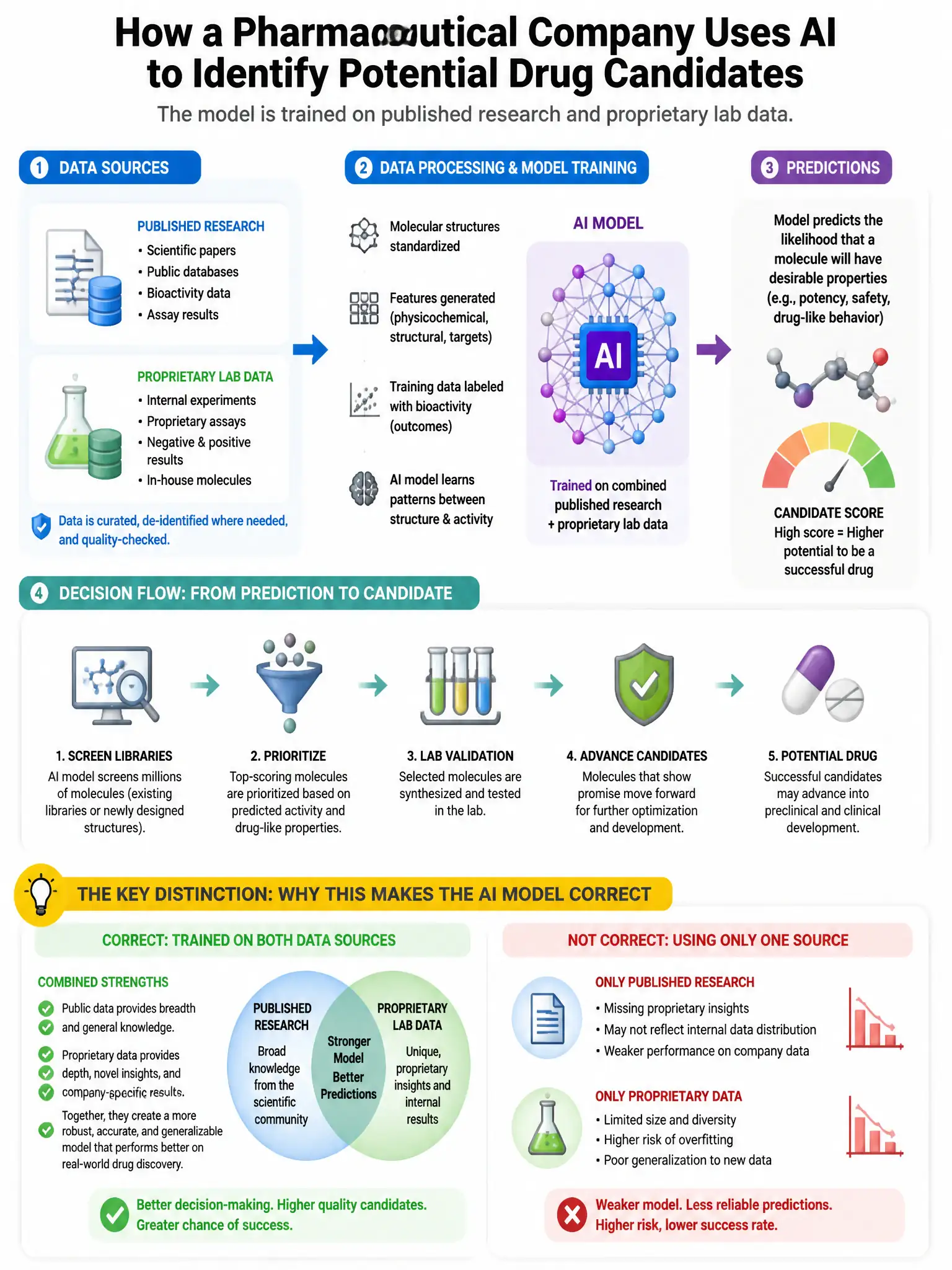
A pharmaceutical company is using an AI model to identify potential drug candidates from molecular structure data. The model was trained on published research and proprietary lab assay data. An AI risk assessment flags that the model may be unintentionally optimizing for patent-protected molecular configurations. Which risk does this represent?
Select an answer to reveal the explanation.
Short Explanation
Here's the deal — you're looking at intellectual property infringement risk because the model may generate or recommend molecular structures that fall within existing patent claims. It learned from patented molecular configurations and can reproduce those patterns. That's not hallucination, poisoning, or distributional shift.
Full Explanation
The intellectual property infringement risk is correct because an AI model trained on data that includes patented molecular configurations may generate or recommend structures that fall within existing patent claims, exposing the organization to patent infringement liability. This is an AI-specific IP risk that arises from the model's ability to generalize from and reproduce patterns in its training data. The hallucination risk producing chemically impossible molecular structures refers to generating incorrect content, not patent replication. The data poisoning risk from adversarially modified molecular structure data in published research requires adversarial intent. The distributional shift risk from differences between published research data and proprietary lab assay data refers to performance differences, not IP issues.