
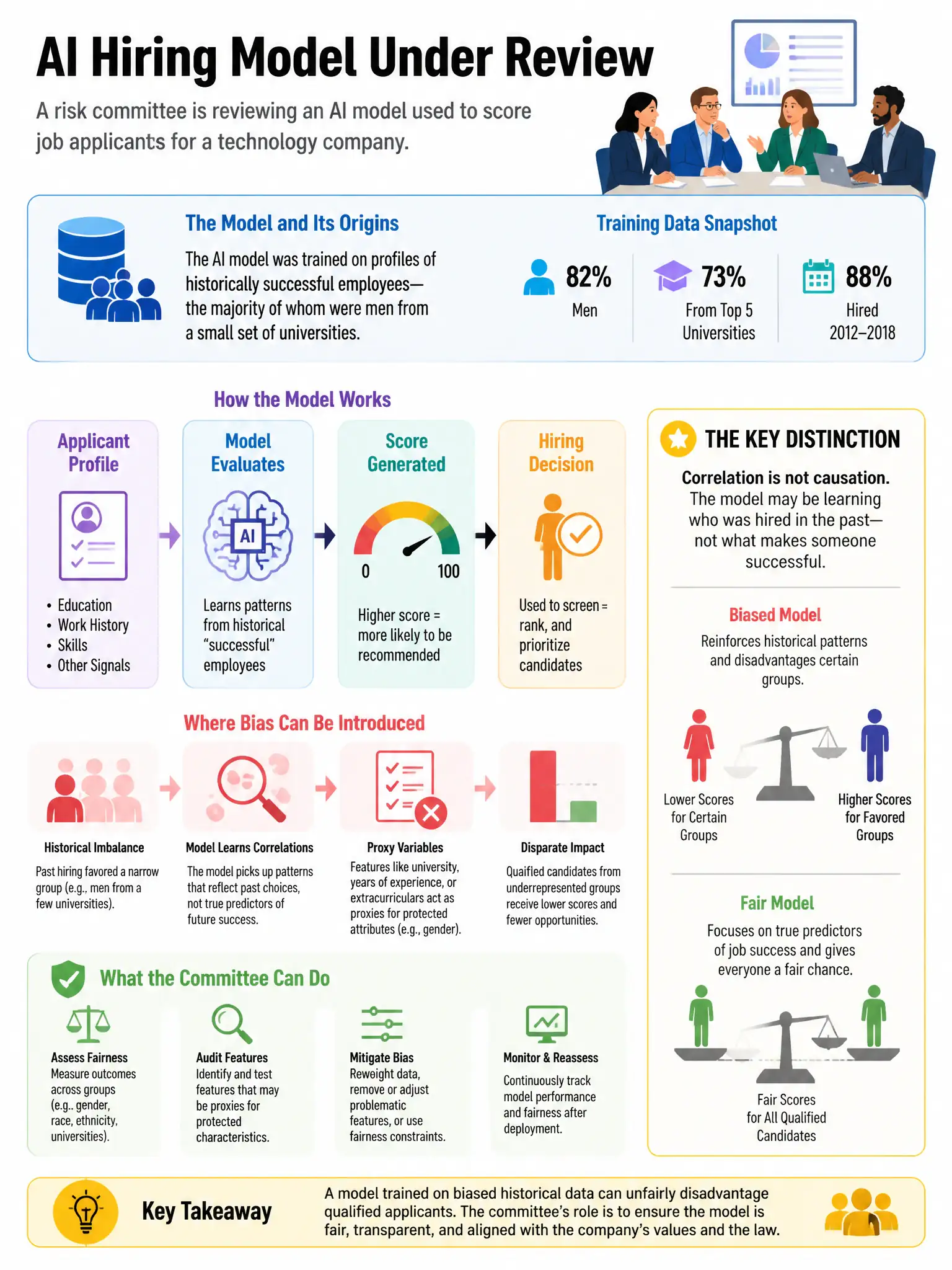
A risk committee is reviewing an AI model used to score job applicants for a technology company. The model was trained on profiles of historically successful employees, the majority of whom are male. The model's top scoring threshold accepts 28% of male applicants and only 14% of female applicants. Under the EEOC's uniform guidelines and the 4/5ths rule, what is the correct assessment?
Select an answer to reveal the explanation.
Short Explanation
Here's the deal — the model fails the 4/5ths rule because the female selection rate is only 50% of the male rate, and that's below the 80% threshold. You're looking at a ratio, not raw percentages or absolute gaps.
Full Explanation
The correct assessment is that the model fails the 4/5ths rule because the female selection rate is 50% of the male selection rate, below the 80% threshold. The 4/5ths rule requires a protected group's selection rate to be at least 80% of the highest-selected group's rate. Here, 14% is 50% of 28%, indicating adverse impact. The idea that both rates being above 10% matters is wrong because the test compares rates as a ratio. The idea that an absolute difference under 20 percentage points matters is wrong because the rule is ratio-based, not difference-based. The idea that the rule does not apply to AI models is wrong because it applies to any selection procedure, including AI-based ones.