
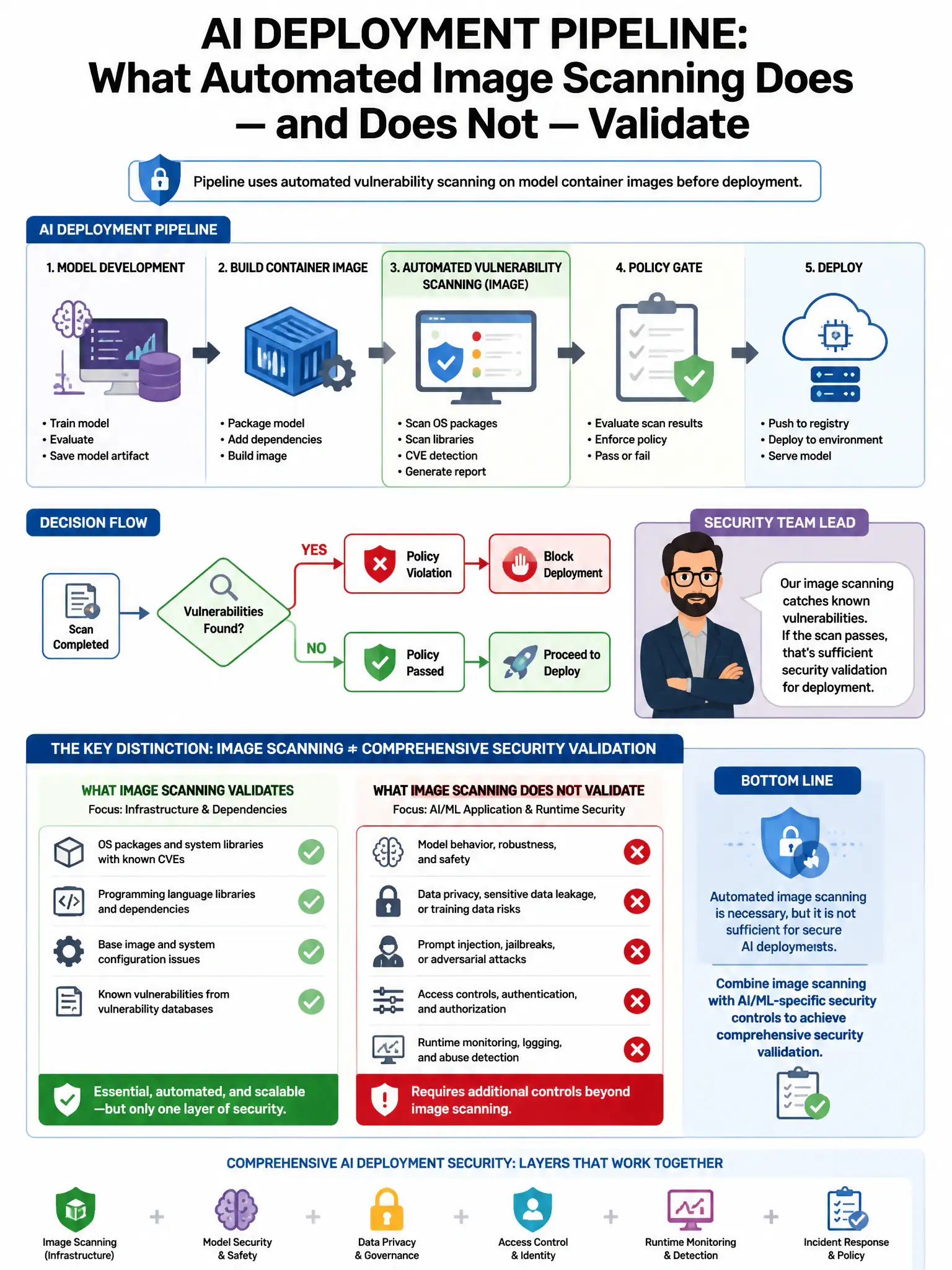
An AI deployment pipeline uses automated vulnerability scanning on the model container images before deployment. A security team lead argues this is sufficient security validation for the AI system. What does this approach FAIL to address?
Select an answer to reveal the explanation.
Short Explanation
Here's the deal — container scanning checks the deployment environment for software flaws, not the AI model itself. You still need to assess model behavior, adversarial robustness, data poisoning, and backdoors.
Full Explanation
Container security scanning is a deployment infrastructure control that checks for known software vulnerabilities in the container environment. It does not assess AI model-specific risks: it cannot detect whether the model has been backdoored during training, whether it is robust to adversarial inputs, whether its predictions are systematically biased, or whether training data was poisoned. AI security requires both infrastructure security, which scanning provides, and AI-specific risk assessment. The claim that container image scanning cannot detect software dependency vulnerabilities mischaracterizes what container scanning can detect. The suggestion to supplement the scanner with manual code review of inference code is a narrower technical argument that misses the fundamental point. The claim that container scanning is only effective for Kubernetes deployments is also a narrower technical argument that misses the fundamental point.