
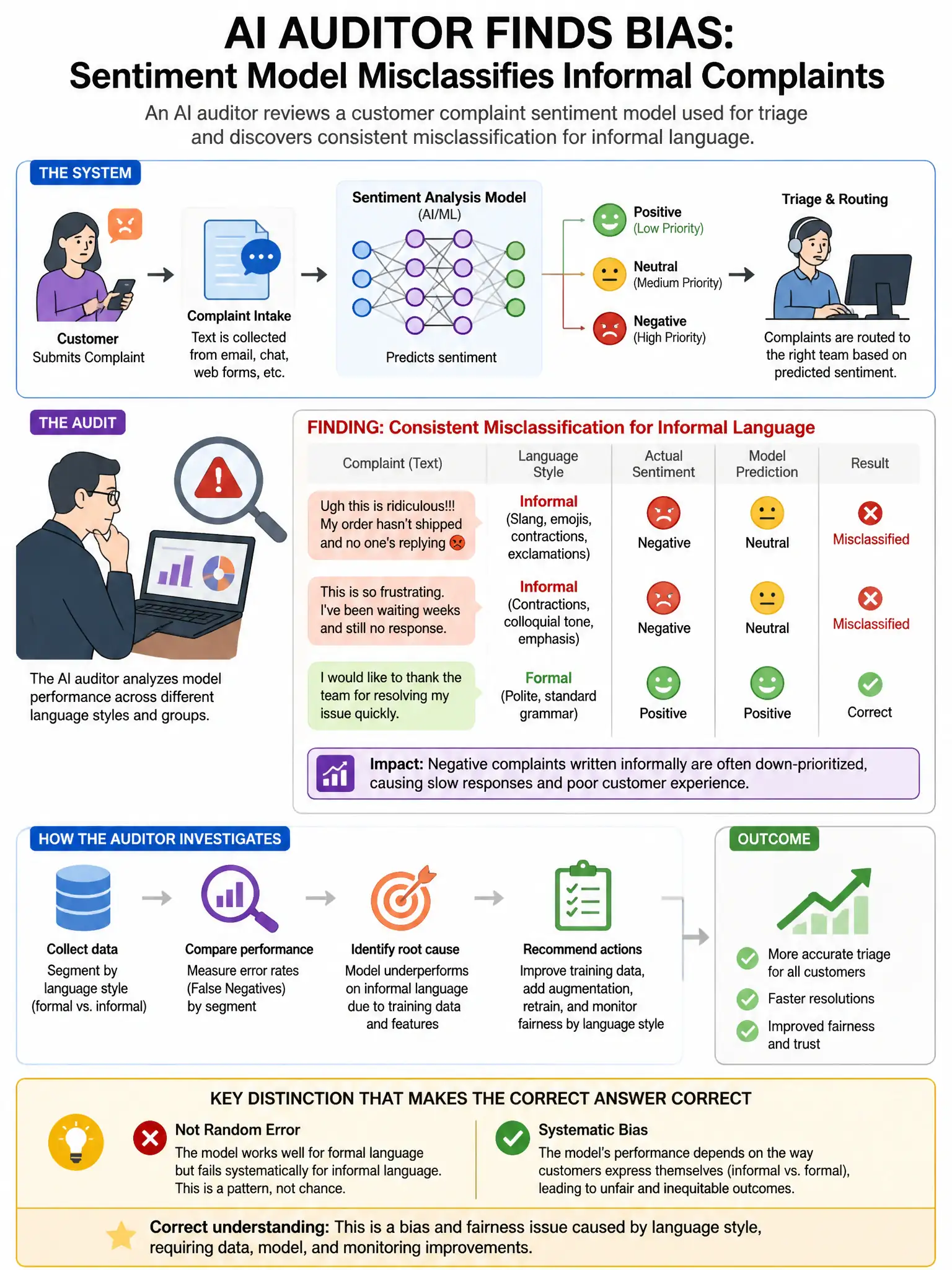
An AI auditor reviewing a sentiment analysis model used for customer complaint triage discovers that the model consistently misclassifies complaints written in informal language, slang, or non-standard spelling. This primarily impacts low-income and younger customers. What audit finding should be documented?
Select an answer to reveal the explanation.
Short Explanation
You're looking at an equity risk because the model performs worse on informal language, and that pattern hits low-income and younger customers harder. That can create unfair service outcomes, not just a technical miss.
Full Explanation
The correct finding is an equity risk where differential model performance based on writing style may create disparate service quality outcomes for specific demographic groups. Differential model performance based on language register, formal versus informal, that systematically disadvantages specific demographic groups such as low-income and younger customers creates an equity risk with potential regulatory implications under consumer protection and fair treatment frameworks. This is not merely a performance deficiency for non-standard language inputs requiring model retraining, because the demographic impact pattern makes it a fairness concern. Treating it as a data quality issue attributable to customers rather than the model's design ignores the organization's responsibility for equitable service delivery. Calling it an out-of-scope use case because the model was not designed to handle informal language would be appropriate only if documented upfront, but the organization is already using it in this way.