
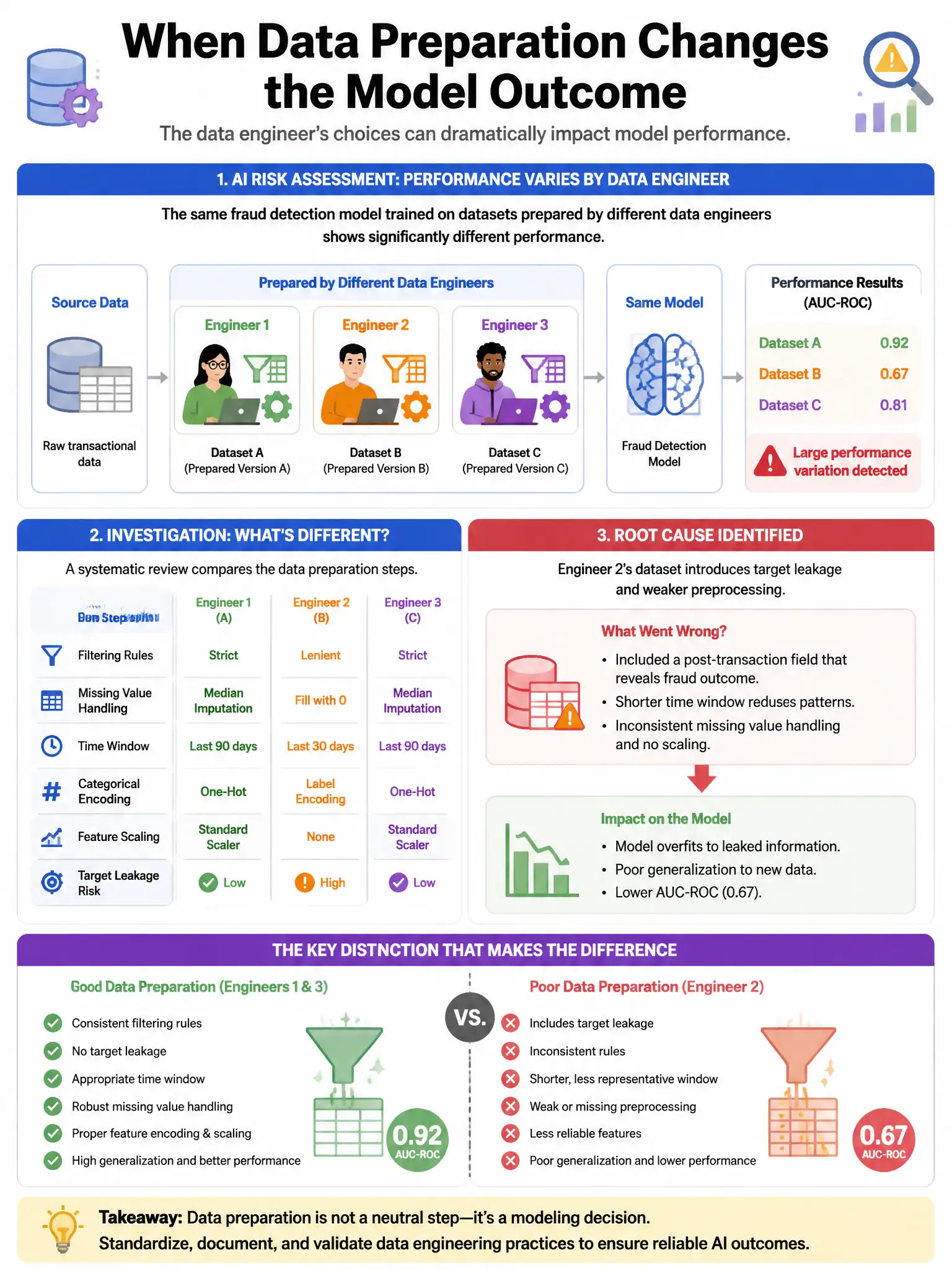
An AI risk assessment reveals that a fraud detection model's performance varies significantly depending on which data engineer prepared the training dataset. Upon investigation, the team finds no standardized data preprocessing pipeline. What category of AI risk does this MOST represent?
Select an answer to reveal the explanation.
Short Explanation
Here's the deal — when model outcomes hinge on ad hoc, undocumented data-prep choices, you can't reliably reproduce, validate, or audit the model. That's model reproducibility risk: retrain the same model with another engineer and results can shift because preprocessing isn't standardized.
Full Explanation
Model reproducibility risk where AI outcomes depend on inconsistent and undocumented human decisions in data preparation is correct because ad hoc, undocumented data-prep decisions prevent reliable reproduction, validation, and audit. Retraining by another engineer can produce materially different results when preprocessing is not standardized, undermining model governance and validation integrity. Algorithmic bias from inconsistent feature engineering across demographic groups is a possible downstream effect, not the root risk. Data privacy risk from inconsistent anonymization is a separate concern. Operational risk from dependence on specific engineers is related but secondary to the model risk.