
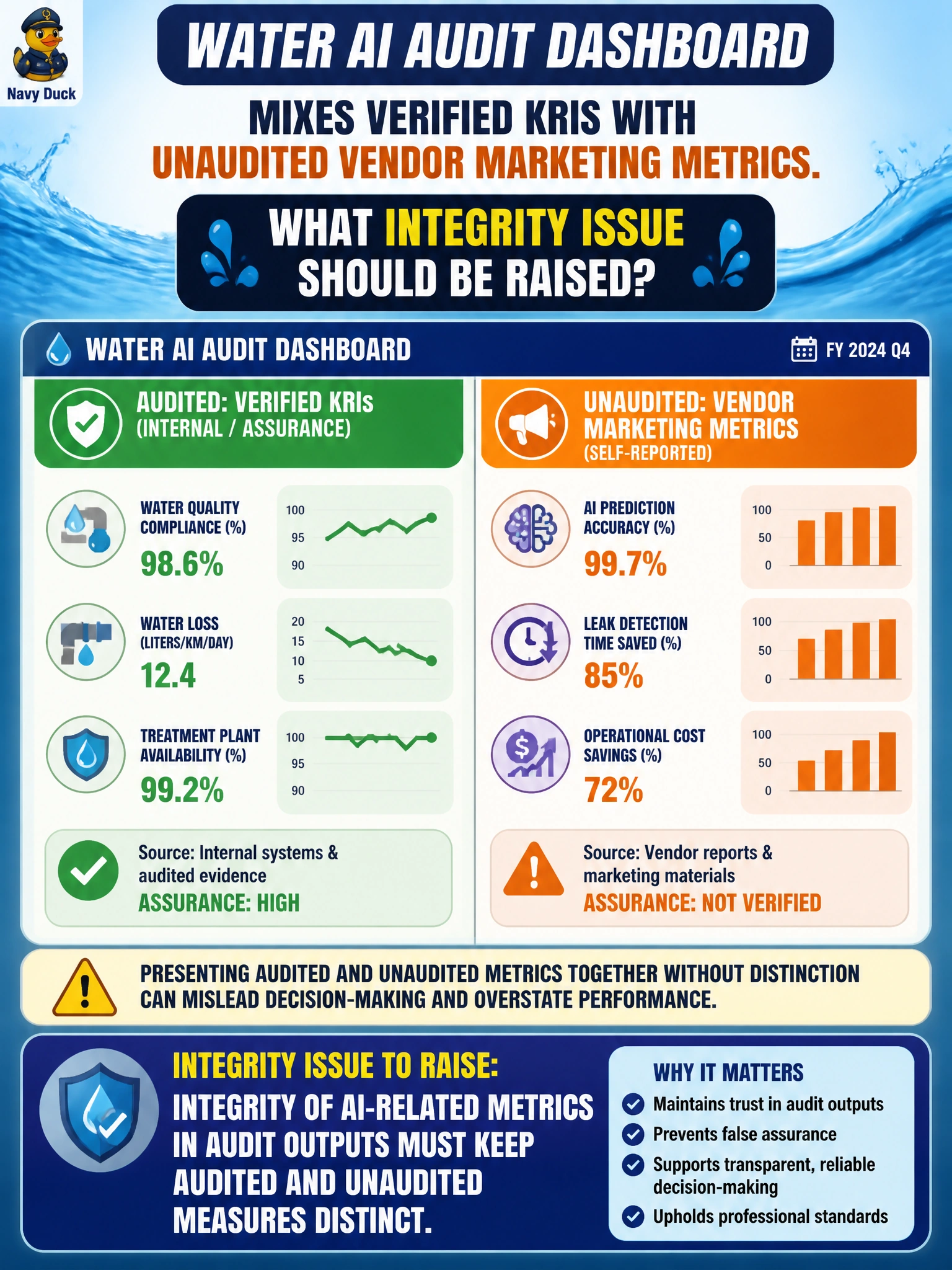
A water AI audit dashboard for executives mixes verified KRIs with unaudited vendor marketing metrics. What integrity issue should be raised?
Select an answer to reveal the explanation.
Short Explanation
Park the vendor hype away from the audited KRIs — mixing them confuses executives. Audit outputs need metric integrity. Blending vendor metrics into one executive score doesn’t make them audited, and you can’t treat marketing figures as verified just because they appear alongside KRIs.
Full Explanation
The integrity issue is that AI-related metrics in audit outputs must keep audited and unaudited measures distinct when a water AI executive dashboard mixes verified KRIs with vendor marketing metrics. Collocation without labeling implies shared assurance and can mislead leadership about what was validated. Metric integrity requires clear source and verification status for civic AI reporting.
Claiming audited KRIs and vendor metrics should be blended into a composite performance score fails by concept: blending audited and unaudited measures into one score obscures verification status and implies shared assurance where none exists. Saying vendor marketing metrics qualify as KRIs once reviewed in an executive dashboard draft fails because governance needs verified operational KRIs, not promotional figures that have merely been seen by leadership. Asserting promotional charts provide sufficient context for interpreting audited KRIs for executive decisions fails because promotional context is not audit evidence, and separation with clear labeling is what preserves meaning and prevents false assurance.
Exam caveat: even verified KRIs need period and definition footnotes; unlabeled “accuracy” tiles can still confuse if definitions drift between vendors and the city. Operational check: segregate or clearly badge unaudited vendor metrics, document verification status for each water AI KRI, and brief executives that only marked measures carry audit reliance.