
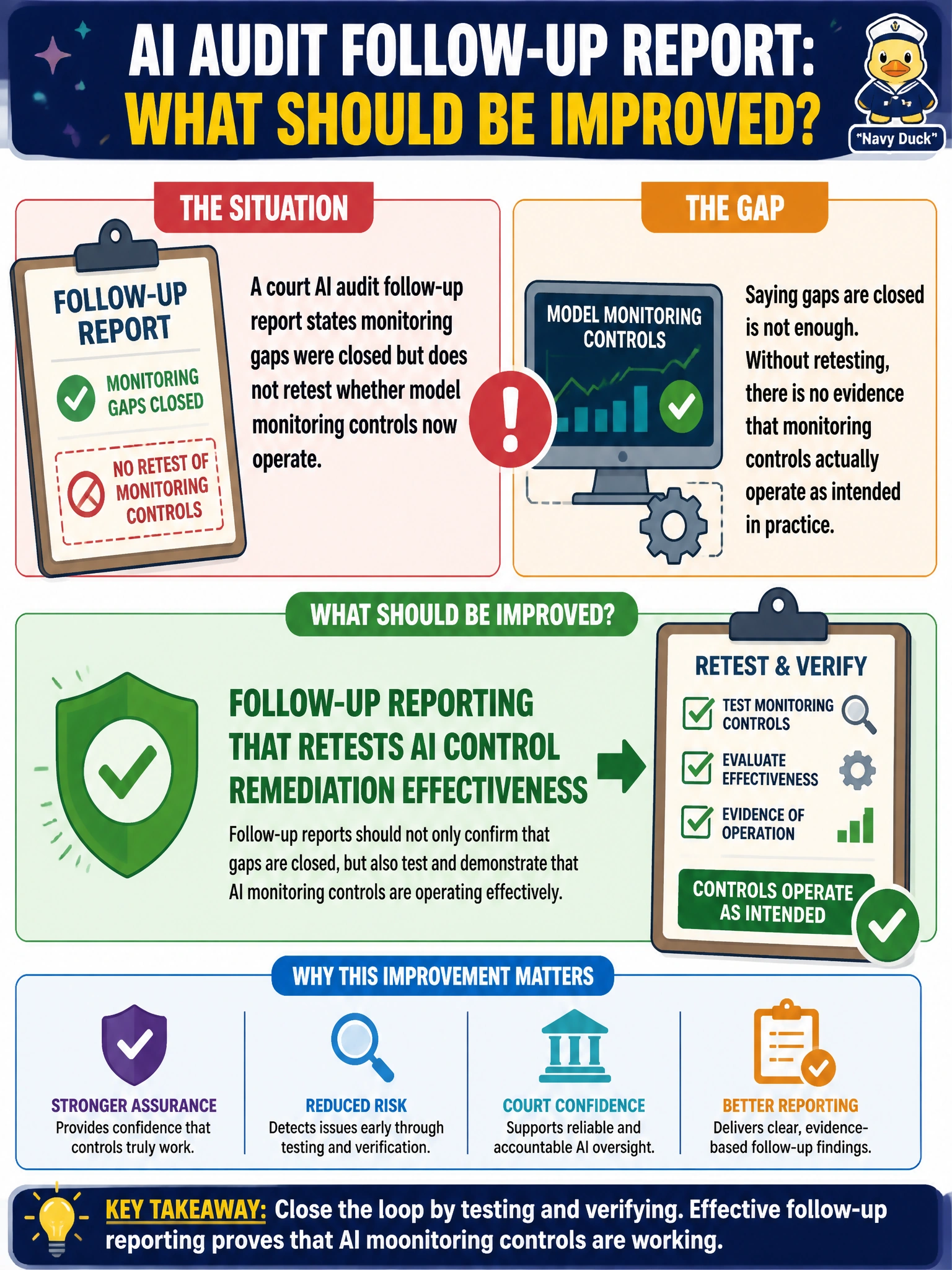
A court AI audit follow-up report states monitoring gaps were closed but does not retest whether model monitoring controls now operate. What should be improved?
Select an answer to reveal the explanation.
Short Explanation
Closed on paper is not closed in production — retest the monitoring. Follow-up without a fresh look is just hopeful filing. Court AI fixes deserve proof they stick.
Full Explanation
Follow-up reporting that retests AI control remediation effectiveness should be improved when a court AI report declares monitoring gaps closed without verifying that monitoring controls now operate. Closure claims require evidence of sustained remediation—alerts firing, responses logged, configurations hardened—not merely management statements that work is done. Retesting protects civic court AI oversight from paper-only fixes that look complete in email but fail in production.
Follow-up reporting that confirms remediation owners and due dates fails because assigning owners and deadlines does not verify that monitoring controls actually operate. Follow-up reporting that reviews updated AI monitoring policy documents fails because reviewing policy documents does not test operating effectiveness and leaves residual court AI risk untested. Follow-up reporting that logs management attestations of gap closure fails because attestations are management assertions, not independent evidence that monitoring controls now operate.
Exam caveat: a single successful retest may not prove durability; for volatile models or frequent vendor releases, follow-up may need a short monitoring window or second sample before permanent closure. Operational check: redefine closure criteria to include reperformance of monitoring alerts, configuration review, and sample evidence of response actions; keep court AI findings open until those tests pass and retain retest artifacts in the follow-up file.