
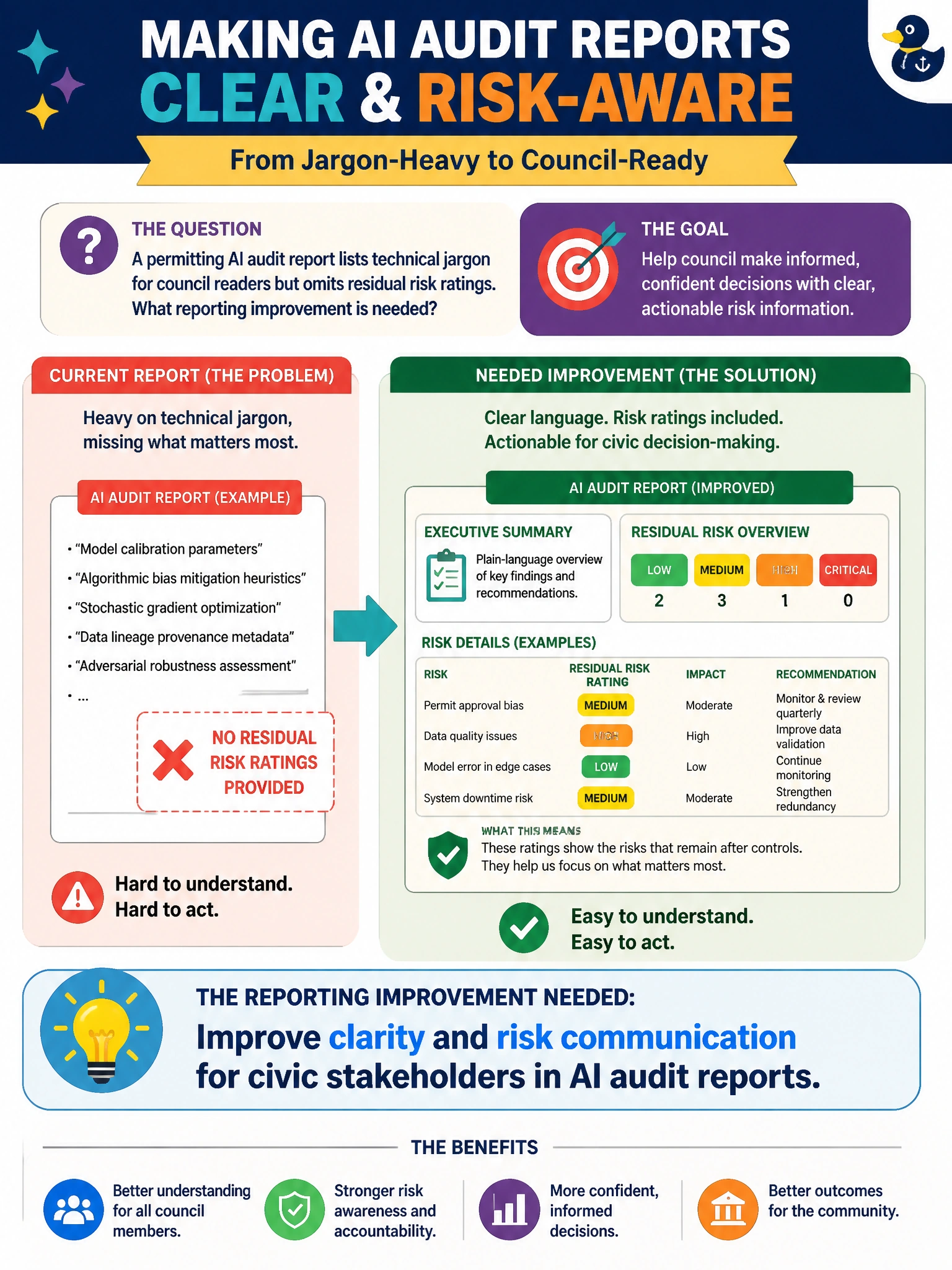
A permitting AI audit report lists technical jargon for council readers but omits residual risk ratings. What reporting improvement is needed?
Select an answer to reveal the explanation.
Short Explanation
Council members need residual risk in plain language, not a jargon pile. Clear ratings beat buzzword bingo. That is how permitting AI findings travel upstairs.
Full Explanation
Improving clarity and risk communication for civic stakeholders is needed when a permitting AI audit report buries council readers in jargon and omits residual risk ratings. Oversight bodies prioritize what risk remains, how severe it is, and what to do next. Technical depth can support specialists, but without accessible residual risk, municipal decision-makers cannot prioritize remediation for permitting AI.
Adding detailed architecture diagrams and hyperparameter logs for council interpretation fails by concept: that burdens civic readers with specialist implementation detail instead of accessible risk guidance. Including raw fairness metrics and confusion matrices for stakeholder review fails because raw technical outputs are not an accessible independent audit communication of risk for civic readers. Summarizing vendor service levels and procurement compliance for civic oversight purposes fails because governance of permitting AI depends on residual risk ratings, not procurement paperwork.
Exam caveat: oversimplification that erases material technical caveats can also mislead; clarity must not become incomplete assurance. Operational check: include plain-language residual risk ratings, owners, and timelines alongside necessary technical appendices, and pilot-read the permitting AI report with a non-technical civic stakeholder before issuance.