
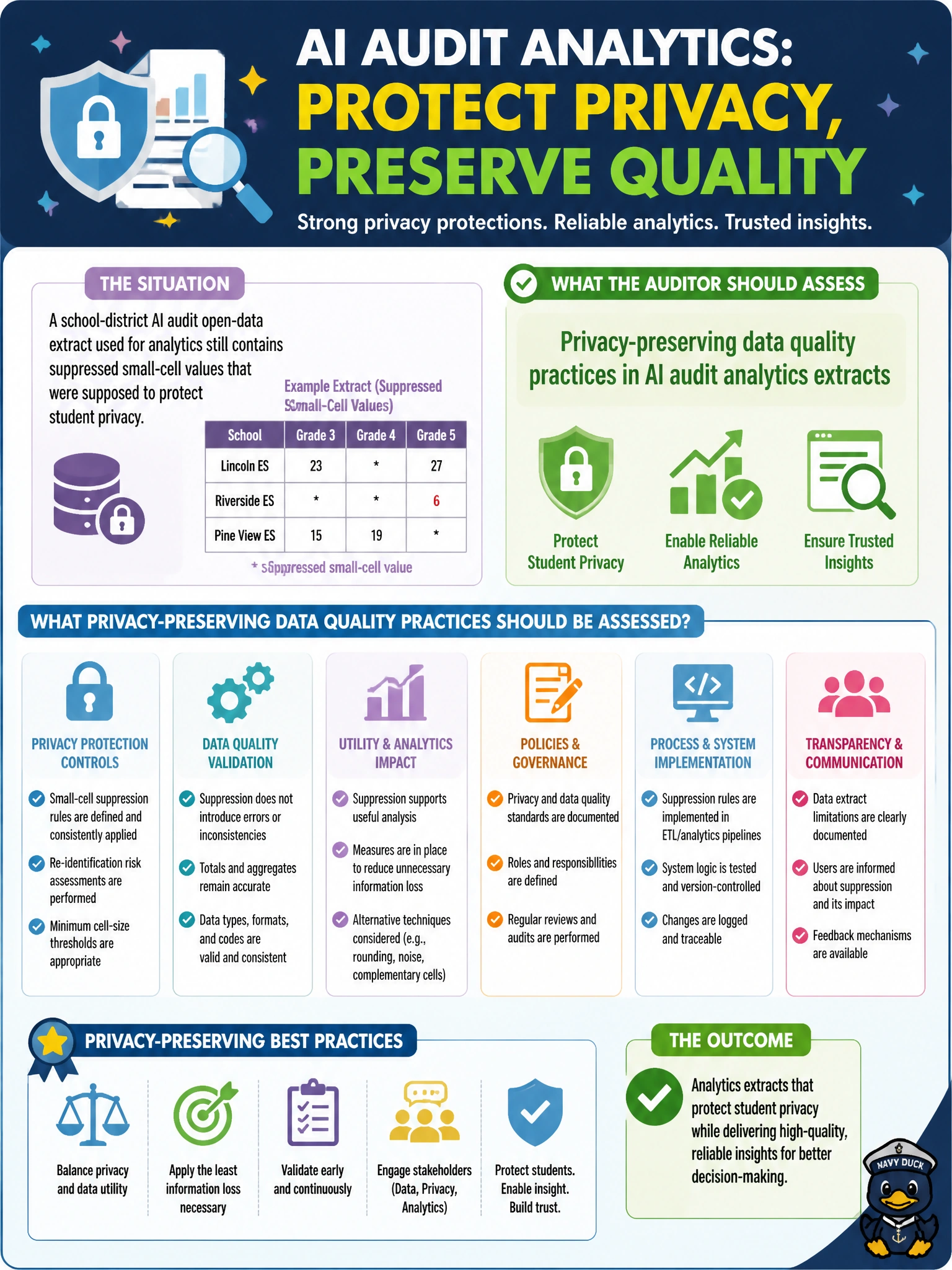
A school-district AI audit open-data extract used for analytics still contains suppressed small-cell values that were supposed to protect student privacy. What should the auditor assess?
Select an answer to reveal the explanation.
Short Explanation
If small cells that should be suppressed are still sitting in the extract, privacy-preserving quality failed. Fix that before leaning on the analytics. Reconciling totals won't fix suppressed small cells or protect student privacy.
Full Explanation
The auditor should assess privacy-preserving data quality practices in AI audit analytics extracts when a school-district open-data file still contains small-cell values that were supposed to be suppressed. Suppression failures mean the extract does not meet privacy rules and may expose students, so quality and privacy controls over analytics inputs are in question. Civic education AI analytics cannot trade student privacy for convenience.
Verifying completeness practices for missing records in audit extracts is a data-availability check, not an assessment of whether the suppression rules meant to protect student privacy actually worked on this extract. Monitoring timeliness of scheduled refreshes in audit extracts fails because tracking when extracts are updated does not address whether small-cell suppression rules were followed to protect student privacy. Reconciling accuracy of aggregate totals across audit extracts fails because matching totals does not address whether suppressed small cells were properly protected or whether privacy obligations were met.
Exam caveat: re-suppression after the fact may not undo prior exposure if the extract was already shared; incident response may be required. Operational check: quarantine the extract, verify suppression rules against policy, remediate the pipeline, assess disclosure scope, and only resume school-district AI audit analytics on a privacy-cleared dataset.