
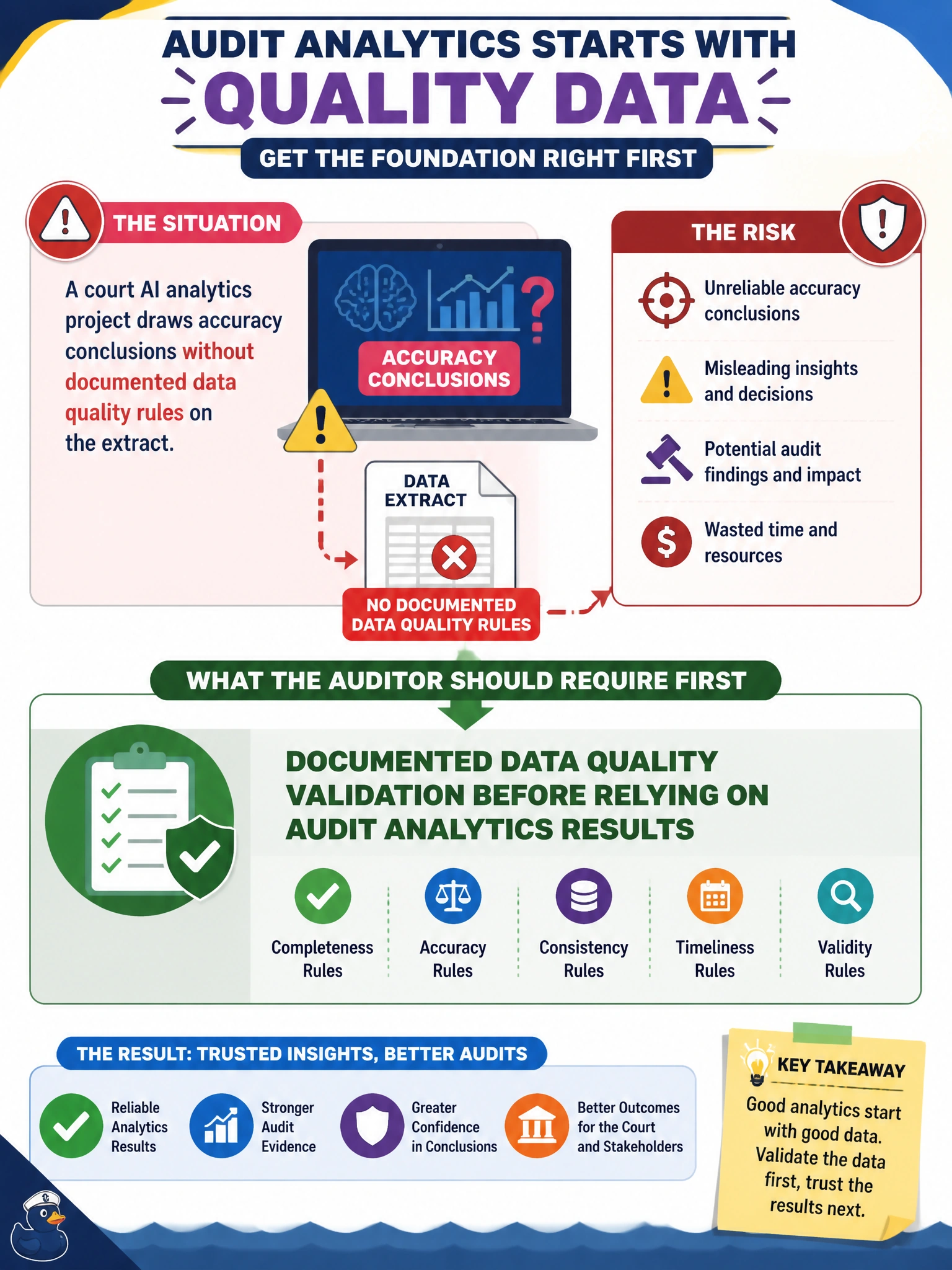
A court AI analytics project draws accuracy conclusions without documented data quality rules on the extract. What should the auditor require first?
Select an answer to reveal the explanation.
Short Explanation
Do not trust the accuracy chart until the extract's quality rules are written and checked. Garbage in, confident nonsense out. Courts deserve validated analytics before big claims.
Full Explanation
Documented data quality validation must come first before a court AI analytics project draws accuracy conclusions from an extract. If completeness, accuracy, timeliness, and transformation rules are undefined or untested, reported accuracy may reflect extract defects rather than model performance. Auditors require a validated data foundation before relying on analytics results for civic court AI judgments.
Independent reperformance of accuracy calculations on the current extract fails by concept: recomputing figures from an extract whose quality rules are undocumented or untested cannot confirm that the underlying data is sound, so it cannot precede validation. Expanded case file sampling to corroborate the reported accuracy conclusions fails because sampling cannot substitute for documented data quality rules on the extract; if the extract is defective, corroborating conclusions built on defective data only compounds the error. Retention of the current data extract with restricted access for audit testing fails because merely preserving and locking down the extract does not create or execute the documented data quality validation that must occur before accuracy conclusions can be trusted.
Exam caveat: documentation alone is insufficient—rules must be executed and exceptions cleared; a dusty DQ policy next to a dirty extract does not validate results. Operational check: approve data quality rules for the court AI extract, run profiling and reconciliation tests, clear material exceptions, then compute accuracy metrics and retain DQ evidence with the analytics workpapers.