
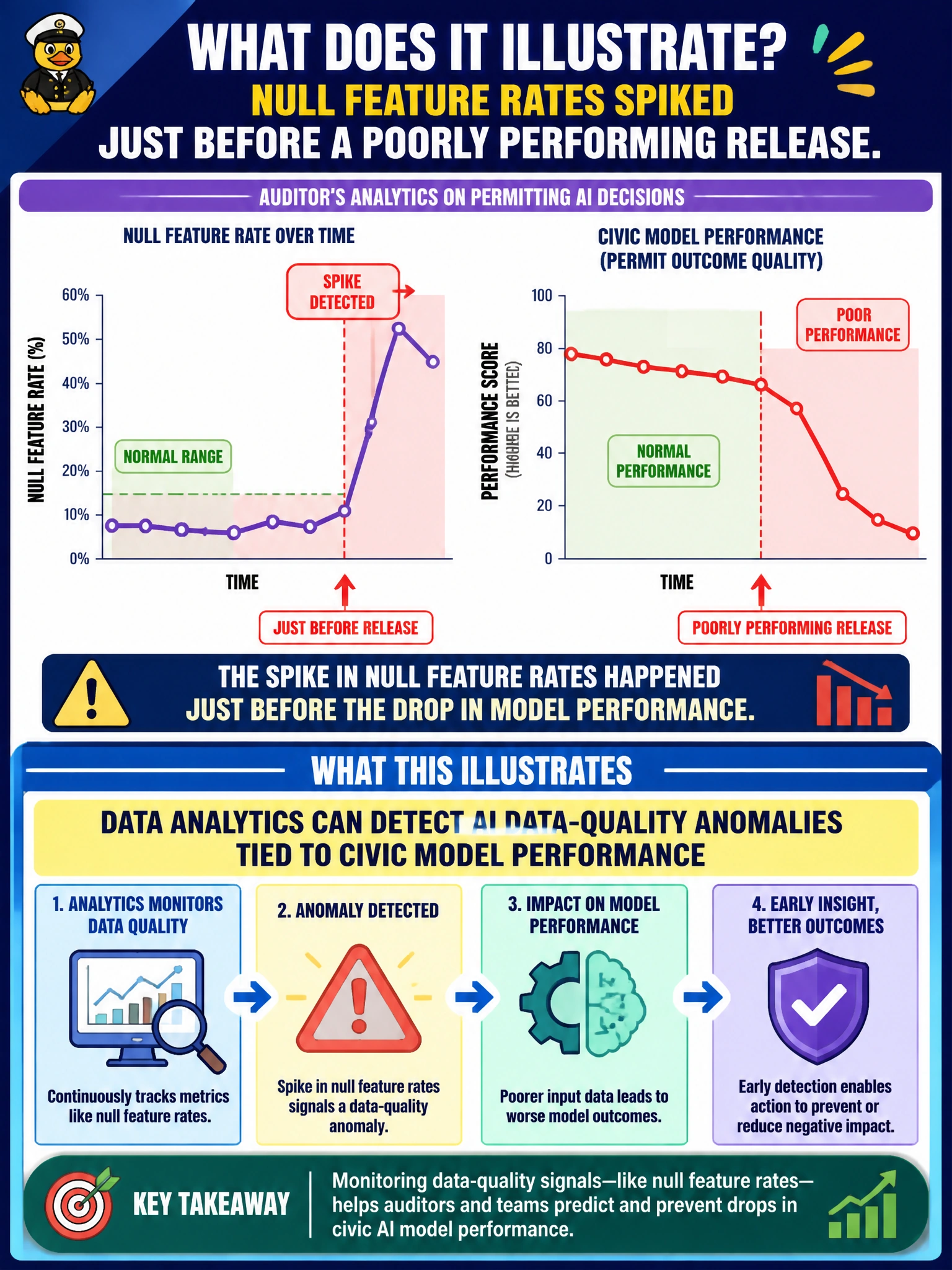
An auditor's analytics on permitting AI decisions shows null feature rates spiked just before a poorly performing release. What does this illustrate?
Select an answer to reveal the explanation.
Short Explanation
When nulls shoot up and the model goes sideways, analytics just waved a red flag. That data-quality signal belongs in the permitting AI audit story. Feature importance rankings won't catch that missing-data problem.
Full Explanation
The null-feature spike preceding a poor permitting AI release illustrates that data analytics can detect AI data-quality anomalies tied to civic model performance. Rising missingness in decision features is an early warning that input integrity degraded and may explain accuracy or fairness drops after promotion. Auditors who trend completeness metrics alongside release markers gain an objective signal for deeper testing of data pipelines and model change controls.
Citing audit logging's preservation of permit decision histories fails by concept: that capability supports reproducibility reviews, not the detection of null-feature data-quality anomalies tied to civic model performance. Invoking feature importance rankings fails because summarizing input contributions to explain permit outcomes does not address feature completeness as a core data-quality dimension for AI assurance. Pointing to load testing fails because measuring inference latency under peak demand validates deployment readiness, but null spikes indicate a data-quality problem to investigate, not a successful release.
Exam caveat: correlation between null spikes and poor performance is not automatic proof of causation; schema changes or logging bugs can inflate nulls without the same risk story. Operational check: join null-rate time series to release calendars, validate whether fields truly went missing in production permitting feeds, and test whether change management caught the data-quality defect before or after go-live.