
A municipal auditor uses an AI assistant to draft findings on a permitting AI system and must support the workpapers. What evidence discipline is required?
Select an answer to reveal the explanation.
Short Explanation
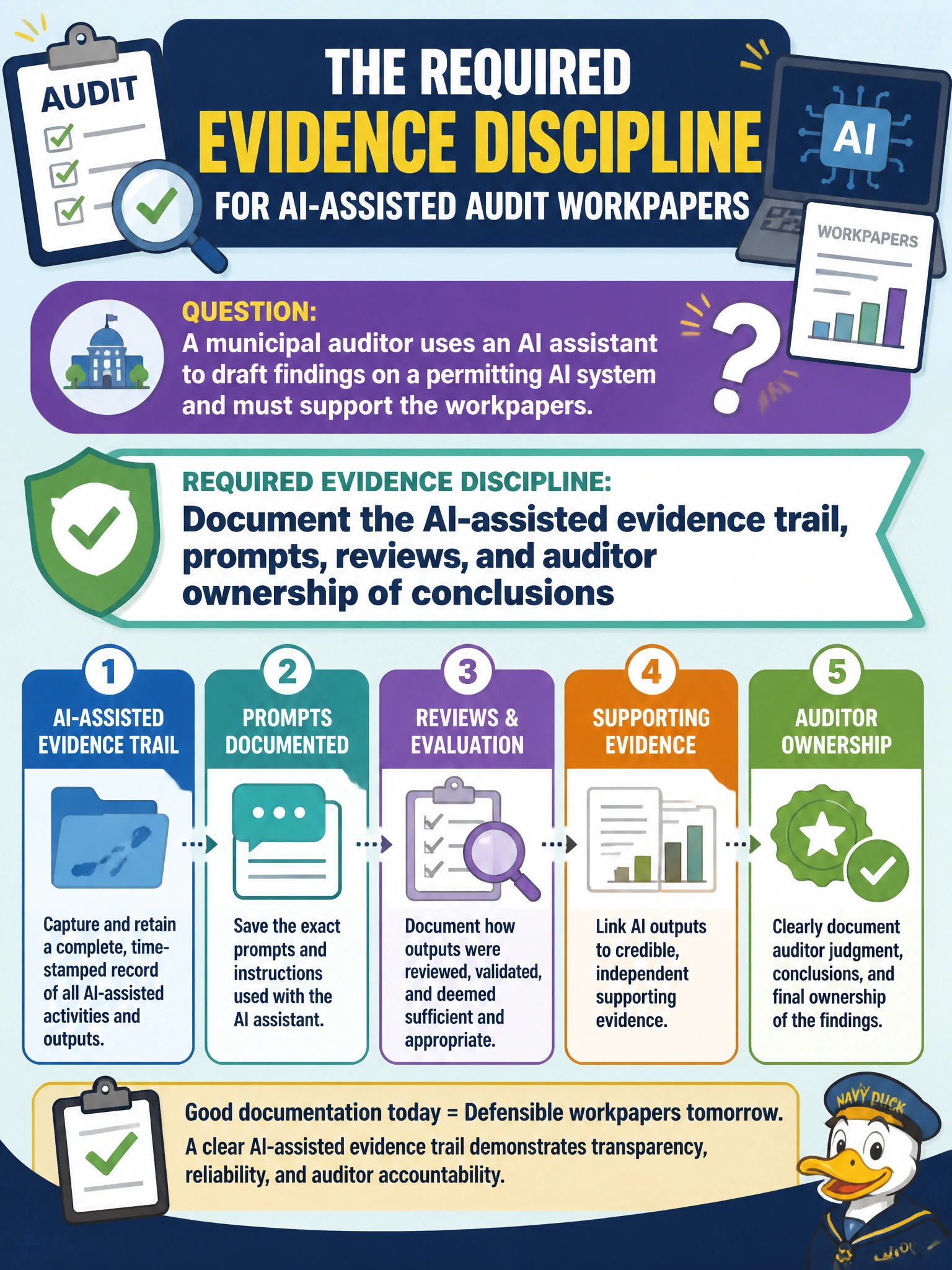
If AI helped draft the finding, leave a trail — prompts, sources, and who signed off. Just logging the model version and saving final outputs isn't enough by itself. The auditor still owns the conclusion.
Full Explanation
Documenting the AI-assisted evidence trail—prompts, sources, reviews, and auditor ownership—is required when a municipal auditor uses an AI assistant to draft findings on a permitting system. Workpapers must show how draft language was produced, what was relied upon, who challenged it, and that a human auditor owns the final conclusion. That discipline preserves skepticism, reviewability, and accountability for civic AI audit outputs.
Merely logging the model version and saving final outputs with workpapers for traceability fails because it provides only partial traceability and omits the required documentation of prompts, reviewer challenges, and auditor ownership of conclusions. Attaching vendor documentation and system logs as primary support for drafted findings fails because vendor materials and logs cannot substitute for the auditor's independent evaluation, review, and ownership of the final conclusions. Summarizing AI assistance in the methodology section with supporting statements about tool performance fails because a narrative summary is not a substitute for retaining the actual prompt records, sources, reviewer notes, and sign-off in the workpapers.
Exam caveat: documentation of AI assistance is not a substitute for sufficient underlying evidence about the permitting system itself; a well-logged weak test is still a weak test. Operational check: retain prompt/input records, cited sources, reviewer notes, and sign-off that the auditor evaluated and adopted the final wording before issuing permitting AI findings.