
A school tutoring AI steers students toward paid products with no monitoring of recommendation impacts. What should the auditor recommend?
Select an answer to reveal the explanation.
Short Explanation
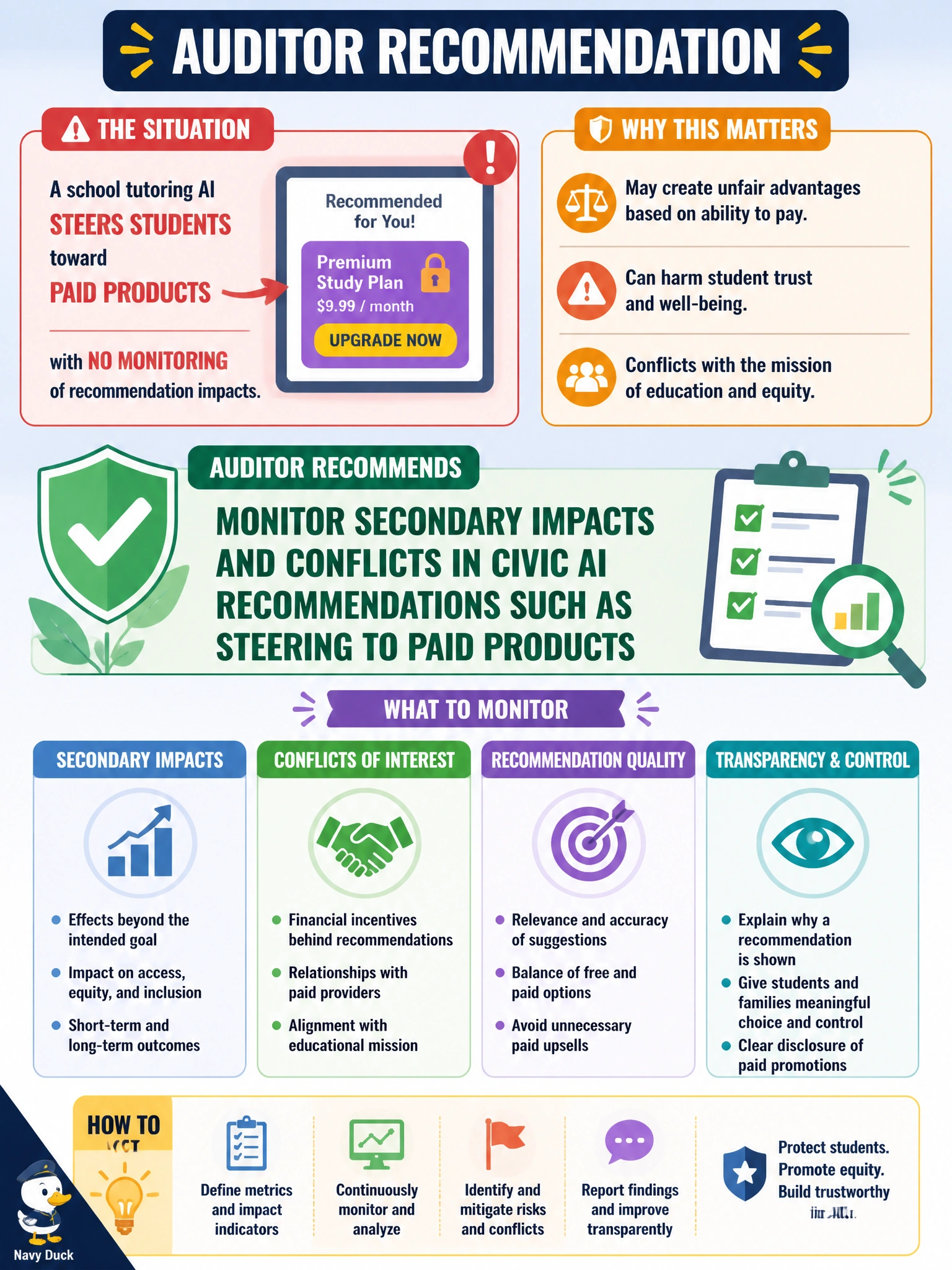
If the tutoring bot keeps nudging kids toward paid stuff, that is a conflict wearing a smile. Watch secondary recommendation impacts. Accuracy alone does not excuse the hard sell.
Full Explanation
A school tutoring AI that steers students toward paid products creates secondary impacts and potential conflicts of interest beyond tutoring accuracy. Civic AI recommendations to minors in educational settings require monitoring of those side effects—commercial steering, equity of access to paid options, and vendor influence—so the district does not outsource soft advertising into learning support. The auditor should recommend monitoring secondary impacts and conflicts in such recommendations.
Monitoring student engagement alongside accuracy still measures the wrong side effect; it does not surface the commercial conflict of interest when the tutoring AI steers students toward paid products. Monitoring tutoring response accuracy and curriculum coverage using standardized classroom benchmark evaluations misses the point, because it checks instructional quality while ignoring the vendor conflict and paid-product steering. Evaluating student satisfaction scores and session completion rates to guide ongoing tutoring interface design improvements looks at interface experience but overlooks the commercial steering and conflict of interest entirely.
Exam caveat: supervision of outputs includes secondary and conflict impacts, especially for vulnerable populations such as students. Operational check: sample tutoring recommendation transcripts for paid-product steering, map any affiliate/vendor relationships, and verify monitoring metrics and policy limits before continued district-wide use.