
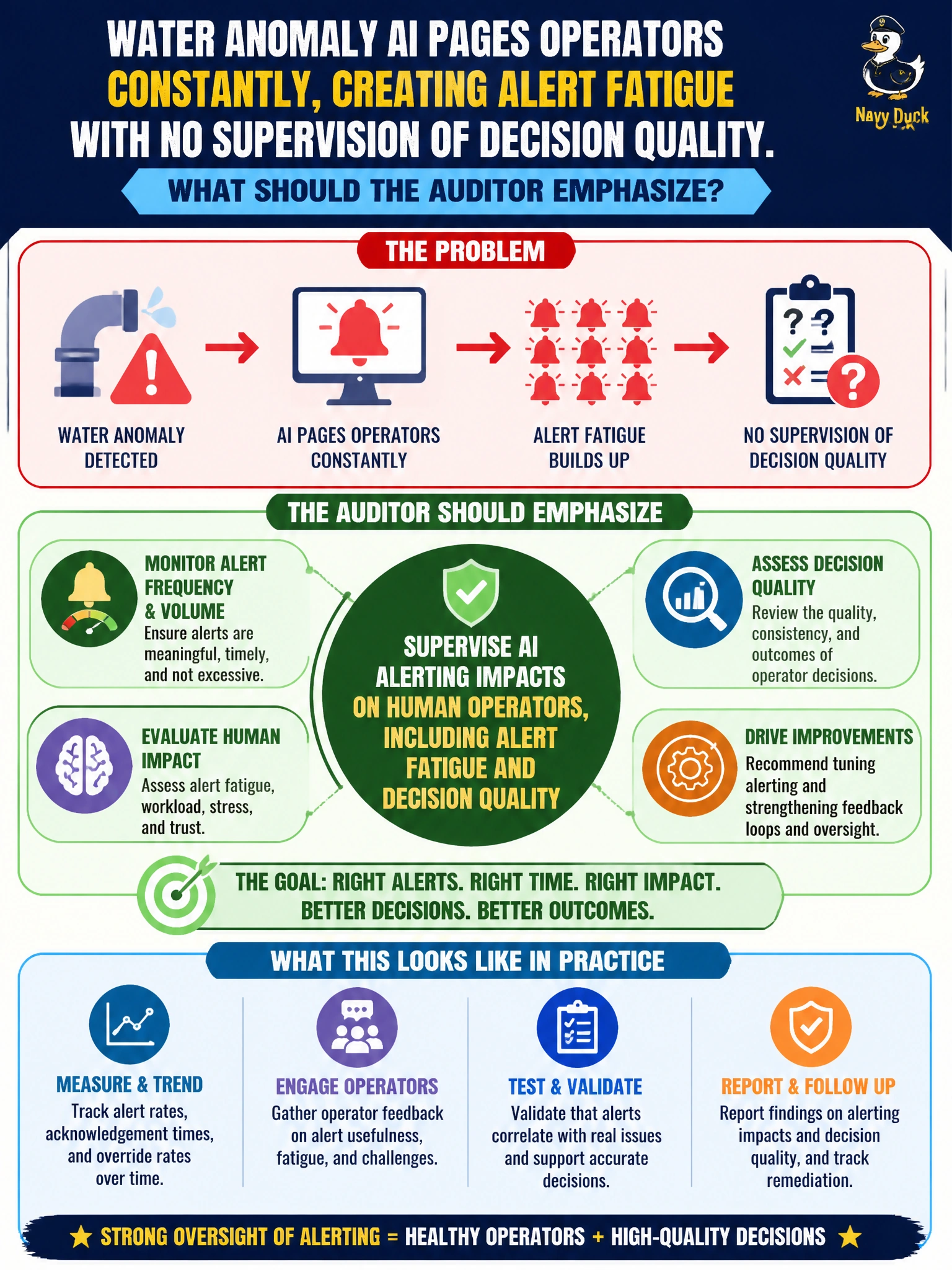
A water anomaly AI pages operators constantly, creating alert fatigue with no supervision of decision quality. What should the auditor emphasize?
Select an answer to reveal the explanation.
Short Explanation
A pager that never sleeps trains people to ignore it — that is how real water problems sneak by. Supervise alert fatigue and decision quality, not just volume. More pages are not more safety.
Full Explanation
A water anomaly AI that pages operators constantly can induce alert fatigue, slowing or dulling response to real plant risks. Supervision of AI solutions must include impacts on human operators and decision quality—not only whether the model fires. The auditor should emphasize supervising alerting impacts: precision/recall of pages, quiet hours and escalation design, override/ignore rates, and whether operators make sound decisions under the alert load.
Increasing page volume so operators "never miss" a signal fails because more noise reduces sensitivity to true positives—classic alert-fatigue dynamics. Disabling all anomaly alerts to eliminate fatigue fails by removing a safety-relevant detection layer regardless of plant risk. Measuring only acknowledgment speed fails because fast acks can be reflexive dismissals; usefulness and decision quality are the supervision targets.
Exam caveat: AAIA supervision covers human–AI interaction effects such as fatigue, automation bias, and decision quality—not raw alert counts alone. Operational check: review paging rates, false-positive trends, operator feedback, and decision outcomes; tune thresholds and escalation with documented ownership rather than maximizing pages or silencing everything.