
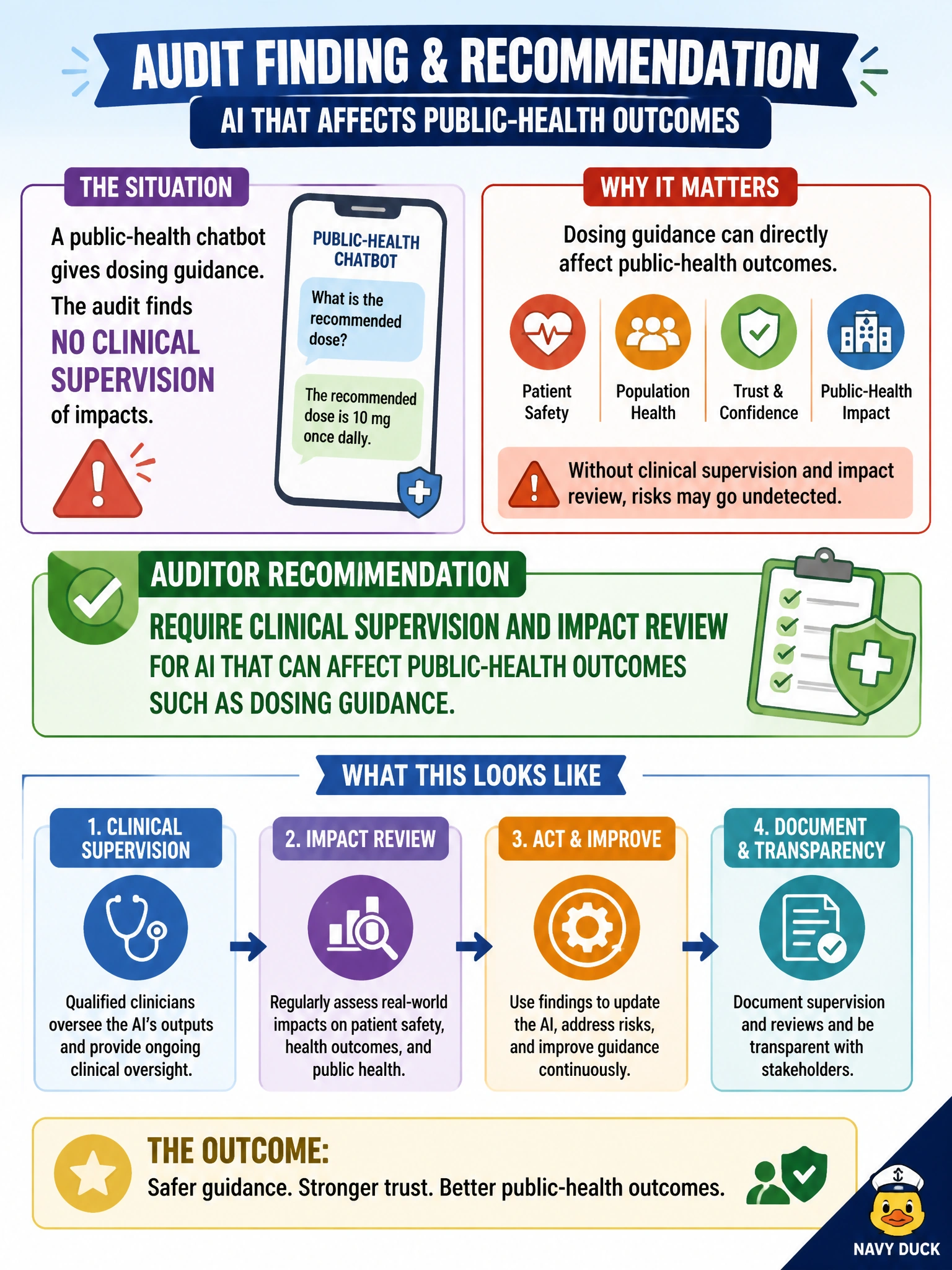
A public-health chatbot gives dosing guidance, and the audit finds no clinical supervision of impacts. What should the auditor recommend?
Select an answer to reveal the explanation.
Short Explanation
A bot that talks dosing is playing in the health sandbox — clinical eyes must watch the impacts. You might extend the customer experience review to cover dosing guidance, but that's just a service-quality check—not clinical oversight—and publishing aggregate usage stats for transparency doesn't supervise impacts either. A separate review queue alone does not equal ongoing clinical oversight.
Full Explanation
A public-health chatbot that provides dosing guidance can influence resident health behavior. Where civic AI advice can affect health outcomes, supervision must include clinical review of impacts and outputs, not merely IT availability. The auditor should recommend clinical supervision and structured impact review for such GenAI—clinical ownership of content boundaries, review of sample dialogues, adverse-event pathways, and clear escalation when the bot should refuse or defer.
Routing dosing questions to a separate clinical review queue addresses intake triage but does not by itself establish ongoing clinical supervision or impact review of what the chatbot actually tells residents, so systemic errors in dosing guidance can still go unexamined. Extending routine conversation quality sampling to include dosing guidance in the existing customer experience review is insufficient—CX review checks conversation quality, not the clinical safety of dosing advice, and it doesn't constitute impact review. Publishing aggregate chatbot usage statistics for transparency reporting on public-health outreach doesn't provide supervision—it reveals how many people use the bot, not whether the dosing advice is safe, and it doesn't fulfill the city's duty of care.
Exam caveat: high-impact civic domains (health, safety, justice, eligibility) require domain-expert supervision beyond generic AI monitoring. Operational check: identify a named clinical supervisor, evidence of periodic output/impact review for dosing-related intents, and documented refusal/deferral rules—extending conversation quality sampling to include dosing guidance in the existing customer experience review does not close the finding.