
A transit delay predictor drifts; ops dashboards show accuracy but not decision impact on riders. What should the auditor emphasize?
Select an answer to reveal the explanation.
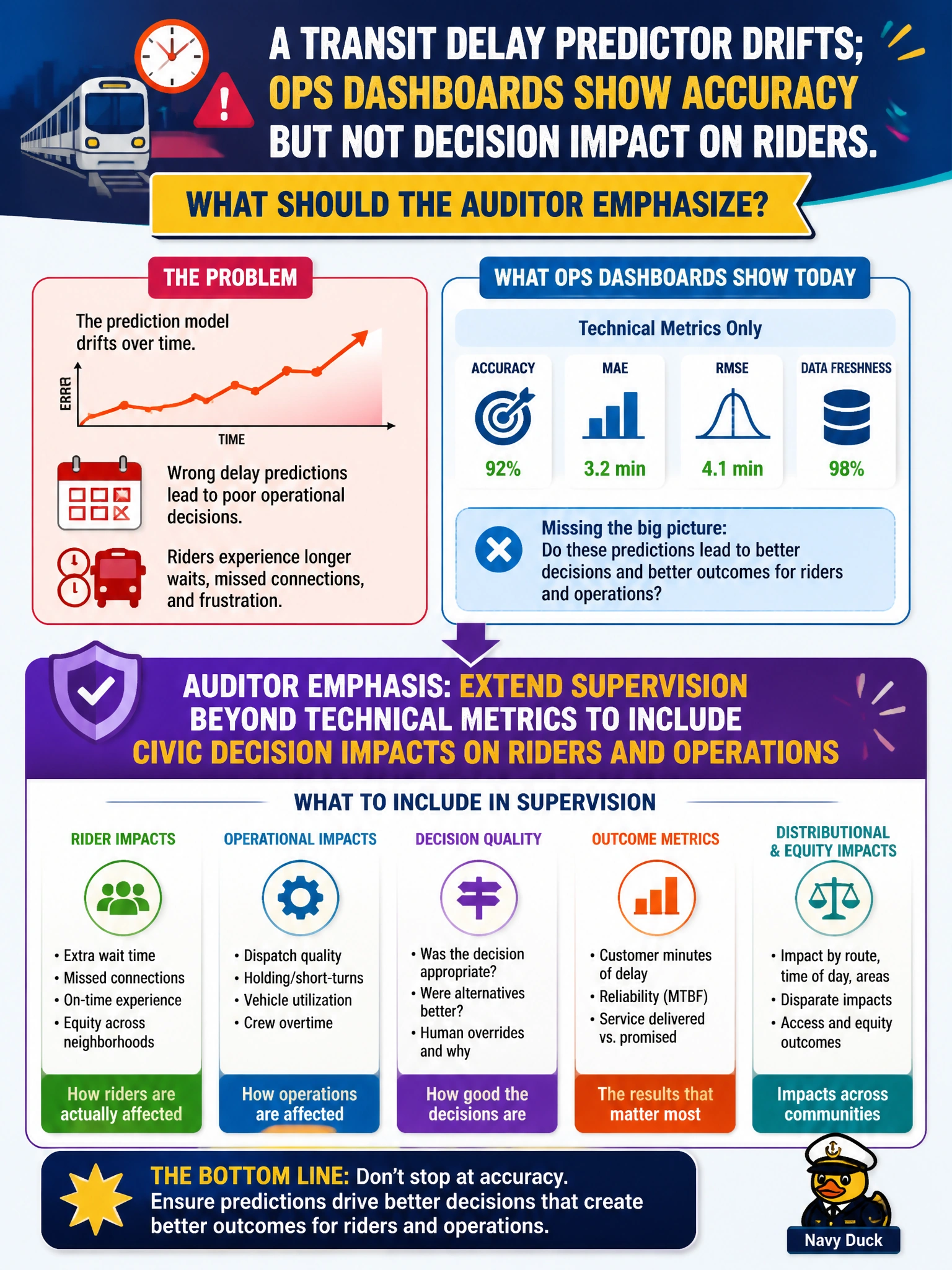
Short Explanation
Accuracy on a dashboard is nice; whether riders get stranded is the real scoreboard. Supervise decision impacts, not just model math. Drift without impact view is half-blind ops.
Full Explanation
A transit delay predictor that drifts can change how dispatchers allocate vehicles and how riders plan trips. Dashboards that show accuracy without decision impact leave operations half-blind: the model may look "fine" statistically while still harming riders through late buses, missed connections, or biased corridor predictions. The auditor should emphasize extending supervision beyond technical metrics to civic decision impacts on riders and operations—service reliability, equity of delay messaging, and dispatcher override patterns.
Monitoring accuracy alongside dispatch efficiency still frames the problem in internal operational terms and leaves out whether riders themselves experience late buses, missed connections, or biased corridor predictions. Tightening drift thresholds by recalibrating accuracy alerts for delay predictions across daily operations only tunes statistical sensitivity; it still leaves the auditor blind to whether riders actually suffer late buses, missed connections, or biased corridor predictions. Improving dashboard precision by adding latency and error breakdowns for dispatch models still treats the problem as a technical display issue; it does not establish whether dispatch changes harm riders or create inequitable corridor outcomes.
Exam caveat: AAIA supervision language explicitly spans outputs, impacts, and decisions—not accuracy alone. Operational check: map predictor outputs to dispatch and rider-facing decisions, then verify impact KPIs and drift-to-action playbooks exist alongside accuracy charts.