
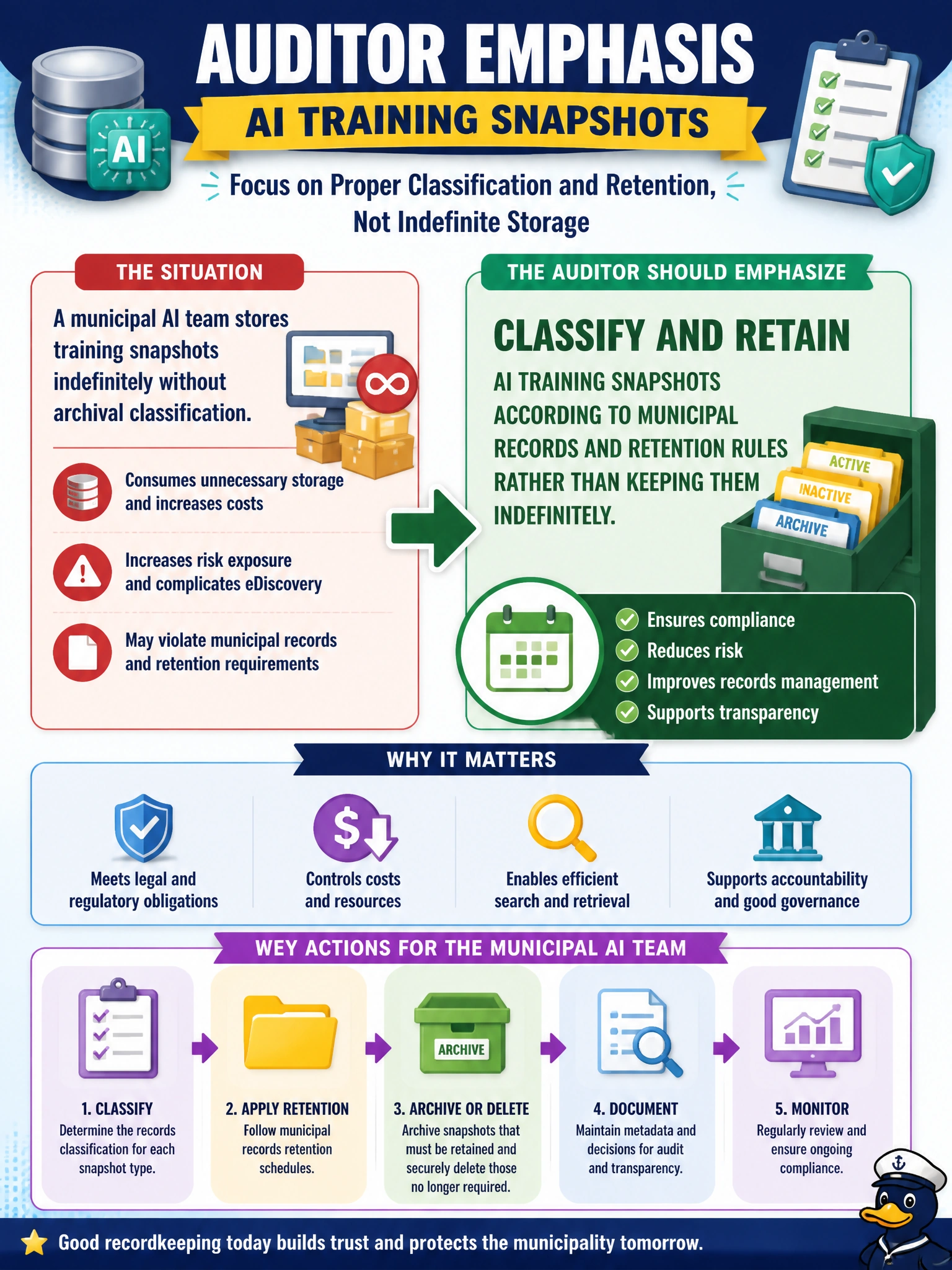
A municipal AI team stores training snapshots indefinitely without archival classification. What should the auditor emphasize?
Select an answer to reveal the explanation.
Short Explanation
Training snapshots are records in digital work boots — not files to keep just because cloud storage has room. Classify them and keep only what retention rules allow. Letting developers set retention by project timeline is a records and risk mess.
Full Explanation
Classifying and retaining AI training snapshots according to municipal records and retention rules, rather than keeping them indefinitely, works because training artifacts are civic records with privacy, security, and disposition obligations. Snapshots may contain resident data, sensitive operational features, or proprietary transforms. Indefinite unclassified retention expands breach surface, complicates discovery, and drifts from records schedules that already govern comparable electronic records. Mapping snapshots to classification labels, retention periods, lawful bases, and approved repositories aligns AI archaeology with municipal records discipline instead of ad-hoc hoarding.
Retaining training snapshots based on cloud storage capacity and engineering preference for reproducibility reviews fails because infrastructure limits and engineering convenience are not lawful retention bases and can leave snapshots unclassified and undisposed under municipal records rules.
Applying standard database backup rotation to training snapshots and relying on commit history for archival context fails because backup rotation and commit history do not substitute for records classification and retention schedules, and technical version tracking omits the custodial and disposition controls required for civic records.
Allowing model developers to set snapshot retention based on project timelines and revisit classification during future platform upgrades fails because deferring classification to individual project preferences leaves civic records unmanaged and outside approved municipal records schedules.
Exam caveat: retention schedules may differ for anonymized feature stores versus raw identifiable extracts—misclassification can still create compliance gaps even when a schedule exists on paper. Operational check: inventory training snapshot locations, assign records series and retention codes, migrate copies into approved repositories, and schedule disposition jobs with dual control before any “keep forever” practice continues.