
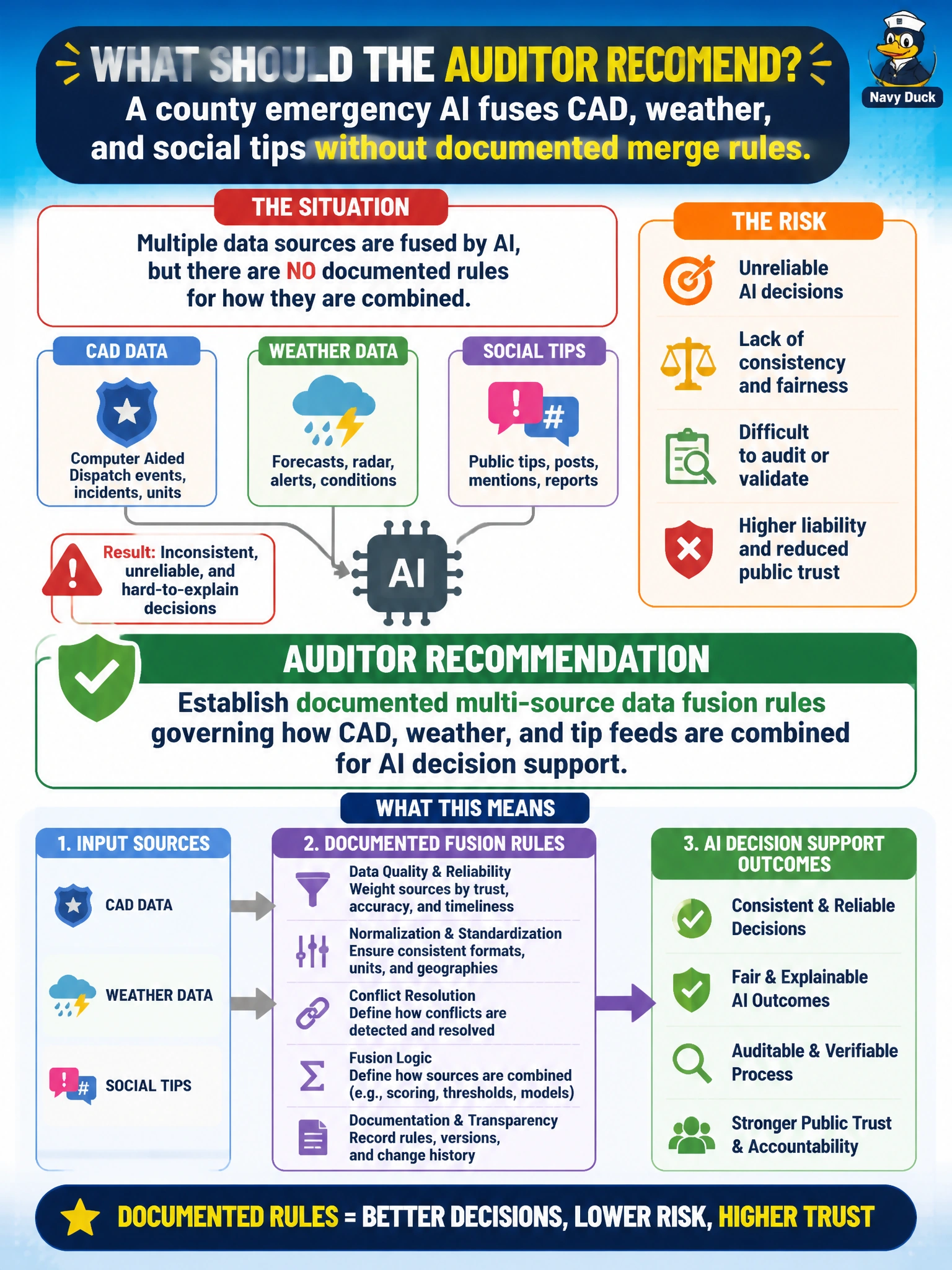
A county emergency AI fuses CAD, weather, and social tips without documented merge rules. What should the auditor recommend?
Select an answer to reveal the explanation.
Short Explanation
Mixing CAD, weather, and social tips without a recipe is a blender with no lid. Write down how sources combine, who wins conflicts, and what gets dropped. Emergency AI needs fusion rules before the next storm.
Full Explanation
Establishing documented multi-source data fusion rules for how CAD, weather, and tip feeds combine in county emergency AI works because fusion without governance produces opaque, unstable decision support under stress. Precedence, conflict handling, freshness windows, and quality filters must be explicit: CAD incidents, weather watches, and social tips differ in reliability, latency, and legal standing. Documented merge logic lets operators and auditors explain why a recommendation was issued, supports testing under conflicting inputs, and prevents silent preference for the noisiest feed. The correct recommendation is governed fusion before production reliance, not improvisation during incidents.
Implementing automated source weighting based on feed update frequency to prioritize the fastest data stream for AI outputs fails because speed alone does not guarantee reliability, and an unweighted fastest feed can inject noise into decision support without governance. Standardizing CAD, weather, and tip feeds to a common timestamp and geocode schema to ensure consistent preprocessing for AI ingestion fails because schema alignment alone does not govern how sources are weighted or reconciled when they conflict. Deploying separate AI models for CAD, weather, and social tips to maintain source independence in decision support outputs fails because independence without a documented fusion strategy leaves the AI without a unified decision support layer, defeating the purpose of multi-source integration.
Exam caveat: rigid fusion rules that never allow human override can also harm outcomes; documented governance should include escalation paths when sources conflict in novel ways. Operational check: publish a fusion matrix (source precedence, conflict resolution, drop criteria), test synthetic disagreement scenarios in a non-production environment, and require on-call acknowledgment that live recommendations cite which rule path produced them.