
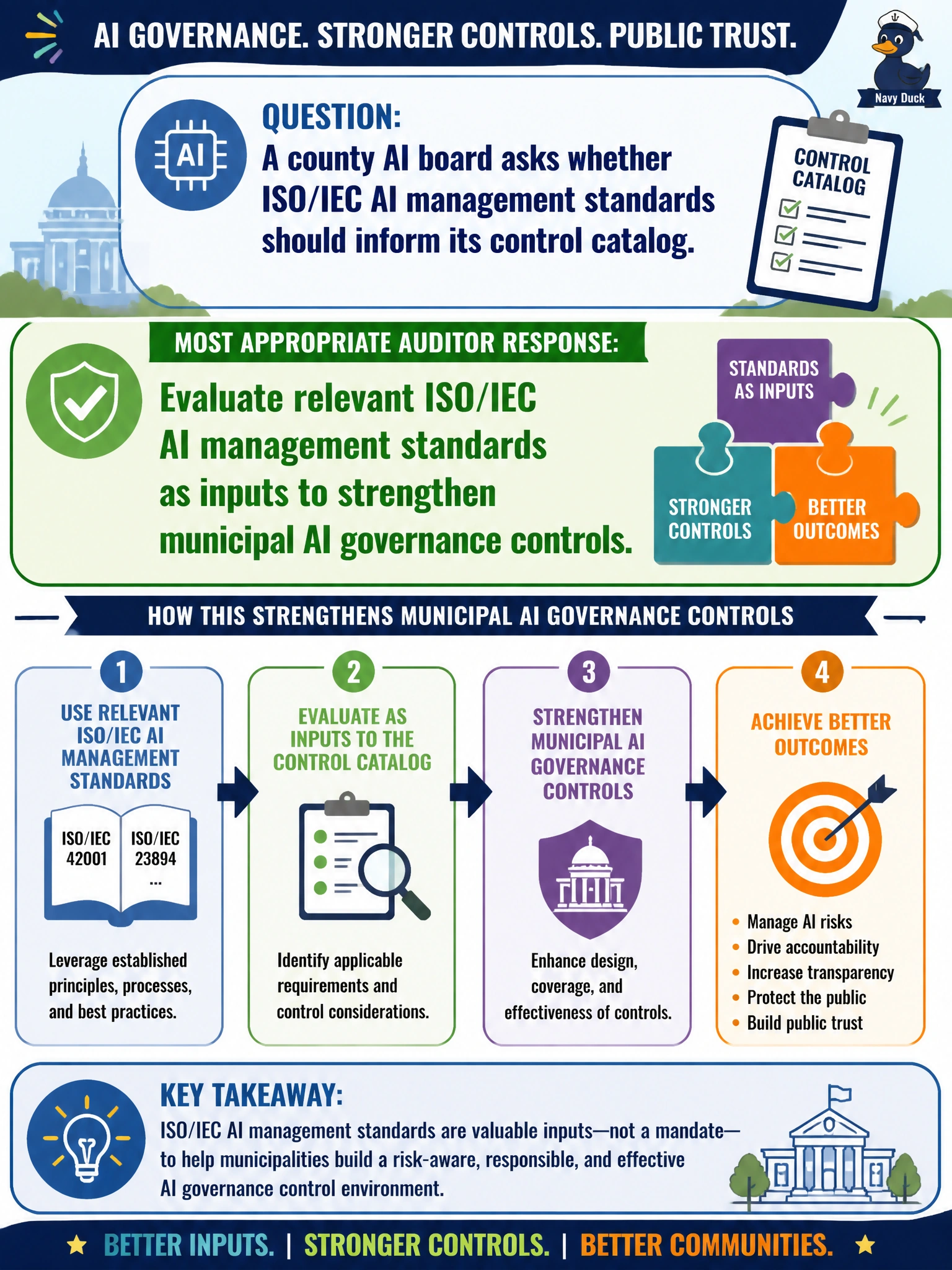
A county AI board asks whether ISO/IEC AI management standards should inform its control catalog. What is the most appropriate auditor response?
Select an answer to reveal the explanation.
Short Explanation
International AI management standards are toolkits, not trophies. Use the relevant pieces to beef up the county control catalog where they fit. Treating a certificate as proof, swapping guidance for your own risk review, or citing standards in procurement as monitoring all misses the point.
Full Explanation
A county AI board asking whether ISO/IEC AI management standards should inform its control catalog should hear that relevant standards can strengthen municipal AI governance when evaluated and adapted thoughtfully. The most appropriate auditor response is to evaluate relevant ISO/IEC AI management standards as inputs to strengthen municipal AI governance controls: select clauses that map to county risks, legal context, and existing control catalogs without treating ISO as an automatic replacement for local law. Treating ISO/IEC 42001 certification as sufficient assurance for county AI control effectiveness fails by concept: a certificate does not prove that controls are operating effectively in the county's environment, and the board still needs evidence of implementation and ongoing performance. Using ISO/IEC AI management guidance to replace county-specific risk assessment for AI systems fails by concept: guidance cannot substitute for the county's own risk identification and evaluation, and skipping that step leaves controls unmatched to local AI risks and legal obligations. Referencing ISO/IEC AI standards in county procurement language as evidence of continuous control monitoring activities fails by concept: procurement language is not monitoring evidence, and citing a standard does not show that controls are actually operating or being continuously evaluated. Exam caveat: AAIA standards questions treat ISO/IEC AI management standards as evaluated inputs to municipal controls—not certifications treated as proof of effectiveness, substitutes for local risk assessment, or procurement-language shortcuts for monitoring. Operational check: review applicable ISO/IEC AI management clauses, map useful controls into the county catalog with owners, note where local law prevails, and document the board's risk-aligned adoption decisions.