
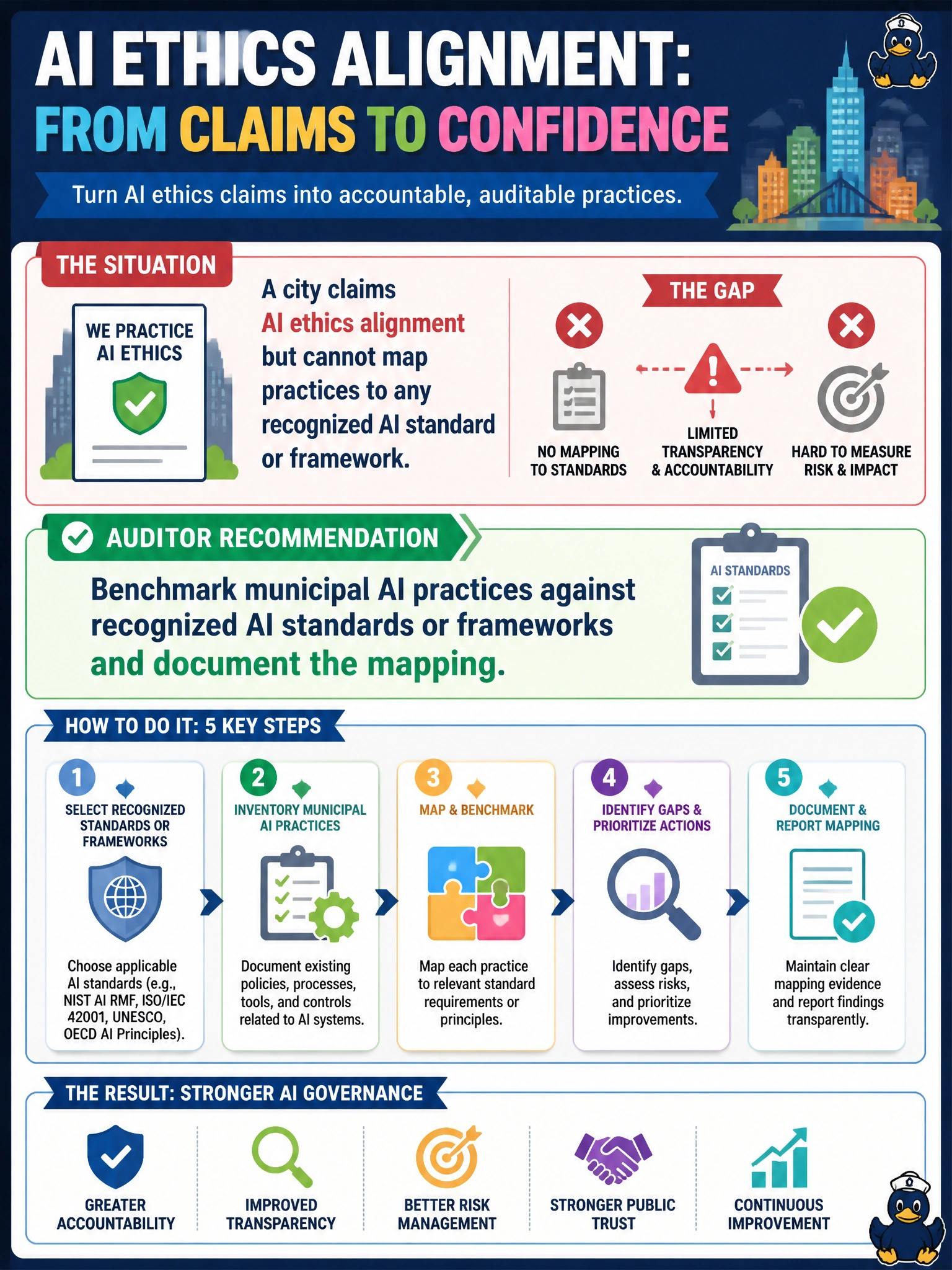
A city claims AI ethics alignment but cannot map practices to any recognized AI standard or framework. What should the auditor recommend?
Select an answer to reveal the explanation.
Short Explanation
Mapping to internal IT milestones is like tracking homework instead of sitting the exam—it doesn't prove you met the standard. Pick a recognized AI standard or framework and show how city practices line up. Auditors want evidence, not vibes.
Full Explanation
A city that claims AI ethics alignment but cannot map practices to any recognized AI standard or framework offers unverifiable assurance. The auditor should recommend benchmarking municipal AI practices against recognized AI standards or frameworks and documenting the mapping because ethics claims become auditable only when tied to external or formally adopted criteria, control objectives, and evidence. Documented mapping shows which principles, risk functions, or management clauses the city intends to meet and where gaps remain for remediation. Mapping municipal AI practices to internal IT project milestones for delivery tracking fails by concept: delivery milestones track project progress, not alignment to recognized AI ethics standards, and they do not provide the external or formally adopted criteria needed for auditable assurance. Benchmarking municipal AI ethics claims against regional peer city press releases for informal comparison fails by concept: peer announcements are not recognized standards or frameworks, and informal comparisons do not establish controls, roles, metrics, or accountability for the city's own AI systems. Requiring vendor ethics training certificates as a substitute for formal standards mapping documentation fails by concept: vendor certificates evidence vendor training, not the city's practice-to-standard mapping, and they cannot replace documented alignment to recognized AI frameworks. Exam caveat: AAIA ethics and standards questions reward evidenced alignment to recognized AI frameworks or standards—not internal delivery milestones, informal peer press releases, or vendor training certificates used in place of formal mapping. Operational check: select applicable AI standards or risk frameworks, produce a practice-to-control mapping for priority municipal systems, identify gaps with owners and due dates, and retain the mapping as audit evidence for the city's ethics claims.