
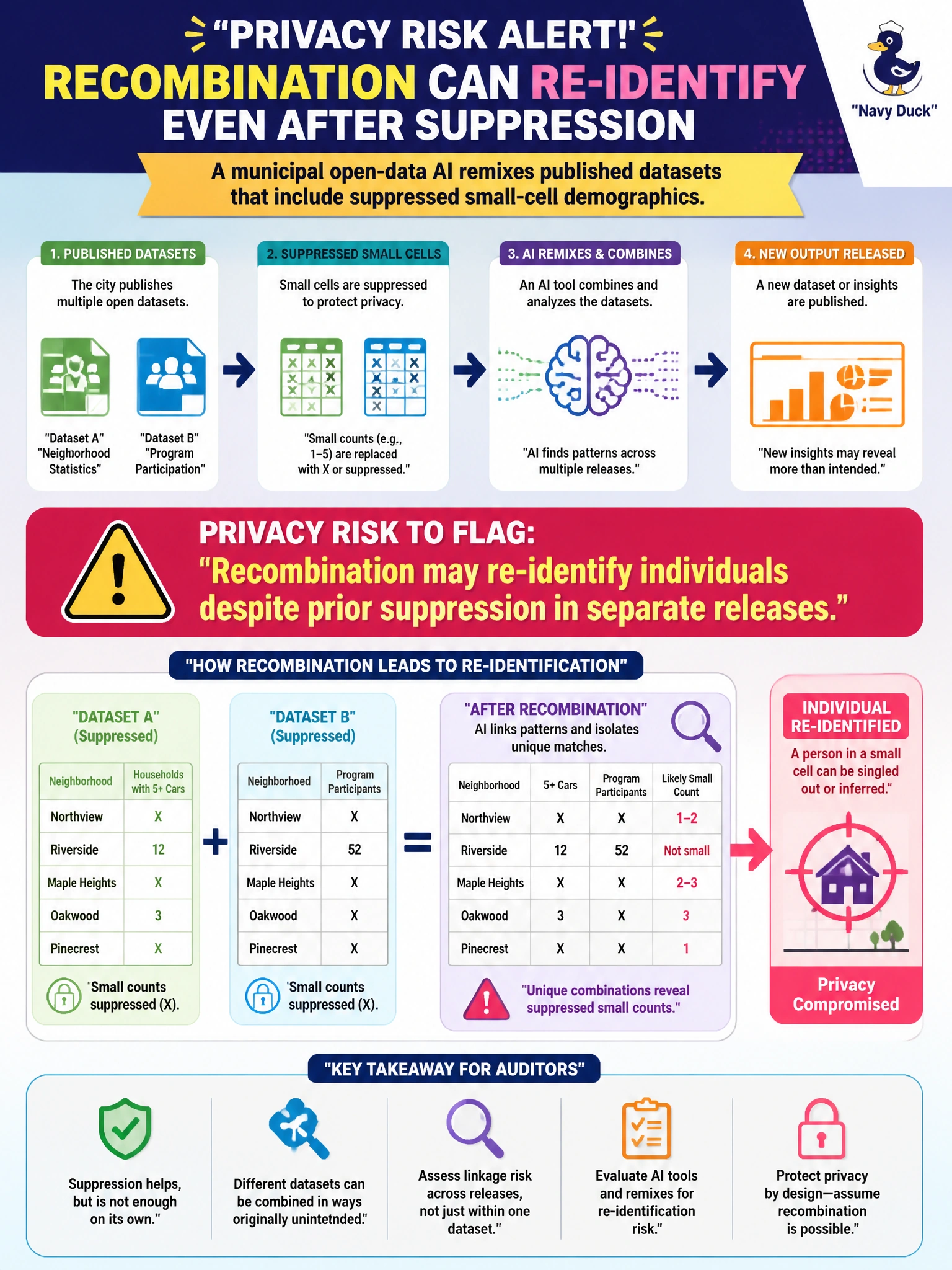
A municipal open-data AI remixes published datasets that include suppressed small-cell demographics. What privacy risk should the auditor flag?
Select an answer to reveal the explanation.
Short Explanation
Cell suppression in a source table doesn't automatically carry over to your AI remix. AI that remixes open datasets can stitch small cells back into identifiable pictures. Treat recombination risk as real privacy work, not a solved checkbox.
Full Explanation
A municipal open-data AI that remixes published datasets containing suppressed small-cell demographics can recreate identifiable records even when each source file was individually protected. The auditor should flag that recombination may re-identify individuals despite prior suppression in separate releases because linkage across geography, demographics, and other attributes can restore uniqueness that single-table suppression removed. Civic open-data programs often publish multiple related tables over time; AI remixing accelerates inference across those releases and elevates residual disclosure risk for residents in small cells. Claiming cell suppression in source tables carries directly over to combined AI outputs fails by concept: suppression is file- and context-specific, and AI remixing can stitch attributes across releases to rebuild the very uniqueness that suppression in any single table was meant to hide. Noting only that open-data licenses permit remixing without overriding the statistical or ethical reasoning behind original suppression fails by concept as the flagged risk: it correctly rejects a free-for-all license reading but stops short of naming the concrete re-identification exposure that recombination across releases creates, which is what the auditor must flag. Claiming disclosure review of input datasets satisfies review of derived model outputs fails by concept: an input-level clearance does not cover what an AI model can infer or emit after training on those inputs, so derived outputs need their own privacy assessment. Exam caveat: AAIA privacy items on open-data AI emphasize recombination and linkage risk after suppression, not an assumption that cell suppression in source tables carries directly over to combined AI outputs. Operational check: inventory remixed open-data inputs, assess small-cell and linkage risk before AI publication or training, require privacy review for cross-dataset joins, and document residual risk acceptance or additional controls such as further aggregation.