
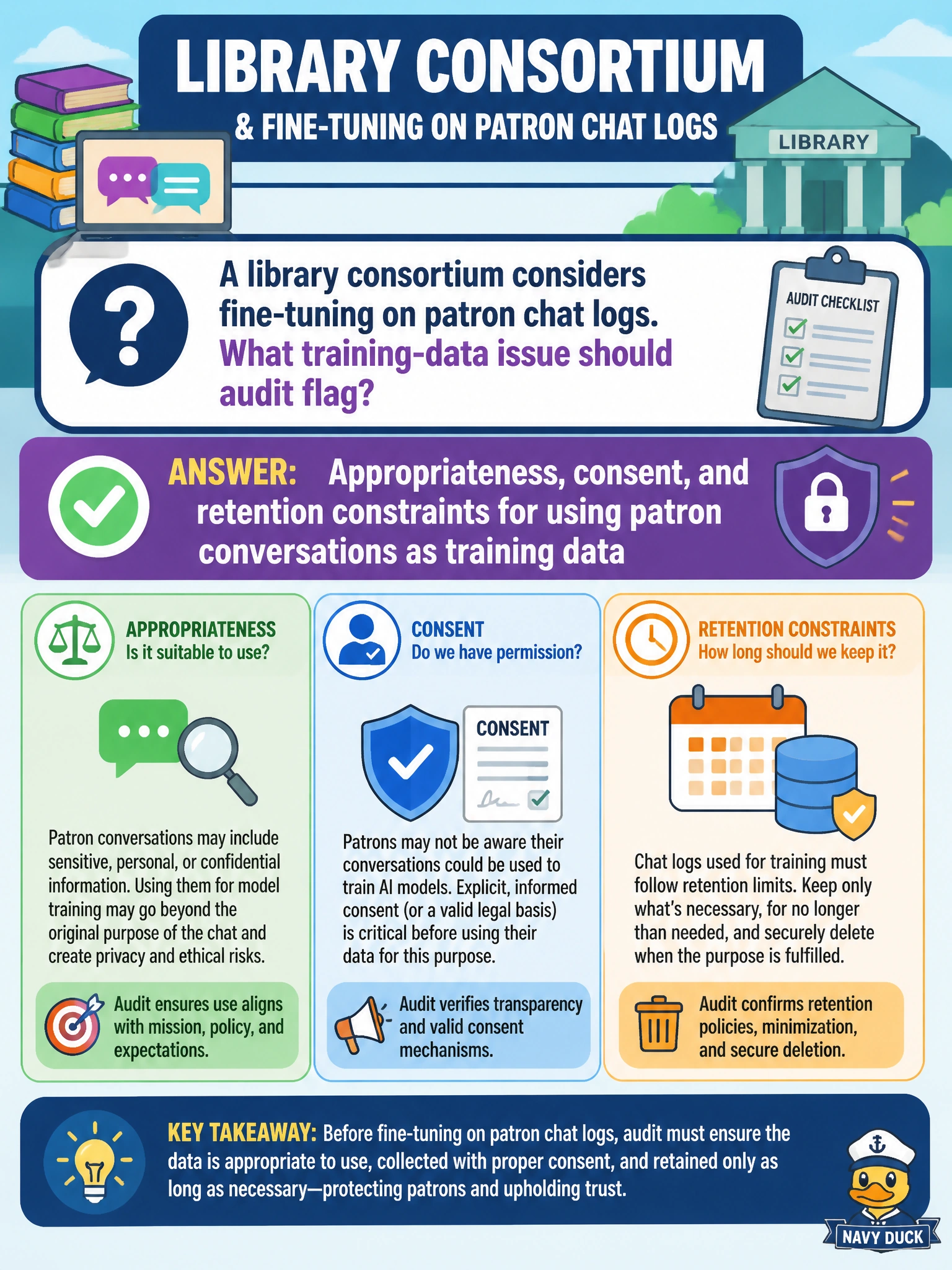
A library consortium considers fine-tuning on patron chat logs. What training-data issue should audit flag?
Select an answer to reveal the explanation.
Short Explanation
Wait—those patron chats aren’t free scrapbooking paper. Stripping names and card numbers doesn’t satisfy privacy review for chat transcripts; you still need consent, purpose limits, and retention schedules before fine-tuning.
Full Explanation
Fine-tuning a library consortium model on patron chat logs raises appropriateness, consent, and retention constraints for using patron conversations as training data. Library interactions can include research interests, health or legal inquiries, and other sensitive context; stripping names and card numbers does not by itself satisfy privacy review for chat transcripts. Audit should flag lawful basis or consent, purpose limitation, minimization, retention schedules, redaction of identifiers, and whether fine-tuning is necessary versus retrieval over approved knowledge bases. Secondary use for model improvement is a distinct processing purpose that needs explicit governance.
Assuming that anonymization by stripping names and card numbers satisfies privacy review is legally and ethically incorrect and undermines patron confidentiality expectations. Validating fine-tuning data for balanced coverage across branches and service topics addresses response quality, not the training-data issue of consent, appropriateness, and retention that audit should flag. Encrypting chat logs in storage and auditing staff access protects the dataset but does not establish consent or a lawful basis for using patron conversations as fine-tuning data.
Exam caveat: training-data provenance and rights are distinct from inference privacy—both matter on assurance exams. Operational check: inventory chat-log fields and retention clocks, require legal/privacy sign-off before fine-tuning, prefer synthetic or opted-in corpora where possible, and document deletion or opt-out implications for models already trained. Verify vendor contracts prohibit unauthorized training on library prompts and responses.