
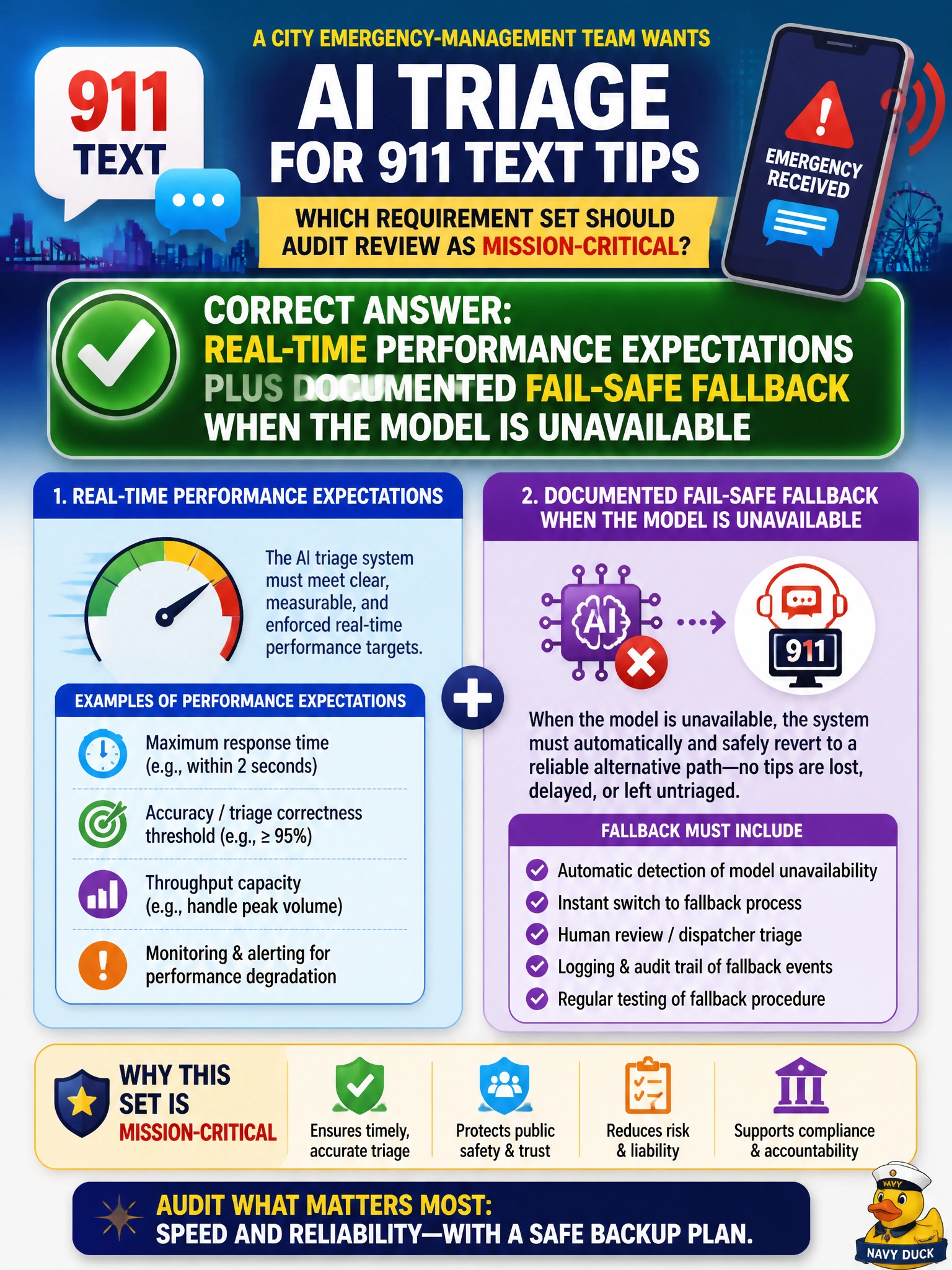
A city emergency-management team wants AI triage of 911 text tips. Which requirement set should audit review as mission-critical?
Select an answer to reveal the explanation.
Short Explanation
Emergency tips can’t vanish into a spinning wheel. You need speed goals and a clear plan for when the model is down—hand off to humans, don’t settle for weekly reports and quarterly drills instead of a live fail-safe.
Full Explanation
For AI triage of 911 text tips, audit should treat as mission-critical the combination of real-time performance expectations plus documented fail-safe fallback when the model is unavailable. Emergency tips are time-sensitive public-safety inputs; models that score slowly, silently drop messages, or lack human queue handoff create life-safety residual risk. Requirements must specify latency and throughput targets, priority escalation paths, confidence thresholds for human review, and explicit behavior during outage, drift, or tool failure. Continuity design should assume the model will fail at inconvenient times.
Nightly batch scoring summaries meant for next-day staffing plans do not provide real-time triage or a fail-safe when the model is unavailable, leaving live emergency tips without immediate handling. Encrypted tip archiving with role-based access supports records retention, but it does not specify real-time performance targets or a documented fail-safe fallback for when the model cannot triage incoming tips. Detailed weekly vendor reports and quarterly continuity exercises are useful governance, but they are not a substitute for real-time latency targets and an explicit, documented fail-safe when the model goes down during live tip triage.
Exam caveat: “AI-assisted” still requires continuity design equivalent to other emergency systems—automation does not reduce the need for fail-safes or monitored SLAs. Operational check: tabletop an inference outage, verify tips route to human queues with immutable audit logs, measure triage latency against documented targets, and confirm ownership of monitoring alerts around the clock. Sample low-confidence outputs to ensure they escalate rather than auto-close.