
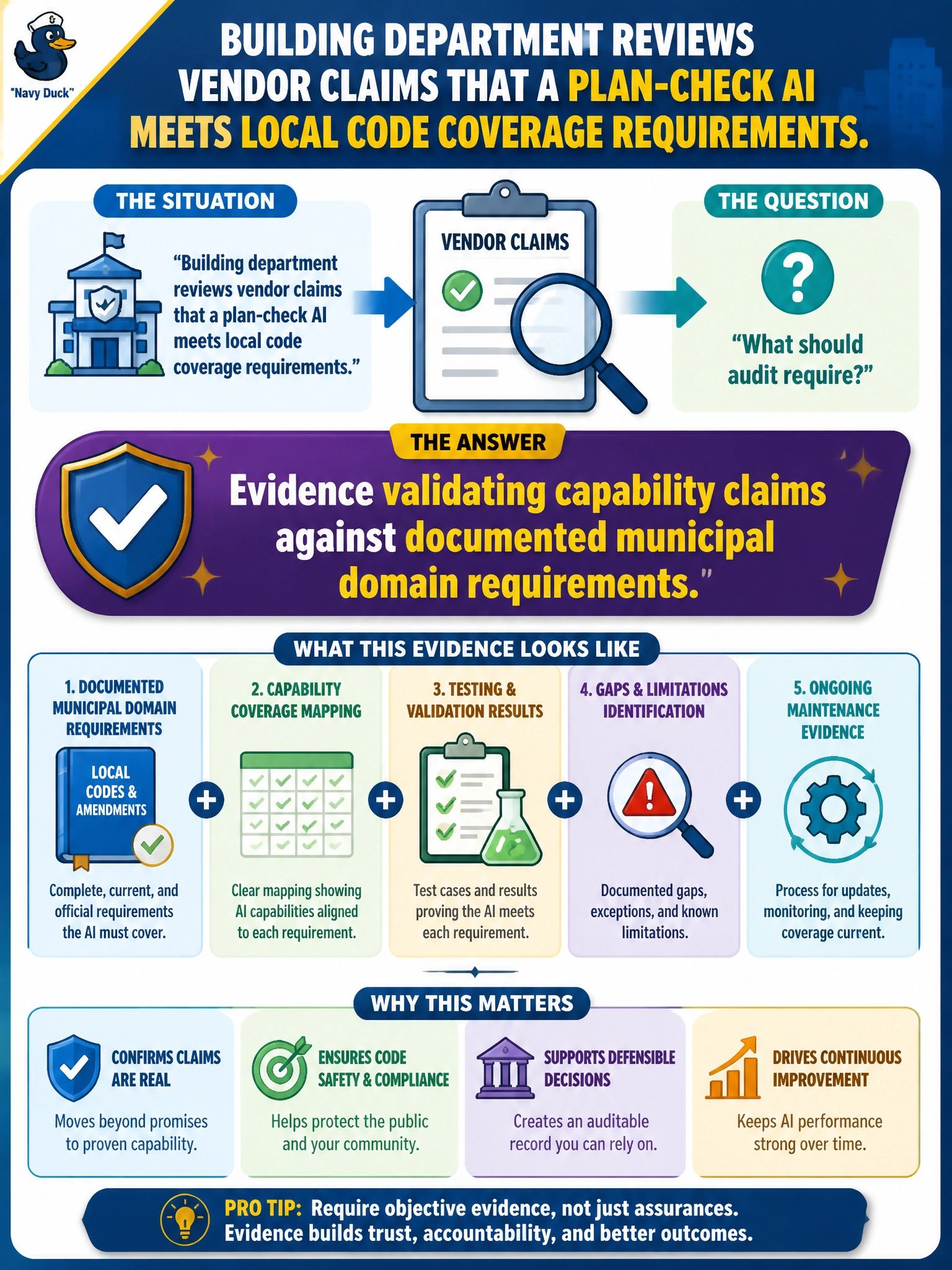
A building department reviews vendor claims that a plan-check AI meets local code coverage requirements. What should audit require?
Select an answer to reveal the explanation.
Short Explanation
A vendor’s SOC 2 report proves cloud security, but it doesn’t show the model knows your city’s code. Ask for evidence tied to the city’s documented requirements—not a security attestation.
Full Explanation
When a building-department vendor claims its AI meets local code coverage requirements, audit should require evidence validating capability claims against documented municipal domain requirements. Benchmark results on national model code datasets, SOC 2 Type II security attestations, and approval records from peer municipalities using older code cycles do not prove the model was evaluated on this city’s adopted code edition, amendments, fee schedules, and permit types. Assurance maps each claim to a requirements matrix and inspects test results on local scenarios, including edge cases inspectors actually encounter.
Relying on benchmark results from national model code datasets is insufficient evidence for a regulated civic domain, because those benchmarks don’t reflect this jurisdiction’s adopted amendments and permit types. Accepting a vendor’s SOC 2 Type II report confuses security controls with code coverage and invites silent gaps on local amendments. Approval records from a peer municipality using a prior code edition cycle ignore the jurisdictional specificity of this city’s current building regulation and enforcement practice.
Exam caveat: domain “coverage” must be demonstrated on the authority’s corpus and workflows, not generic construction NLP benchmarks alone. Operational check: demand edition-specific evaluation sets, sample permit Q&A with verifiable citations, gap analysis for local amendments, and contractual acceptance criteria tied to those tests. Re-test after code-cycle updates so coverage claims remain current.