
A manufacturing plant classified as a RCRA Large Quantity Generator accumulates spent corrosive liquid in a stationary 2,500-gallon indoor tank rather than in drums. Under 40 CFR 262.17(a)(5)(ii), how must the facility demonstrate that the waste in the tank is not accumulated beyond 90 days?
Select an answer to reveal the explanation.
Short Explanation
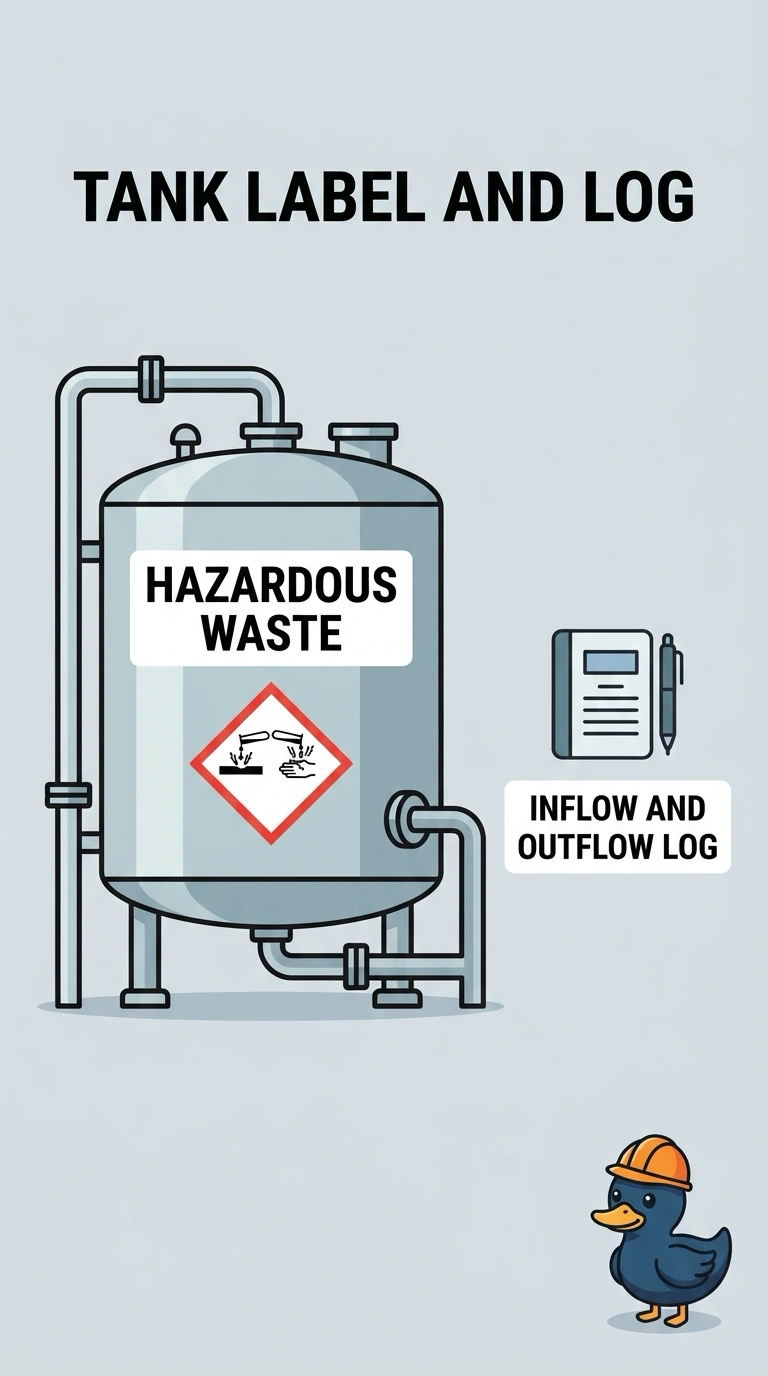
Think of a hazardous waste accumulation tank like a dated milk carton in your fridge: without a clear label and a timeline, nobody knows when it expires. The trap is treating a stationary RCRA tank like a raw-material storage vessel and relying only on fire diamonds or valve checks. Under 40 CFR 262.17, you must label the tank with Hazardous Waste and its hazards and track inflows and outflows to prove compliance with the 90-day limit.
Full Explanation
Under 40 CFR 262.17, a Large Quantity Generator accumulating hazardous waste in a stationary tank must satisfy both hazard communication and accumulation-time tracking rules. Choosing to Label the tank with Hazardous Waste and its hazards, and log inflows and outflows directly meets federal requirements by using inventory logs, monitoring equipment, or batch records to prove waste leaves the tank within 90 days. By contrast, choosing to Apply an NFPA 704 hazard diamond on the tank shell and perform monthly ultrasonic thickness checks addresses fire-responder signage and shell integrity, not RCRA accumulation-time verification. Similarly, choosing to Record weekly visual inspections of the tank valves in a binder kept at the facility guardhouse omits mandatory tank markings and fails to establish daily tank inspections required for RCRA tank systems. Choosing to Submit an annual tank inventory report to the local fire marshal before the calendar year ends confuses local fire-code reporting with federal 90-day waste tracking. As an operational caveat, batch tanks require documenting when waste first enters, whereas continuous-flow tanks track daily volume against 90-day throughput. For an operational check, audit the tank logbook against level-gauge readings and manifest dates each week.
Prefer to study offline? Printable PDF study book + test engine ($7.50, unofficial). These questions stay free here.