
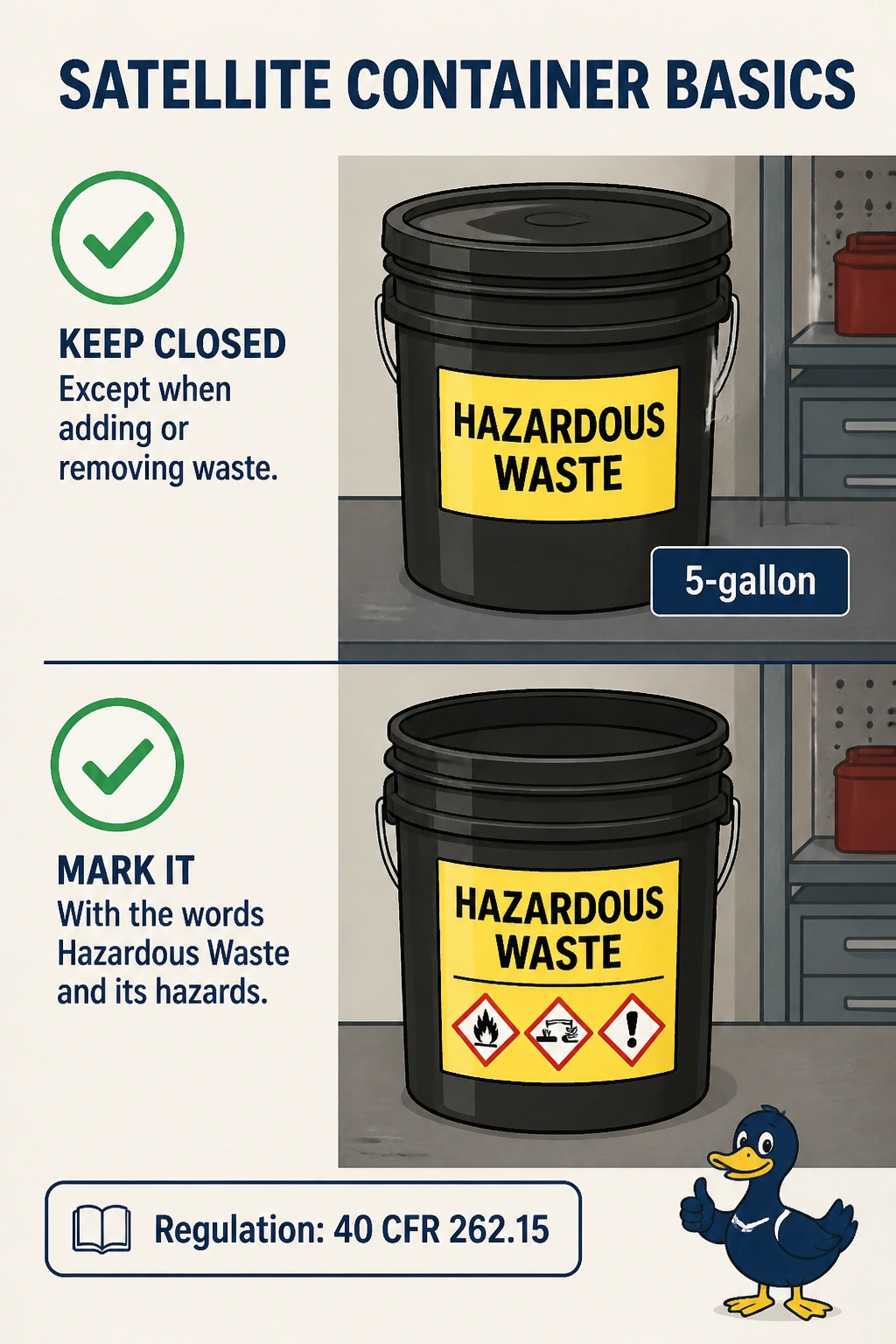
A laboratory technician at a manufacturing facility generates spent ignitable solvent at a benchtop workstation and collects it in a 5-gallon safety carboy located next to the hood under RCRA satellite accumulation rules (40 CFR 262.15). Which practice keeps the satellite accumulation container in compliance during routine operations?
Select an answer to reveal the explanation.
Short Explanation
Satellite accumulation gives you flexibility at the workbench, but inspectors love to catch open funnels and missing hazard words. The trap is confusing central accumulation pad rules—like start dates on the first drop—with what applies right at the point of generation.
Full Explanation
Keeping the container closed except when adding or removing waste, and marking it with the words Hazardous Waste and its hazards directly satisfies RCRA satellite accumulation standards in 40 CFR 262.15, which require closed containers during accumulation and clear labeling of both the waste status and specific hazards such as ignitability. Leaving a funnel open in the bung continuously while marking the drum with the facility EPA ID number violates the closed-container rule unless a self-closing or latched safety funnel is used, and an EPA ID number alone does not replace hazard-specific marking. Storing the carboy in a central 90-day pad and updating the weekly inspection log every Friday describes central accumulation area management rather than satellite accumulation at or near the point of generation. Applying a DOT Class 3 placard to the carboy and recording the accumulation start date upon first drop mixes up highway placards with container labels and misapplies the start-date trigger, which in a satellite area only begins when the volume limit is exceeded. Caveat: satellite accumulation must remain under the control of the operator of the process generating the waste. Operational check: walk benchtop hoods daily to confirm carboy caps or spring-loaded funnels are snapped shut and hazard labels are legible.
Prefer to study offline? Printable PDF study book + test engine ($7.50, unofficial). These questions stay free here.