
A highway tanker carrying chlorine, a material highlighted in green in the PHMSA Emergency Response Guidebook, develops a valve leak near a suburban rail yard. First responders have confirmed the four-digit UN number and need initial isolation and protective action distances that account for day versus night atmospheric conditions and spill size. Which section of the guidebook provides those distances?
Select an answer to reveal the explanation.
Short Explanation
When a toxic gas cloud drifts across a rail yard, you need wind-smart distances fast, not just generic firefighting tips. A common trap is stopping at the orange action guide and forgetting that green-highlighted entries unlock specialized downwind evacuation tables.
Full Explanation
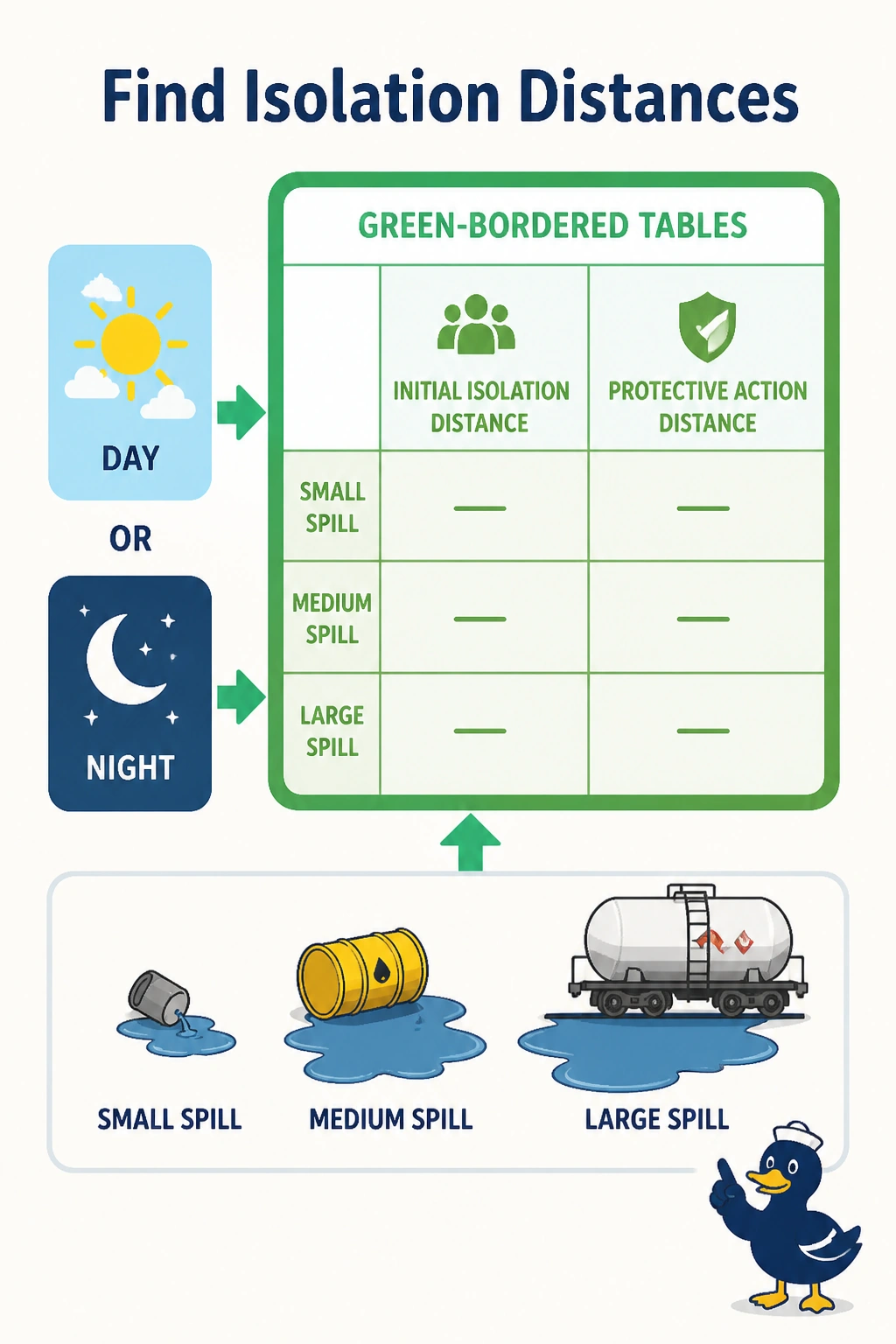
In the PHMSA Emergency Response Guidebook, green-highlighted entries in the yellow or blue indexes signal a Toxic Inhalation Hazard or dangerous water-reactive chemical that requires consulting "The green-bordered tables of initial isolation and protective action distances". These tables list an initial isolation radius in all directions plus downwind protective action distances that vary by small versus large spill size and daytime versus nighttime atmospheric stability. "The white-bordered pages listing hazard class placards" only help responders match visual transport placards to a numbered guide when shipping papers or UN numbers are unavailable. "The orange-bordered guides for general firefighting actions" provide broad public-safety, spill-control, and first-aid instructions for a family of materials, but they do not contain chemical-specific downwind dispersion tables. "The blue-bordered alphabetical index of chemical shipping names" helps locate a material by name and points to the three-digit orange guide number, rather than supplying evacuation distances. Caveat: the green-bordered tables are designed for the first 30 minutes of an incident and must be refined once air monitoring and plume modeling data arrive. As an operational check, verify whether the release qualifies as a small or large spill, confirm day or night conditions, and check wind direction before establishing perimeter roadblocks.
Prefer to study offline? Printable PDF study book + test engine ($7.50, unofficial). These questions stay free here.